UN atomic watchdog: Iran further raising nuclear stockpile

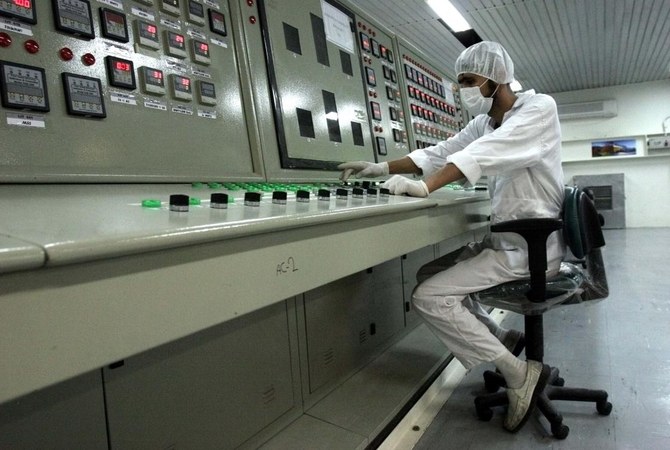
A technician works at the Uranium Conversion Facility just outside the city of Isfahan, Iran. (AP/File))
Short Url
Updated 17 November 2021
Follow

UN atomic watchdog: Iran further raising nuclear stockpile

  • Iran has an estimated stock of 17.7 kilograms of uranium enriched to up to 60 percent fissile purity

VIENNA: The United Nations’ atomic watchdog says it believes Iran has further increased its stockpile of highly enriched uranium in breach of a 2015 accord with world powers.
The International Atomic Energy Agency told member nations in its confidential quarterly report Wednesday that Iran has an estimated stock of 17.7 kilograms of uranium enriched to up to 60 percent fissile purity, an increase of almost 8 kilograms since August.
Such highly enriched uranium can be easily refined to make atomic weapons, which is why world powers have sought to contain Tehran’s nuclear program.
The Vienna-based agency told members that it is still not able to verify Iran’s exact stockpile of enriched uranium due to the limitations Tehran imposed on UN inspectors earlier this year.
The IAEA has been unable to access surveillance footage of Iranian nuclear sites or of online enrichment monitors and electronic seals since February. The agency’s chief, Rafael Mariano Grossi, told The Associated Press this month that the situation was like “flying in a heavily clouded sky.”
In a separate report to member states Wednesday about its work in Iran, the agency said Grossi was concerned about inspectors “being subjected to excessively invasive physical searches by security officials at nuclear facilities in Iran.”
“He reiterates the call upon Iran to take immediate steps to remedy the situation, and to implement security procedures at nuclear facilities that are consistent with internationally accepted security practices and Iran’s legal obligations in relation to privileges and immunities of the agency and its inspectors,” the IAEA said, according to the confidential quarterly report seen by The Associated Press.
The agency said it “categorically rejects” the idea its cameras at Iranian nuclear sites played a role in a sabotage attack on the Karaj facility near Tehran in June. Iran accuses Israel of being behind the incident.
A senior diplomat who spoke to The Associated Press on condition of anonymity said the searches of the inspectors carried out in Iran were very time-consuming and made some feel intimidated. The diplomat was not authorized to be named while speaking to the media about the visits.
Grossi is expected to travel to Tehran this month for direct talks with Iranian officials on restoring the agency’s ability to know in real-time what the country is doing.


First responders enter devastated Aleppo neighborhood after days of deadly fighting

Updated 12 January 2026
Follow

First responders enter devastated Aleppo neighborhood after days of deadly fighting

  • The US-backed SDF, which have played a key role in combating the Daesh group in large swaths of eastern Syria, are the largest force yet to be absorbed into Syria’s national army

ALEPPO, Syria: First responders on Sunday entered a contested neighborhood in Syria’ s northern city of Aleppo after days of deadly clashes between government forces and Kurdish-led forces. Syrian state media said the military was deployed in large numbers.
The clashes broke out Tuesday in the predominantly Kurdish neighborhoods of Sheikh Maqsoud, Achrafieh and Bani Zaid after the government and the Syrian Democratic Forces, the main Kurdish-led force in the country, failed to make progress on how to merge the SDF into the national army. Security forces captured Achrafieh and Bani Zaid.
The fighting between the two sides was the most intense since the fall of then-President Bashar Assad to insurgents in December 2024. At least 23 people were killed in five days of clashes and more than 140,000 were displaced amid shelling and drone strikes.
The US-backed SDF, which have played a key role in combating the Daesh group in large swaths of eastern Syria, are the largest force yet to be absorbed into Syria’s national army. Some of the factions that make up the army, however, were previously Turkish-backed insurgent groups that have a long history of clashing with Kurdish forces.
The Kurdish fighters have now evacuated from the Sheikh Maqsoud neighborhood to northeastern Syria, which is under the control of the SDF. However, they said in a statement they will continue to fight now that the wounded and civilians have been evacuated, in what they called a “partial ceasefire.”
The neighborhood appeared calm Sunday. The United Nations said it was trying to dispatch more convoys to the neighborhoods with food, fuel, blankets and other urgent supplies.
Government security forces brought journalists to tour the devastated area, showing them the damaged Khalid Al-Fajer Hospital and a military position belonging to the SDF’s security forces that government forces had targeted.
The SDF statement accused the government of targeting the hospital “dozens of times” before patients were evacuated. Damascus accused the Kurdish-led group of using the hospital and other civilian facilities as military positions.
On one street, Syrian Red Crescent first responders spoke to a resident surrounded by charred cars and badly damaged residential buildings.
Some residents told The Associated Press that SDF forces did not allow their cars through checkpoints to leave.
“We lived a night of horror. I still cannot believe that I am right here standing on my own two feet,” said Ahmad Shaikho. “So far the situation has been calm. There hasn’t been any gunfire.”
Syrian Civil Defense first responders have been disarming improvised mines that they say were left by the Kurdish forces as booby traps.
Residents who fled are not being allowed back into the neighborhood until all the mines are cleared. Some were reminded of the displacement during Syria’s long civil war.
“I want to go back to my home, I beg you,” said Hoda Alnasiri.