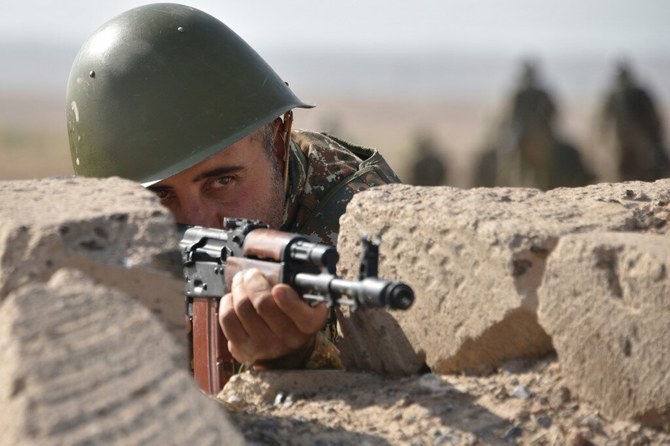
YEREVAN: Armenia on Tuesday reported deaths and the loss of military positions in border clashes with Azerbaijani troops, a year after the arch-foes fought a war over the disputed Nagorno-Karabakh region.
The six-week conflict, which left more than 6,500 dead, ended last November in a Russian-brokered deal that saw Armenia cede swathes of territory it had controlled for decades.
Armenia’s defense ministry said on Tuesday that “there are fatalities and wounded among Armenian troops as a result of fighting that erupted following an attack by Azerbaijani forces.”
It said the number of casualties was being verified and that Armenia had “lost control of two military positions.”
The ministry reported later in the evening that 12 Armenian servicemen were captured by the Azerbaijani military.
Earlier on Tuesday, the two sides accused each other of initiating fighting along their shared border.
“Armenian troops attacked Azerbaijani positions in the districts of Kelbajar and Lachin,” Azerbaijan’s defense ministry said in a statement, adding that two Azerbaijani troops were wounded.
The ministry said Azerbaijani troops “stopped the enemy’s advance, surrounded and detained Armenian servicemen.”
The country’s foreign ministry said Armenia “is deliberately mounting tensions and is not interested in ensuring peace and security in the region.”
Armenia’s defense ministry said Azerbaijani forces tried to “break through” the border before being repelled.
The European Union called on both sides to cease hostilities.
“Call for urgent de-escalation and full cease-fire,” European Council President Charles Michel said on Twitter.
“Challenging situation in region — EU is committed to work with partners to overcome tensions for a prosperous and stable South Caucasus,” he added.
Armenia appealed to ally Russia for military support under the Collective Security Treaty Organization pact, which obliges Moscow to protect it in the event of a foreign invasion.
“Given that there was an attack on Armenia’s sovereign territory, we appeal to the Russian Federation to protect Armenia’s territorial integrity,” said Security Council Secretary Armen Grigoryan.
Since last year’s war, both Armenia and Azerbaijan have reported occasional exchanges of fire, sparking fears of another flare-up in their territorial dispute.
Both Armenia and Azerbaijan said the situation along their border remained tense with clashes ongoing on Tuesday evening.
On Sunday, they traded accusations of opening fire at their border near Karabakh.
The day before, Nagorno-Karabakh authorities said the only road connecting Armenia to the separatist territory — the Lachin Corridor — was briefly closed due to an incident between the two sides.
Ethnic Armenian separatists in Nagorno-Karabakh broke away from Azerbaijan as the Soviet Union collapsed in 1991, and the ensuing conflict claimed around 30,000 lives.


![]()


Armenia reports deaths in Azerbaijan border clashes
Short Url
https://arab.news/zv2ug
Armenia reports deaths in Azerbaijan border clashes
- Armenia's defence ministry said "there are fatalities and wounded among Armenian troops as a result of fighting that erupted following an attack by Azerbaijani forces"
- The ministry reported later in the evening that 12 Armenian servicemen were captured by the Azerbaijani military

Turkiye’s Kurdish party says Syria deal leaves Ankara ‘no excuses’ on peace process
ANKARA: Turkiye’s pro-Kurdish DEM Party said on Monday that the Turkish government had no more “excuses” to delay a peace process with the Kurdistan Workers Party (PKK) now that a landmark integration deal was achieved in neighboring Syria.
On Sunday in Syria, the Kurdish-led Syrian Democratic Forces (SDF) agreed to come under the control of authorities in Damascus — a move that Ankara had long sought as integral to its own peace effort with the PKK. “For more than a year, the government has presented the SDF’s integration with Damascus as the biggest obstacle to the process,” Tuncer Bakirhan, co-leader of the DEM Party, told Reuters, in some of the party’s first public comments on the deal in Syria.
“The government will no longer have any excuses left. Now it is the government’s turn to take concrete steps.” Bakirhan cautioned President Tayyip Erdogan’s government against concluding that the rolling back Kurdish territorial gains in Syria negated the need for a peace process in Turkiye. “If the government calculates that ‘we have weakened the Kurds in Syria, so there is no longer a need for a process in Turkiye,’ it would be making a historic mistake,” he said in the interview.
Turkish officials said earlier on Monday that the Syrian integration deal, if implemented, could
advance the more than year-long process with the PKK, which is based in northern Iraq. Erdogan urged
swift integration of Kurdish fighters into Syria’s armed forces. Turkiye, the strongest foreign backer of Damascus, has since 2016 repeatedly sent forces into northern Syria to curb the gains of the SDF — which after the 2011–2024 civil war had controlled more than a quarter of Syria while fighting Islamic State with strong US backing.
The United States has built close ties with Damascus over the last year and was closely involved in mediation between it and the SDF toward the deal.
Bakirhan said progress required recognition of Kurdish rights on both sides of the border.
“What needs to be done is clear: Kurdish rights must be recognized in both Turkiye and Syria, democratic regimes must be established, and freedoms must be guaranteed,” he said.
On Sunday in Syria, the Kurdish-led Syrian Democratic Forces (SDF) agreed to come under the control of authorities in Damascus — a move that Ankara had long sought as integral to its own peace effort with the PKK. “For more than a year, the government has presented the SDF’s integration with Damascus as the biggest obstacle to the process,” Tuncer Bakirhan, co-leader of the DEM Party, told Reuters, in some of the party’s first public comments on the deal in Syria.
“The government will no longer have any excuses left. Now it is the government’s turn to take concrete steps.” Bakirhan cautioned President Tayyip Erdogan’s government against concluding that the rolling back Kurdish territorial gains in Syria negated the need for a peace process in Turkiye. “If the government calculates that ‘we have weakened the Kurds in Syria, so there is no longer a need for a process in Turkiye,’ it would be making a historic mistake,” he said in the interview.
Turkish officials said earlier on Monday that the Syrian integration deal, if implemented, could
advance the more than year-long process with the PKK, which is based in northern Iraq. Erdogan urged
swift integration of Kurdish fighters into Syria’s armed forces. Turkiye, the strongest foreign backer of Damascus, has since 2016 repeatedly sent forces into northern Syria to curb the gains of the SDF — which after the 2011–2024 civil war had controlled more than a quarter of Syria while fighting Islamic State with strong US backing.
The United States has built close ties with Damascus over the last year and was closely involved in mediation between it and the SDF toward the deal.
Bakirhan said progress required recognition of Kurdish rights on both sides of the border.
“What needs to be done is clear: Kurdish rights must be recognized in both Turkiye and Syria, democratic regimes must be established, and freedoms must be guaranteed,” he said.
Latest updates


© 2026 SAUDI RESEARCH & PUBLISHING COMPANY, All Rights Reserved And subject to Terms of Use Agreement.