At UN court, Armenia accuses Azerbaijan of ethnic hatred

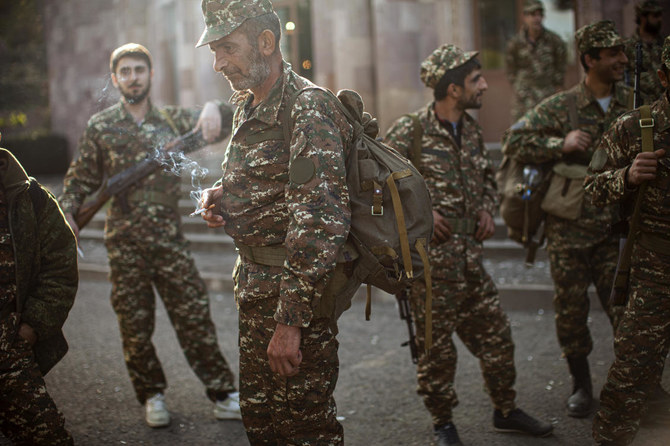
In this Sept. 2020 file photo, ethnic Armenian volunteer recruits gather at a center near Hadrut, self-proclaimed Republic of Nagorno-Karabakh, where they receive their uniforms and weapons before being dispatched to the frontline. (AP)
Short Url
Updated 14 October 2021
Follow

At UN court, Armenia accuses Azerbaijan of ethnic hatred

THE HAGUE, Netherlands: Armenia urged judges at a United Nations court Thursday to order Azerbaijan to release Armenians detained during a six-week war last year and to stop promoting ethnic hatred. Azerbaijan urged judges to reject the requests as the two nations faced off in a Hague courtroom.
Armenian representative Yeghishe Kirakosyan made the requests as a hearing opened at the International Court of Justice into a petition by Armenia for judges to impose urgent interim measures to prevent Azerbaijan breaching an international convention to stamp out ethnic discrimination.
Among measures Armenia wants the court to impose on Azerbaijan an order to release and repatriate prisoners of war and halt hate speech aimed at Armenians.
Azerbaijan’s deputy foreign minister, Elnur Mammadov, said Armenia’s request “is defective, and must be rejected.”
The case stems from longstanding enmity that boiled over into last year’s war over the disputed region of Nagorno-Karabakh that left more than 6,600 people dead. The region is within Azerbaijan but had been under the control of ethnic Armenian forces backed by Armenia since the end of a separatist war in 1994.
Kirakosyan said Armenia wasn’t asking the court to rule on the root causes of the war, but “seeks to prevent and remedy the cycle of violence and hatred perpetrated against ethnic Armenians.”
Azerbaijan also has filed a similar case alleging discrimination against its citizens by Armenia and also has requested the world court to impose interim measures. Hearings in the Azerbaijan case are scheduled to start next Monday. Rulings on both requests will likely be issued in coming weeks.
Both nations’ cases alleging breaches of the International Convention on the Elimination of All Forms of Racial Discrimination will likely take years to reach their conclusion at the Hague-based court.
Last year’s conflict ended when Armenian Prime Minister Nikol Pashinyan signed a Russia-brokered cease-fire agreement that granted Azerbaijan control over parts of Nagorno-Karabakh as well as adjacent territories occupied by Armenians.
Armenia says more than 3,700 Armenians and Nagorno-Karabakh residents died in the war. Azerbaijan said it lost 2,900 people.
Kirakosyan told the court that despite the deal that ended last year’s conflict, “Azerbaijan continues to espouse and actively promote ethnic hatred against Armenians.”
He said that Azerbaijan has “captured, tortured, and arbitrarily detained numerous members of Armenian armed forces and civilians of ethnic Armenian origin” and “continues to destroy Armenian cultural heritage and religious sites or negate the Armenian character, and the territory’s economic controls.”
Lawyers for Azerbaijan said Baku has released most prisoners and those who remain in detention were convicted or are being prosecuted on charges including murder, torture and espionage.


Turkish border region feels economic fallout from Iran

Updated 3 sec ago
Follow

Turkish border region feels economic fallout from Iran

  • Turkiye shares a 550-kilometer border with Iran, 300km of which flank Van province
  • The city of Van has traditionally offered escape and relaxation for Iranian tourists
VAN, Turkiye: As vice president of the chamber of commerce in the eastern Turkish city of Van, Fevzi Celiktas’s job is to boost the local economy. But he has one major problem: his neighbors.
“We have some of the most feared countries in the world right on our doorstep: Iraq, Syria, and Iran,” he said.
“This greatly complicates our development.”
Celiktas is not indifferent to the fate of Iranians who cross to the Turkish side of the border after the ruthless repression of protests in January.
But the collapse of their economy and currency, which sparked the popular uprising, is being felt acutely in the province.
Turkiye shares a 550-kilometer border with Iran, 300km of which flank Van province, with the main pedestrian border crossing of Kapikoy just a 90-minute drive from the provincial capital, also called Van.
The latest crisis is another blow to the struggling economy in this region of 1.1 million people which lies at the eastern end of Anatolia.
Perched on the eastern shores of Lake Van and surrounded by snow-capped mountains, the city of Van has traditionally offered escape and relaxation for Iranian tourists.
Visitors come to shop, enjoy the local bars or take out boats on Turkiye’s largest lake, which is also the second-largest in the Middle East.
“Iranian tourists are our main clientele,” said Emre Deger, head of Van’s tourism professionals association, whose own hotel has seen occupancy rates decline year after year.
Even though winter is the low season, a third of its rooms are usually occupied, he explained.
“But currently, all the hotels are empty or at 10 percent of capacity at best,” he added.
‘For the Internet’
For eight to 10 days after the crackdown on Iranian protesters when there was an Internet blackout, the flow of visitors “completely dried up,” Deger said.
“Those who came were just here for the Internet,” he added.
Every morning when the Kapikoy crossing opens, a few dozen travelers arrive in the cold, wearily boarding buses or taxis headed for Van.
Apart from a handful of students and the odd few with long-term plans outside of Iran, not many are prepared to speak, quickly scurrying off to discreet hotels where they keep to themselves.
“Most even hesitate to go out to get food,” said Deger, who is waiting for March 21 when Iranians mark Nowruz, Persian New Year, to see if the tourists will return.
One Iranian woman in her 30s from the northwestern city of Tabriz said she understood the decline in visitors.
“There’s no middle class left in Iran. We’re all at the bottom, the very bottom,” she said, without giving her name.
“Everyone is poor.”
Back in Iran, she used to work in insurance, but now has a job at an elegant café in downtown Van.
“In the whole of January, I saw maybe two Iranians here,” she said.
‘Our money is worthless’
“Two years ago, when you came to Turkiye with 5 or 10 million rials ($4-$8), you were fine. Now you need at least 40 or 50 million rials. Hotels, food, everything has become more expensive for us.
“Our money is worthless now.”
The monthly salary she earned in Iran would barely last three days in Van today, she added.
“Our customers used to fill entire suitcases with clothes (to take home). But it’s very quiet now,” said Emre Teker in his clothing store.
Celiktas also blamed US and European sanctions for crippling Iran’s economy — and Van’s.
“The Van bypass still isn’t finished after 18 years of construction,” he said. “It’s become a joke, sometimes written on the back of trucks: ‘May our love be like the Van bypass and never end’.”
If a country faces trade restrictions for decades, it inevitably has consequences, he said.
“In a neighborhood, if your neighbor bothers you, you can move. But you can’t do that with countries: you can’t replace Iran with Germany, Italy, France, or Russia,” he said.
“So you have to reach some sort of agreement.”