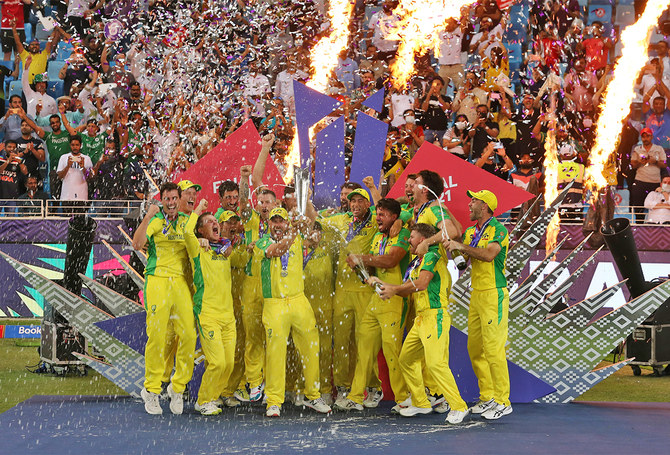
DUBAI: Mitchell Marsh smashed an unbeaten 77 as Australia hammered New Zealand by eight wickets to clinch their maiden Twenty20 World Cup title on Sunday.
Chasing 173 for victory, Australia depended on a 92-run second-wicket stand between David Warner, who made 53, and Marsh to achieve their target with seven balls to spare in Dubai.
Warner became Trent Boult’s second wicket but Marsh kept up the charge to power Australia home to their long-awaited T20 crown and add to their five 50-over World Cup trophies.
Glenn Maxwell, who made 28, joined Marsh, who hit six fours and four sixes in his 50-ball knock, to put on 66 runs and hit the winning boundary as the Aussies came charging in to celebrate the triumph.
Skipper Kane Williamson hit a valiant 85 in New Zealand’s 172-4 after being invited to bat first in a crucial toss won by Aaron Finch as teams chasing have won all but one game at the venue.
Australia, whose previous best was a runners-up finish in 2010, came into this edition’s semifinal with one loss to England and beat Pakistan in the final-four clash with a chase of 177.
Australia fast bowler Josh Hazlewood returned figures of 3-16 and leg-spinner Adam Zampa had 1-26.
Australia suffered an early blow in their chase when Finch departed for five off Boult as a largely neutral but not packed-to-capacity crowd roared.
But the left-right batting pair of Warner and Marsh combined to take apart the bowling with fours and sixes galore.
Marsh hit Adam Milne for one six and two fours on his first three balls of the knock to signal his ruthless intent.
Warner also kept up his punishing act as he hammered leg-spinner Ish Sodhi for 17 runs in one over with just a single to Marsh.
He smoked Jimmy Neesham for a six to raise his third half-century of the tournament but soon fell to Boult.
Warner, with 289 runs in total, ended second behind Pakistan’s Babar Azam (303) in the tournament’s batting chart.
Earlier Williamson, who was dropped on 21, started cautiously but once settled took on the opposition bowling to reach his first half-century of the tournament.
He finished with 10 fours and three sixes in his 48-ball blitz to lift New Zealand from 57-1 in 10.
The Kiwis initially struggled and lost Daryl Mitchell caught behind for 11 off Hazlewood.
Opening batsman Martin Guptill failed to get quick runs despite his three boundaries and a 48-run second-wicket stand with Williamson.
Williamson survived a spill by Hazlewood in the deep with the ball popping out of the fielder’s hand to find the boundary. Pace spearhead Mitchell Starc was the bowler.
The captain hit back with two more fours off left-arm quick Starc who was taken for 60 runs from his four overs, to get some momentum into the innings.
Zampa sent Guptill trudging back to the dugout after the opener’s 35-ball 28 but Williamson kept up the charge with two sixes off Maxwell.
Williamson again picked out Starc to smash four fours and one six in a 22-run 16th over and put on 68 with Glenn Phillips, who made 18.
Hazlewood returned in his final over to break the stand with Phillips’ wicket and then got Williamson out with a leg-cutter.

Marsh powers Australia to maiden T20 World Cup title in Dubai final
https://arab.news/je5gz
Marsh powers Australia to maiden T20 World Cup title in Dubai final
- Skipper Kane Williamson hit valiant 85 in New Zealand’s 172-4
- Aussies chased target with eight wickets, seven balls to spare
Youth voters take center stage in Bangladesh election after student-led regime change
- About 45% of Bangladeshis eligible to vote in Thursday’s election are aged 18-33
- Election follows 18 months of reforms after the end of Sheikh Hasina’s 15-year rule
DHAKA: When he goes to the polls on Thursday, Atikur Rahman Toha will vote for the first time, believing that this election can bring democratic change to Bangladesh.
A philosophy student at Dhaka University, Toha was already eligible to vote in the 2024 poll but, like many others, he opted out.
“I didn’t feel motivated to even go to vote,” he said. “That was a truly one-sided election. The election system was fully corrupted. That’s why I felt demotivated. But this time I am truly excited to exercise my voting rights for the first time.”
The January 2024 vote was widely criticized by both domestic and international observers and marred by a crackdown on the opposition and allegations of voter fraud.
But the victory of the Awami League of ex-Prime Minister Sheikh Hasina was short-lived, as a few months later the government was ousted by a student-led uprising, which ended the 15-year rule of Bangladesh’s longest-serving leader.
The interim administration, led by Nobel laureate Muhammad Yunus, took control in August 2024 and prepared a series of reforms to restructure the country’s political and institutional framework and organize the upcoming vote.
About 127.7 million Bangladeshis are eligible to cast their ballots, according to Election Commission data, with nearly a third of them, or 40.4 million, aged 18-29. Another 16.9 million are 30-33, making it a youth–dominated poll, with the voters hopeful the outcome will help continue the momentum of the 2024 student-led uprising.
“We haven’t yet fully transitioned into a democratic process. And there is no fully stable situation in the country,” Toha said. “After the election we truly hope that the situation will change.”
For Rawnak Jahan Rakamoni, also a Dhaka University student, who is graduating in information science, voting this time meant that her voice would count.
“We are feeling that we are heard, we will be heard, our opinion will matter,” she said.
“I think it is a very important moment for our country, because after many years of controversial elections, people are finally getting a chance to exercise their voting rights and people are hoping that this election will be more meaningful and credible. This should be a fair election.”
But despite the much wider representation than before, the upcoming vote will not be entirely inclusive in the absence of the Awami League, which still retains a significant foothold.
The Election Commission last year barred Hasina’s party from contesting the next national elections, after the government banned Awami League’s activities citing national security threats and a war crimes investigation against the party’s top leadership.
The UN Human Rights Office has estimated that between July 15 and Aug. 5, 2024 the former government and its security and intelligence apparatus, together with “violent elements” linked to the Awami League, “engaged systematically in serious human rights violations and abuses in a coordinated effort to suppress the protest movement.”
It estimated that at least 1,400 people were killed during the protests, with the majority shot dead from military rifles.
Rezwan Ahmed Rifat, a law student, wanted the new government to “ensure justice for the victims of the July (uprising), enforced disappearances, and other forms of torture” carried out by the previous regime.
The two main parties out of the 51 contesting Thursday’s vote are the Bangladesh Nationalist Party and Jamaat-e-Islami. Jamaat, which in 2013 was banned from political participation by Hasina’s government, heads an 11-party alliance, including the National Citizen Party formed by student leaders from the 2024 movement.
“I see this election as a turning point of our country’s democratic journey … It’s not just a normal election,” said Falguni Ahmed, a psychology student who will head to the polls convinced that no matter who wins, it will result in the “democratic accountability” of the next government.
Ahmed added: “People are not voting only for their leaders; they are also voting for the restoration of democratic credibility. That’s why this election is very different.”


