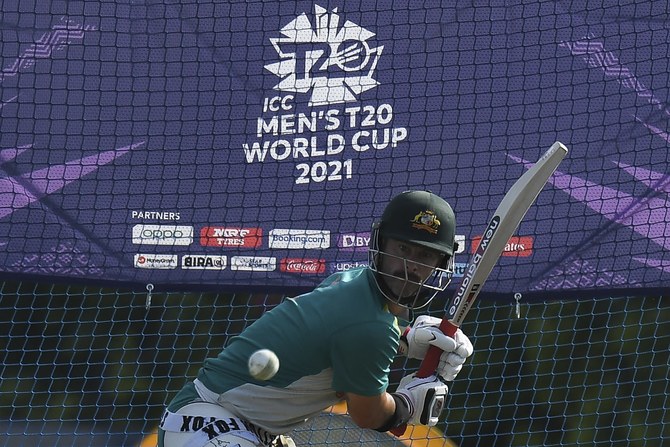
DUBAI: Kane Williamson’s New Zealand eye a second global crown in a single year when they take on Australia at the Twenty20 World Cup final that will witness a new winner on Sunday.
New Zealand and Australia renew their trans-Tasman rivalry in Dubai as both teams look to clinch their maiden world title in the shortest format.
It’s a hat-trick of ICC finals for the once perennial underdogs of world cricket after they outplayed India to win the inaugural Test championship in June.
They beat favorites England in the semifinal to avenge their 2019 defeat in a dramatic 50-over World Cup final at Lord’s when they went down on boundary count after a super over.
Head coach Gary Stead said the Black Caps are excited to take on the Australian challenge in what will be their first ever T20 World Cup final appearance.
“That’s probably a final that I’m not sure too many people would have predicted a month or so ago, Australia and New Zealand,” said Stead.
The Kiwis though have suffered an injury blow after wicketkeeper Devon Conway was ruled out following a broken hand when he punched his bat on his dismissal in the semifinal.
Tim Seifert is set to take over the wicketkeeping duties from Conway who made 129 runs at the event with an average of just over 32.
“Obviously the loss of Devon is a big one. He’s been a big part of all formats for us. It’s a disappointing and really freak thing to happen,” admitted Williamson.
Aaron Finch’s Australians, who have won the 50-over World Cup five times, beat title favorites Pakistan by five wickets in the second semifinal.
Australia were in trouble at 96-5 while chasing 177 on Thursday when Marcus Stoinis (40) and Matthew Wade (41) put on an unbeaten partnership of 82 and win by an over to spare.
Wade smashed Pakistan pace ace Shaheen Shah Afridi for three straight sixes including two audacious scoop shots — the final one sailing over fine leg to silence the Pakistan crowd.
‘Piece to the puzzle’
Stoinis said a T20 World Cup title will “mean a bloody lot to us.”
“Obviously Test cricket and the Ashes, that’s what we grew up when we played. Then the transformation of T20 cricket. It’s not a hit and a giggle anymore in terms of the pressure,” said Stoinis.
“I don’t think many people gave us a chance leading into this tournament apart from the players and coaching staff. So it’s definitely going to mean a bloody lot to us and we will be super proud when we bring that home to Australia.”
Key will be the form of opener David Warner who has plundered 236 runs at the tournament.
“Everyone had written us off, but we had a lot of confidence within. I think we came here with a really clear plan to win the tournament,” Finch.
“We always felt as though we’ve got the depth of the squad and the quality in our squad to put ourselves in a position to do that.
Finch acknowledged the importance of pressing home the advantage in the first six overs of powerplay, especially against a potent New Zealand pace attack including Trent Boult and Tim Southee.
“I think we’ve seen throughout the tournament the importance of the powerplay,” said Finch.
“A lot of games have been dictated by who has won the initial contest in the power play in both innings. No doubt it will be a real challenge. It won’t define who wins the match but it does help set up your innings if you perform.”
But the skipper said he does not “fuss” about the toss and bowling first despite 11 out of 12 matches being won by the team batting second at the Dubai International Stadium.

Australia, New Zealand seek history in T20 World Cup final in Dubai
https://arab.news/mrhep
Australia, New Zealand seek history in T20 World Cup final in Dubai
- New Zealand and Australia renew their trans-Tasman rivalry in Dubai as both look to clinch their maiden world title in the shortest format
- It's a hat-trick of ICC finals for the once perennial underdogs of world cricket after they outplayed India to win the inaugural Test championship in June
T20 cricket set to dominate game’s landscape in 2026
- Inexorable rise of one of sport’s controlling forces
Following the end of the Ashes series in Australia, it has not taken long for cricket’s longest format — Test cricket — to be overwhelmed by the T20 format.
Apart from the 50-over Under-19s World Cup taking place in Namibia, it seems that, wherever one turns, there are only T20 tournaments.
Two explanations for this situation are the looming ICC Men’s and Women’s World Cups. The men’s event, to be jointly hosted by India and Sri Lanka, starts on Feb. 7, while the women’s tournament starts on June 12 in England.
The women’s event will comprise 12 teams, the largest number ever, of which eight have qualified already. The other four will emerge from 10 teams competing in a qualifying tournament in Nepal. This began on Jan. 18 and will end on Feb. 1. The teams have been divided into two groups of five and will play each other once. Group A comprises Bangladesh, Ireland, Namibia, Papua New Guinea and the US, with the Netherlands, Nepal, Scotland, Thailand and Zimbabwe in Group B. The top three teams will qualify for the Super Six stage in which the three teams from Group A will play the three teams from Group B. Points earned against the other two qualifying teams from each group are carried forward. The top four teams at the end of the Super Six will qualify for the World Cup in June.
The four highest-ranked teams in the competition are Ireland, Bangladesh, Scotland and Thailand. They are expected to progress to the Super Sixes but it remains to be seen if each of them will reach the main event in June. Thailand will probably face tough challenges against Ireland and Bangladesh in the Super Six stage. The Thai team are in good form, having triumphed in the ICC Women’s Emerging Nations Trophy and won double gold medals in the women’s cricket competitions in the SE Asia Games at the end of 2025. This form has continued into the tournament with victories over Nepal and Zimbabwe, but sterner tests lie ahead.
Players who are squad members of teams who have qualified for the World Cup are warming up in different ways. A number are currently involved in India’s Women’s Premier League, which is halfway into its schedule and will conclude on Feb. 5. In New Zealand, the Women’s Super Smash concludes on Jan. 31, while in South Africa the CSA Women’s Pro20 will resume on Feb. 8. There are upcoming bilateral tours by India to Australia in late February, Pakistan to South Africa in February, Zimbabwe to New Zealand in March, followed by South Africa. No doubt other matches will be arranged once the identity of the final four qualifying teams is known. Immediately prior to the World Cup, formal warm-up matches will take place at three venues in England and Wales.
The need for preparation is even more pressing for those involved in the men’s T20 World Cup, which comprises 20 teams. The Big Bash League in Australia allows four overseas players in each 18-man squad. In 2025/26, English players represent the bulk of non-Australian players, followed by players from Pakistan and New Zealand. The South African World Cup players are fully engaged in SA20, in which 19-man squads are allowed to contain seven overseas players, four of whom can be selected for a playing 11. English players are well represented. The Bangladesh Premier League will conclude on Jan. 23. Indian players with central contracts are not allowed to participate in franchise leagues outside India. Their World Cup players will feature in a T20 series against New Zealand that started on Jan. 21 in Nagpur. It followed an ODI series which was won by New Zealand. England start a three-match T20 series against Sri Lanka on Jan. 30, following three ODIs.
Outside of the leading countries, it can be difficult for players and teams to gain enough game-time preparation. Some of the UAE players participated in the DP World ILT20. Their next international action is a two-match series on Jan. 29 and 31 against Ireland in Dubai, where Afghanistan currently have a three-match T20 series against the West Indies, who then play a series against South Africa. Ireland will remain in Dubai where they will play three T20 matches against Italy, who are making their first appearance in a World Cup.
Australia will visit Pakistan and play three T20 matches. Teams such as the US, Canada, Oman, Nepal, Namibia and the Netherlands appear to have limited match preparation opportunities.
At least they do not face the uncertainties of Bangladesh. In early January, in a further example of the use of cricket as a political weapon, the Indian authorities excluded the Bangladeshi cricketer Mustafizur Rahman from the 2026 Indian Premier League, amid rising tensions between the two countries. Rahman had been bought at auction by the Kolkata Knight Riders franchise, which is owned by Shah Rukh Khan, the Indian actor and film producer, who was born into a Muslim family. Following this decision, the Bangladesh Cricket Board requested that the International Cricket Council move matches involving Bangladesh in the T20 World Cup out of India, citing the “safety and well-being of the players.”
Discussions ensued between the parties. Independent security assessments were commissioned by the ICC, along with comprehensive venue-level security plans and formal assurances from the host authorities. These were shared with the BCB. All assessments consistently concluded that “there is no credible or verifiable threat to the safety or security of the Bangladesh team in India.” On Jan. 17, the BCB suggested a swap of their matches with those of Ireland, whose group matches are to be played in Sri Lanka. The suggestion was rejected. At an emergency meeting of the ICC’s board on Jan. 21, 14 out of the 16 members voted against Bangladesh’s request. It is assumed that, apart from Bangladesh, the other vote in favour was from Pakistan.
It appears that the BCB’s attempt at a hardline stance has backfired. It must now either accept to play in India or withdraw from the competition, with significant loss of face either way. If it withdraws, a replacement team need to be introduced. The next-best-ranked T20I team are Scotland, who will have even less time to prepare than the other 19 teams.
Once again, a major international tournament has been disrupted by geopolitics. It is also the case that, once again, almost everyone has fallen in behind the combined power of the ICC and the Indian board. This stranglehold and the inexorable rise of T20 cricket are now undoubtedly the controlling forces shaping cricket’s future landscape.


