

Pakistan stocks, currency close lower over uncertain outcome of IMF talks

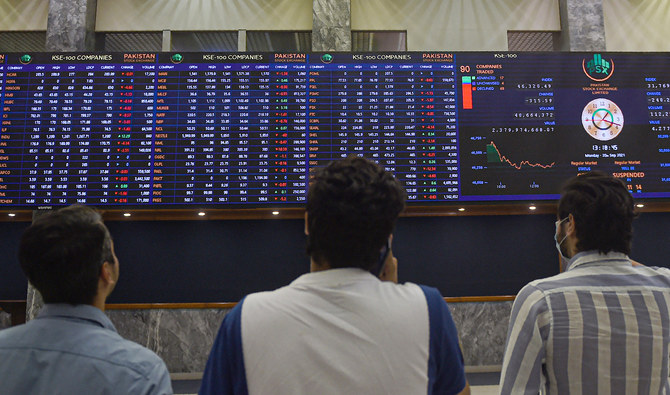
Stockbrokers watch an index board showing the latest share prices during a trading session at the Pakistan Stock Exchange (PSX) in Karachi on September 20, 2021. (AFP/File)
Short Url
Updated 09 November 2021
Follow

Pakistan stocks, currency close lower over uncertain outcome of IMF talks

  • Pakistan is in talks with IMF to secure a $1 billion loan tranche
  • Its sixth review remains inconclusive after weeks of negotiations

KARACHI: Pakistan’s currency and stocks closed lower on Tuesday amid the uncertain outcome of over a month-long negotiations between Pakistani authorities and the International Monetary Fund for the release of a $1 billion tranche of a bailout package.

The three-year, $6 billion package, approved in 2019, was aimed at shoring up fragile public finances and strengthening a slowing economy. Negotiations for the release of the latest tranche started in the first week of October in Washington. 

Five reviews of the program had been completed by March. The sixth is pending since June this year, which, if completed, will enable Pakistan to receive around $1 billion from the fund.

In the meantime, the Pakistan’s currency has remained under pressure in recent weeks due to rising import bills and the ongoing IMF talks.

On Tuesday, the rupee closed at Rs 71.63, losing 0.65 percent value against the United States dollar (USD). The currency had appreciated following Saudi Arabia’s announcement late last month of $3 billion to support Pakistan's foreign reserves, as well as $1.2 billion in financing for the oil derivatives trade during the year.

The benchmark KSE 100 index also shed 715 points on Tuesday to close at the 46399.91 level due to concerns about rupee depreciation and delays in the outcome of IMF talks. 

“Delays in release of IMF tranche amid ongoing IMF review, and foreign outflows played a catalyst role in bearish close,” Ahsan Mehanti, chief executive at Arif Habib Corporation, told Arab News. “Stocks closed sharply lower post earnings season profit taking on concerns for slump in rupee parity and reports of likely surge in taxes and removal of subsidies on resumption of IMF program.”

However, analysts also said the outcome of talks with the IMF, expected any day now, would provide a cushion to the unstable currency.  

“The major uncertainty is related to the IMF talks, which is keeping the Pakistan rupee under pressure. If the IMF announces the outcome of talks which is expected within a couple of days it would arrest the rupee fall,” Abdul Azeem, head of research at Spectrum Securities, said.   

The currency also depreciated in the free market where it was trading at Rs173.80 for buying and Rs174.80 for selling as compared to Rs172 for buying and Rs173 for selling on Monday. 

However, currency traders said their transaction volume had halved due to strict conditions imposed by regulators and investigations into foreign currency purchases.  

“Our trade volume has declined by 50 percent as people fear being questioned by security agencies and are thus staying away from the market”, Malik Bostan, chairman of the Exchange Companies Association of Pakistan, told Arab News. “The agency [Federal Investigation Agency] summons people to its offices to take data from exchange companies. This practice is keeping people away from exchange companies and impacting their business.”

The rupee is also facing pressure due to the increasing demand for import payments.

Pakistan’s imports during Jul-Oct 2021 increased by 64% to $24.99 billion compared to $15.19 billion during Jul-Oct 2020. 


12 killed, 27 injured in suicide blast outside district court in Pakistani capital

Updated 12 min 8 sec ago
Follow

12 killed, 27 injured in suicide blast outside district court in Pakistani capital

  • Attack comes amid surge in violence against Pakistan by Tehreek-e-Taliban Pakistan group
  • Islamabad says attackers operate from Afghanistan with India backing, Kabul and New Delhi deny

ISLAMABAD: At least twelve people were killed and 27 others injured in a suicide blast outside a court in Islamabad on Tuesday, the interior minister said. 

The explosion took place near the entrance of a district court in Islamabad’s G-11 sector while it was crowded with a large number of litigants.

“As of now, 12 people have been martyred and 27 have been injured,” Interior Minister Mohsin Naqvi told reporters. 

“We are already treating the injured, our teams are in the hospitals already. We are providing them the best possible facilities.”

A security official who declined to be named said “Indian-sponsored and Afghan Taliban–backed proxy group “Fitna-ul-Khawarij” carried out the suicide bombing, referring to the Tehreek-e-Taliban Pakistan (TTP) group that Islamabad says operates from safe havens in Afghanistan, with backing from India. Both nations deny this. 

The latest attack comes a day after militants including a suicide bomber tried to storm a cadet college in Wana, a city in the northwestern South Waziristan district, triggering a gunbattle that killed at least two of the attackers.

On Monday, Pakistani security forces said they had killed 20 Pakistani Taliban insurgents in raids on hideouts in the northwest region bordering Afghanistan as tensions between the two countries escalated. The army said eight militants were killed Sunday in North Waziristan, a former TTP stronghold in Khyber Pakhtunkhwa province, and 12 others were killed in a separate raid in the Dara Adam Khel district, also in the northwest.

Meanwhile, Pakistan and Afghanistan have blamed each other for the collapse of a third round of peace talks in Istanbul over the weekend. 

The negotiations, facilitated by Qatar and Turkiye, began last month following deadly border clashes that killed dozens of soldiers and civilians on both sides.

TP is separate from but allied with the Afghan Taliban and has been emboldened since the Afghan Taliban’s return to power in 2021. Many TTP leaders and fighters are believed to have taken refuge in Afghanistan since then. 

The Islamabad attack also takes place a day after a deadly car blast in India’s capital New Delhi killed at least eight and injured 20 people. An Indian officer said on Tuesday that police are probing the blast under a law used to fight “terrorism.”

Arch-rivals India and Pakistan frequently trade blame for supporting militant groups against each other. A militant attack in Indian-administered Kashmir in April that killed 22 people, mostly tourists, sparked a four-day confrontation between the nuclear-armed neighbors in May that saw them exchange artillery, drone and air strikes before a ceasefire was brokered by the US.