

Saudi ministers assure PM Sharif of support for Pakistan’s development — PM’s office

1 / 2
Saudi Minister for Industry Bandar bin Ibrahim Alkhourayef (R) meets Pakistan Prime Minister Shehbaz Sharif on the sidelines of a special meeting of the World Economic Forum in Riyadh on April 28, 2024. (Photo courtesy: PMO)
2 / 2
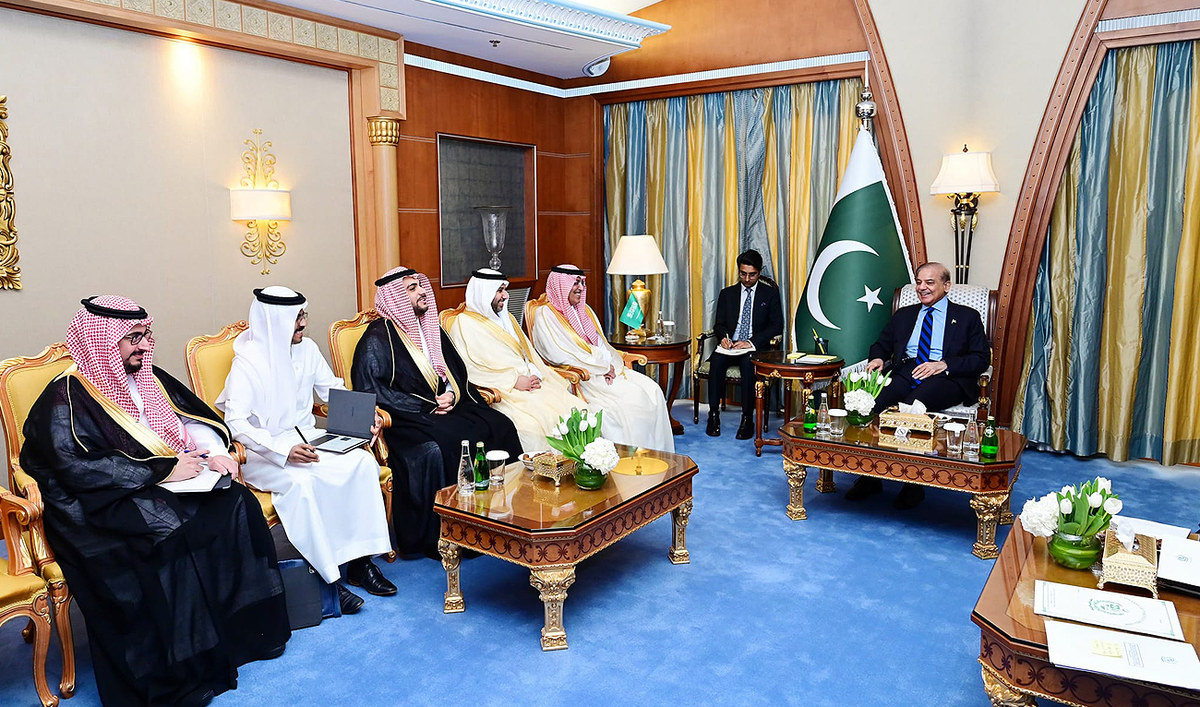
Saudi Minister for Industry Bandar bin Ibrahim Alkhourayef along with his team (R) meets Pakistan Prime Minister Shehbaz Sharif and his delegation on the sidelines of a special meeting of the World Economic Forum in Riyadh on April 28, 2024. (Photo courtesy: PMO)
Short Url
Updated 28 April 2024
Follow

Saudi ministers assure PM Sharif of support for Pakistan’s development — PM’s office

  • PM Shehbaz Sharif is in Riyadh to attend WEF meeting on global collaboration, growth and energy
  • On Sunday, he met with Saudi Arabia’s minister of finance, investment, and industry and minerals

ISLAMABAD: Prime Minister Shehbaz Sharif on Sunday met with Saudi Arabia’s ministers of finance, investment and industry in Riyadh on the sidelines of a World Economic Forum (WEF) meeting, Sharif’s office said, adding that the Saudi ministers assured him of the Kingdom’s support for Pakistan’s development.

The Pakistan prime minister arrived in Riyadh on Saturday to attend the WEF meeting on global collaboration, growth and energy on April 28-29, after being extended an invitation by Crown Prince Mohammed bin Salman and Professor Klaus Schwab, the WEF executive chairman.

On the sidelines of the WEF meeting, Sharif held separate meetings with Saudi Arabia’s Finance Minister Mohammed Al-Jadaan, Investment Minister Khalid Al-Falih, and Industry and Mineral Resources Minister Bandar Alkhorayef, according to the Pakistan PM’s office.

In his meeting with the Saudi finance minister, the two sides agreed that Saudi Arabia would explore more opportunities for investment in Pakistan.

“The Saudi finance minister reiterated Saudi Arabia’s support for Pakistan’s economic development,” Sharif’s office said in a statement.


Saudi Minister for Finance Mohammad Al Jadaan (2R) along with his team meets Pakistan Prime Minister Shehbaz Sharif (R) on the sidelines of a special meeting of the World Economic Forum in Riyadh on April 28, 2024. (Photo courtesy: PMO)

The Saudi investment minister acknowledged PM Sharif’s efforts for Pakistan’s growth and prosperity.

“A delegation of Saudi investors will soon visit Pakistan,” he was quoted as saying by Sharif’s office.

“Pakistan is our priority in terms of investment. Both sides will continue to fully cooperate in agriculture, information technology (IT) and energy sector.”

Pakistan and Saudi Arabia enjoy strong trade, defense and cultural ties. The Kingdom is home to over 2.7 million Pakistani expatriates and serves as the top source of remittances to the cash-strapped South Asian country.

Both Pakistan and Saudi Arabia have been closely working to increase their bilateral trade and investment, and the Kingdom recently reaffirmed its commitment to expedite an investment package worth $5 billion discussed previously with Islamabad.

In his meeting with the prime minister, Saudi Arabia’s Industry and Mineral Resources Minister Bandar Alkhorayef expressed “deep interest” in cooperation with Pakistan in agriculture, minerals, IT and other sectors, according to Sharif’s office.

“I am in touch with Saudi private companies regarding investment in Pakistan and [representatives of] these companies will visit Pakistan very soon,” the Saudi minister was quoted as telling PM Sharif.

“Cooperation between private sectors of the two countries is among our top priorities.”

PM Sharif thanked Saudi Arabia’s King Salman and Crown Prince Mohammed bin Salman as well as the Saudi ministers for supporting Pakistan in every difficulty.

“During my previous government, our economic situation improved, thanks to Saudi Arabia’s support and assistance,” he said, describing both countries as strategic partners.

Pakistan’s Foreign Minister Ishaq Dar, Finance Minister Muhammad Aurangzeb and other members of PM Sharif’s cabinet were also present at the meetings.


Walnut tree remains ‘under arrest’ for over a century, living symbol of colonial power in Pakistan

Updated 4 sec ago
Follow

Walnut tree remains ‘under arrest’ for over a century, living symbol of colonial power in Pakistan

  • British officer is said to have ordered chaining of the tree in 1898, a reminder of the absolute authority and psychological control enforced under colonial rule in Khyber Pass region
  • Locals and historians say the shackled tree survives as a physical memory of the Frontier Crimes Regulation era, when even nature could be punished to discipline subjects and display power

LANDI KOTAL, KHYBER: In the military cantonment of Landi Kotal, close to Pakistan’s Torkham border crossing with Afghanistan and the mouth of the historic Khyber Pass, a single walnut tree stands bound in heavy iron chains.

It has been this way for more than a century, a surreal, almost absurd monument to the power structures and punitive imagination of the British Empire’s rule in the tribal frontier.

Black shackles still brace parts of its branches, giving it the appearance of a theatrical installation. To locals, it is a wound that never fully healed, a reminder that even nature could be punished when authority wished to show dominance.

Local oral histories trace the origin of this bizarre imprisonment to 1898, when a British officer named James Squid, allegedly intoxicated, believed the tree was moving toward him and instantly ordered it arrested. Soldiers carried out the instruction and the walnut tree has never been freed since.

Muhammad Sardar, the caretaker who oversees the site today, recounted the story as it has been passed down for generations.

“This British military official at that time was drunk and thought this walnut tree was moving toward him to attack him,” he told Arab News. “The officer ordered to arrest this tree, hence the soldiers had to obey the order and arrest this tree.”

Whether the event unfolded exactly as described is impossible to verify, but historians and residents agree on what the continued chaining represented: the unquestionable authority of colonial power.

A LAW THAT COULD BIND PEOPLE — AND TREES

Landi Kotal was one of the most militarized points of the British-controlled frontier, a strategic chokepoint along the Khyber Pass, a route armies, traders and empires have used for thousands of years. To control the region, the British introduced the Frontier Crimes Regulation (FCR), a law that denied locals the right to appeal, hire lawyers or challenge government decisions. Entire tribes could be punished for the suspected action of one member.

The chained walnut tree is often interpreted as a physical embodiment of that era: a warning made visible.

Dr. Syed Waqar Ali Shah, Assistant Professor of History at the University of Peshawar, said the symbolism was deliberate.

“It was an assertion of their [British] authority, it was a symbol of their power. Right. It’s a funny thing as well, because it’s something which was under the influence of some intoxication,” he explained.

“The officer behaved or gave orders for the imprisonment of that particular tree under the influence of some intoxicants.”

Dr. Shah continued:

“It was something which was a symbol of colonial authority, assertion of their authority, of bureaucratic diplomacy, a symbol of their bureaucratic strength and power, and maybe some cultural encounter as well.”

He added that such displays endured because “it was a cultural link between the locals and the colonial power. So it was a reflection of that. But later on, they continued with it in the presence of FCR (Frontier Crimes Regulation) and regulations like this.”

Even once the officer sobered, the chains remained.

Dr. Shah believes that was intentional: psychological messaging meant to instill conformity and fear in people living under colonial law.

“Their objective and purpose was to make it a symbol of discipline for the masses. It was an exhibition of power, a sheer exhibition of power, a symbol that if we can do this to something which was inhuman … if they can deal with a tree like this, so the general public, they should be aware that discipline is very important.”

Landi Kotal’s older residents say their fathers and grandfathers retold the story long before Pakistan existed and long before independence movements dismantled the Raj.

Usman Khan Shinwari, a 26-year-old shopkeeper, said the story continues to live in households like a family inheritance.

“My grandfather would often narrate this story of the arrested tree,” he recalled. “My grandfather would say that it shows how the then rulers were treating the locals and what our ancestors had endured.”

Over a century later, long after the end of British rule and the formal abolition of the Frontier Crimes Regulation in 2018, the walnut tree remains exactly where it was chained, part spectacle, part scar.

Tourists sometimes come to photograph it. Others stand silently before it.

But for many in Khyber, it is neither attraction nor curiosity.

It is proof that power once flowed one way only. A tree could be punished, so people learned not to resist.