

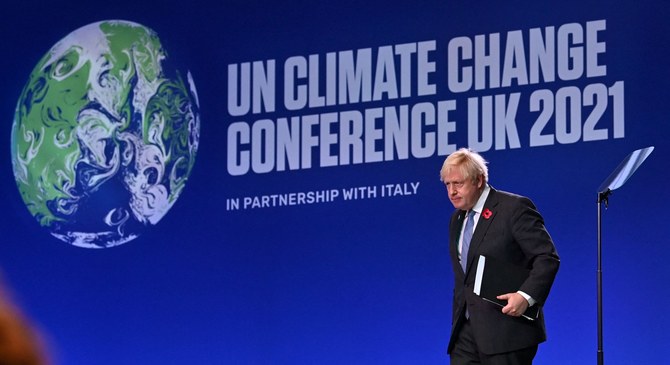
Global leaders are in ‘same position as James Bond,’ UK PM says at COP26 address

Short Url
Updated 01 November 2021
Follow

Global leaders are in ‘same position as James Bond,’ UK PM says at COP26 address

GLASGOW: UK prime minister Boris Johnson said global leaders were "in roughly the same position" as James Bond as he opened the leaders summit section of the UN Cop26 in Glasgow.

Johnson said that James Bond "generally comes to the climax of his highly lucrative films strapped to a doomsday device, desperately trying to work out which coloured wire to pull to turn it off, while a red digital clock ticks down remorselessly to a detonation that will end human life as we know it".

Opinion

This section contains relevant reference points, placed in (Opinion field)

He added: "We are in roughly the same position, my fellow global leaders, as James Bond today - except that the tragedy is this is not a movie and the doomsday device is real.The clock is ticking to the furious rhythm of hundreds of billions of pistons and furnaces and engines with which we are pumping carbon into the air faster and faster.”

Johnson continued: Johnson has urged world leaders not to "fluff our lines", warning that younger generations will "not forgive us".

He said: "Because if we fail, they will not forgive us - they will know that Glasgow was the historic turning point when history failed to turn. They will judge us with bitterness and with a resentment that eclipses any of the climate activists of today and they will be right. Cop26 will not and cannot be the end of the story on climate change."


Saudi Arabia’s industrial output rises 10.4% in November: GASTAT 

Updated 10 sec ago
Follow

Saudi Arabia’s industrial output rises 10.4% in November: GASTAT 

RIYADH: Saudi Arabia’s industrial output rose at its fastest rate in months, climbing 10.4 percent year on year in November, supported by stronger manufacturing activity and higher oil production, official data showed. 

The Industrial Production Index increased to 114.4, up from 103.6 a year earlier, according to the General Authority for Statistics, though the index slipped 0.7 percent from October.

The latest figures highlight continued momentum in the Kingdom’s industrial sector as Saudi Arabia pursues economic diversification under its Vision 2030 agenda.

In its latest report, GASTAT stated: “Preliminary results indicate an increase of 10.4 percent in the IPI in November 2025 compared to the same month of the previous year, supported by the rise in mining and quarrying activity, manufacturing activity and water supply, sewerage and waste management and remediation activities.”  

The sub-index of mining and quarrying activity increased by 12.6 percent year on year in November, supported by Saudi Arabia’s decision to raise oil production to 10.1 million barrels per day, compared to 8.9 million bpd a year earlier. 

Manufacturing activity rose by 8.1 percent compared to November 2024, driven by a 14.5 percent increase in the production of coke and refined petroleum products. The manufacture of chemical products also recorded a 10.9 percent annual rise.

In contrast, the sub-index of electricity, gas, steam, and air conditioning supply declined by 4.3 percent year on year, while water supply, sewerage and waste management and remediation activities rose by 10.2 percent. 

On a month-on-month basis, the overall IPI fell by 0.7 percent in November. 

Mining and quarrying activity rose by 0.5 percent from October, while manufacturing activity edged up by 0.3 percent.

However, electricity, gas, steam, and air conditioning supply recorded a sharp monthly decline of 28.6 percent. Water supply, sewerage and waste management and remediation activities fell by 3.1 percent over the same period. 

Overall, the index of oil activities advanced by 12.9 percent year on year in November, while non-oil activities increased by 4.4 percent. 

Compared to October, oil activities rose by 0.4 percent, while non-oil activities declined by 3.4 percent. 

The IPI measures changes in industrial output based on the International Standard Industrial Classification framework and covers mining, manufacturing, utilities, and waste management sectors.