Saudi Arabia’s first industrial-scale wind farm to be fully operational within weeks - EDF

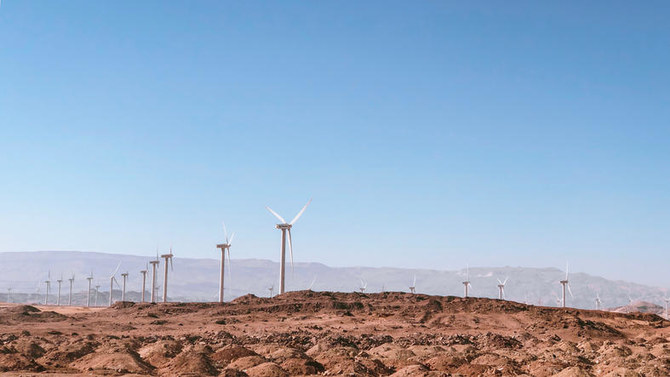
Dumat Al-Jandal will be the most cost-efficient wind-energy project in the world. (Getty Images)
Short Url
Updated 31 October 2021
Follow

Saudi Arabia’s first industrial-scale wind farm to be fully operational within weeks - EDF

  • Project will be operated by locally hired Saudis

RIYADH: Saudi Arabia’s first large industrial-scale wind farm will be ready to operate within the coming weeks and is expected to produce its first power within months, said Bruno Bensasson, EDF group senior executive vice president renewable energies and chairman and CEO of EDF Renewables.
The 400 MW project in Dumat Al Jandal consists of 99 turbines and will be operated by locally hired Saudis, he told Arab News in an interview on the sidelines of the FII summit in Riyadh.
“It will produce renewable power at a very competitive price,” Bensasson said. “It also helps the country to shift power production from liquids to a mix of gas and renewables.”
The Kingdom’s first utility-scale wind-power farm is being developed by a consortium led by EDF Renewables in partnership with Abu Dhabi-based Masdar and Saudi Arabia's Nesma. Once fully operational, it will reduce CO2 emissions by nearly 1 million tons annually and supply 72,000 homes with clean energy.
Its tariff of $21.3 per megawatt-hour (MWh), the lowest bid submitted, was reduced to $19.9/MWh at financial close, making Dumat Al-Jandal the most cost-efficient wind-energy project in the world.
According to the US-Saudi Arabian Business Council, the development of Saudi Arabia’s renewable energy sector could create up to 750,000 jobs over the next decade, as the Kingdom pushes to generate 7 percent of its total electricity output from renewables by 2030.
“Wind and solar are complimentary,” said Bensasson. “Solar, of course, delivers power during the day when the sun is here. Wind is a bit different. It comes, for instance, in the evening when the sun is not here anymore. So, we will do both wind and solar.”
Renewable energy projects, including wind and solar, are planned across more than 35 parks in Saudi Arabia by 2030.


Closing Bell: Saudi main index extends gains as market opens wider to foreign investment

Updated 02 February 2026
Follow

Closing Bell: Saudi main index extends gains as market opens wider to foreign investment

RIYADH: Saudi Arabia’s Tadawul All Share Index rose on Monday, gaining 153.61 points, or 1.38 percent, to close at 11,321.09.

The total trading turnover of the benchmark index was SR5.85 billion ($1.56 billion), as 207 of the listed stocks advanced, while 55 retreated.

The MSCI Tadawul Index increased, up 21.20 points or 1.41 percent, to close at 1,524.18.

The Kingdom’s parallel market Nomu gained 278.13 points, or 1.17 percent, to close at 24,013.03. This comes as 43 of the listed stocks advanced, while 29 retreated.

The best-performing stock was Saudi Pharmaceutical Industries and Medical Appliances Corp., with its share price surging by 7.26 percent to SR28.94.

Other top performers included Rasan Information Technology Co., which saw its share price rise by 6.51 percent to SR144, and Knowledge Economic City, which saw a 6.25 percent increase to SR13.09.

On the downside, the worst performer of the day was Najran Cement Co., whose share price fell by 2.11 percent to SR6.49.

Almasane Alkobra Mining Co. and Saudi Cable Co. also saw declines, with their shares dropping by 2 percent and 1.88 percent to SR103.10 and SR166.80, respectively.

On the announcement front, Riyad Bank has announced its annual financial results for 2025, with the total income from special commission of financing reaching SR24.1 billion, while net income from special commission of financing amounted to SR12 billion.

In a statement on Tadawul, the bank said: “Net income increased by 11.7 percent mainly due to an increase in total operating income and a decrease in total operating expenses.”

The bank further noted that the rise in total operating income was primarily driven by increased revenue from fees and commissions, trading activities, special commissions, gains on non-trading investments, and other operating sources. This growth was partially tempered by declines in exchange and dividend income.

“Net provision of expected credit losses and other losses decreased by 15.8 percent due to a decrease in impairment charge of credit losses and impairment charge for other financial assets, partially offset by an increase in impairment charge for investments,” it added.

RIBL’s share price closed at SR18.18 on the main market, marking a 1.43 percent increase.