- Brainchild of brothers Ali and Omar Shah, Colabs plans to build community of 100,000 entrepreneurs in seven years
- Backed by Swedish E-commerce giant Bangerhead, the Colabs mission is to “redefine the future of work in Pakistan”
KARACHI: Colabs, a Lahore-based shared workplace startup, has plans to expand its footprint beyond Pakistan in the next two years and has its eyes set on the Middle East and North Africa (MENA) region, the company’s cofounder said this week.
Coworking operators around the world usually rent out property space which hordes of self-employed persons or companies then share, amid a growing belief that shared spaces deliver greater synergies by driving up innovation and productivity.
Backed by Swedish E-commerce giant Bangerhead, Pakistani firm Colabs says it wants to “redefine the future of work in Pakistan” and create a community of 100,000 entrepreneurs across the country within seven years. It has set a 5,000-seat target in the next 18 months and aims for 10,000 seats over the next two years.
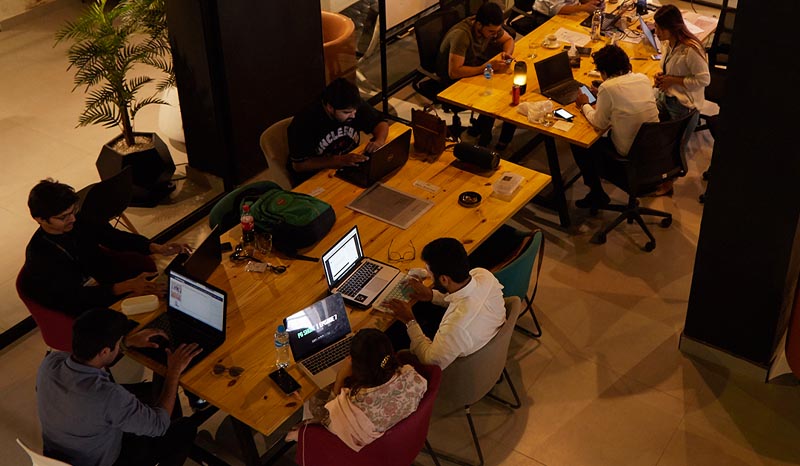
Colabs offers seats to individuals and companies on a rental basis to work and organize workshops or seminars in a complete office environment The Colabs community currently has 1,000 seats and services over 100 companies across multiple facilities in Pakistan. Sixty percent of the firm’s co-working space is occupied by tech companies. Users include a mix of freelancers, startups, small and medium enterprises and multinational corporations, including Rocket Internet, Patari, SadaPay, 10pearls, USAID, OMD and Coca Cola.
“We have created co-working space with 1,000 seats for over 100 companies since the launch of Colabs in 2019 and target creating 100,000 seats across the country,” CEO and cofounder Omar Shah, who established the company with his twin brother Ali, said in an exclusive interview with Arab News.
“Funding will be raised for targeted 4,000 seats within the next 18 months across Pakistan, including 1,000 each in Karachi and Islamabad, before starting overseas operations,” Omar said, without divulging how much funding would be required for the expansion.
Shah, who has around sevens years of work experience as a private equity and venture capital investor in Dubai, with a focus on emerging markets like Mexico, UAE, Turkey, and Pakistan, wants his startup to act as a “gateway” for foreign investment into Pakistan.
“We are projecting Colabs as a gateway to Pakistan by enabling international companies to enter and accelerate growth in the Pakistani market,” Shah said. “Young startups mainly in the Middle East and North Africa (MENA) region want access to Pakistan.”
The startup is eyeing the MENA region, Bangladesh and Sri Lanka to set up its overseas operations after achieving a 5,000-seat target in Pakistan.
“Companies come to us and ask for setting up offices, hiring and managing teams, including their payroll… in this scenario international expansion is in our plan and we will go to other markets,” he said. “Within two years, we would like to enter other markets, for example Saudi Arabia, Jordan, Egypt, Bangladesh and Sri Lanka.”
The demand for co-working spaces was increasing with the growth of startups and freelancers, and they would replicate the same co-working space model in other countries, the Colabs CEO said.
“Such space in Pakistan is limited roughly to around 8,000 to 9,000 seats, but in neighboring India, such seats are available to the tune of 250,000-300,000,” he said.
Shah said Colabs needed 5 million square feet of space to meet its goal of 100,000 seats, which was easily available across Pakistan.
Earlier this month, Abdul Razak Dawood, adviser for commerce and investment to Pakistani Prime Minister Imran Khan, said the country’s startups had set a record by raising $305 million during January and September 2021.
A group of young startups have made splashy funding announcements in recent weeks.
Quick-commerce startup Airlift unveiled a record $85 million Series B round last month, followed by business-to-business (B2B) venture Bazaar’s record $30 million Series A round. Last month, Tag, a one-year-old Pakistani startup that offers banking and financial services, raised over $12 million in what is now the largest seed financing round in Pakistan, and Oraan raised $3 million in the largest seed funding closed by a women-led startup in the country.
“India was the hub, where global investors were sitting for over a decade but in Pakistan people for the first time are coming to invest, including institutional and venture capitals,” Shah said.
However, he warned:
“Everyone is bullish on Pakistan today and we need to be very vigilant about the utilization of foreign funds that must not be wrongly utilized in the absence of a governance structure.”