December election may not spell the end for Libya’s crisis: Experts

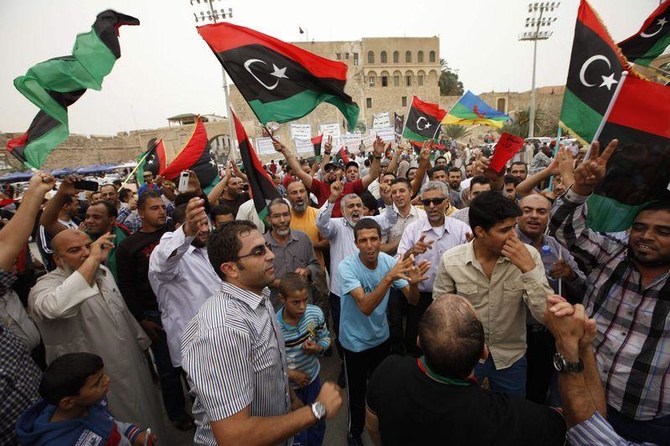
The first elections since the end of the war between the Tripoli-based Government of National Accord and Benghazi-based Libyan National Army are scheduled for Dec. 24. (Reuters/File Photo)
Short Url
Updated 14 October 2021
Follow

December election may not spell the end for Libya’s crisis: Experts

  • Debate over Ghaddafi-era officials and entities in post-Ghaddafi Libya has yet to be comprehensively resolved
  • Libyans will vote on Dec. 24 in the first elections since warring parties put down their weapons in 2020

LONDON: Libya’s first election since a peace deal was struck last year between its warring parties may not be the end of the conflict in the country because the underlying issues that sparked a war in 2015 have not yet been addressed, a panel of experts said.

Speaking at an online event on Thursday, hosted by the Council for Arab-British Understanding, and attended by Arab News, Libyan activists and policy experts also said the intransigence of the international community, including the UN, threatens to undermine the pursuit of real resolution to Libya's problems.

The first elections since the end of the war between the Tripoli-based Government of National Accord and Benghazi-based Libyan National Army are scheduled for Dec. 24.

But, according to Asma Khalifa, a Libyan peace activist, there remains no consensus on the core question between officials from the era of former Libyan leader Muammar Gaddafi and institutions in a post-Ghaddafi Libya.

“The biggest problem is the Political Isolation Law,” said Khalifa, referring to the proposed law that bars Ghaddafi-era officials, such as LNA general Khalifa Haftar, from participating in a post-war Libyan government.

The proposed Political Isolation Law was a major source of discontent in late 2014 and early 2015 and ultimately contributed to the breakdown of Libya’s first unity government.

“It is not clear really what happens to this law,” under the second unity government, which was agreed earlier this year, Khalifa said. 

“No one mentions it anymore, especially with court cases involving head Ghaddafi figures being dismissed and the release of prisoners as part of reconciliation efforts by the government.”

This lack of clarity over the law, Khalifa said, exists in all legal texts since 2012 and “is the biggest problem.”

She also explained that various legal reforms have concentrated power in the position of president in Libya, at the expense of the prime minister and other bodies, as well as allowed senior leaders from fighting factions to run for the position.

These reforms further undermine the peace process, said Tarek Megersisi, senior policy fellow at the European Council on Foreign Relations.

“All of Libya’s old war criminals could run for this office of absolute power, of no real clear and equal mandate or restrictions. It has no wider political governance or political framework attached to it — and then simply be able to return to their barracks should they lose,” Megerisi said. 

“You could argue that such a play was designed to provoke outrage and designed to provoke opposition and stop the electoral process, rather than to make it happen.”

Despite the problems with the legal reforms, Megerisi said, the UN and other members of the international community quickly embraced the legal changes in the pursuit of a December election to demonstrate the success of the international effort in Libya. 

But their singular pursuit of an election above a true political resolution to the country’s deep divides represents a major flaw in their strategy, he said.

“If you go to some of these keys officials, like the UN’s (Libya) special envoy Ján Kubiš, or key capitals like Washington D.C. or Paris, then you might think that the future is actually quite bright,” Megerisi said. “Because they are all adamant that elections will be held on Dec. 24. And logistically speaking, that is indeed tentatively possible.

“Meanwhile the political or substantive problems at play are nonchalantly dismissed by a simplistic and dubious legal process whereby (members of the international community) say that the risk of having elections is less than the risk of not having them on that specific date.”

But he warned: “Because the roadmap (to peace) ends on the elections of that day, there is not much thinking that has been given to the day after the date.”


In Gaza hospital, patients cling to MSF as Israel orders it out

Updated 2 sec ago
Follow

In Gaza hospital, patients cling to MSF as Israel orders it out

KHAN YUNIS: At a hospital in Gaza, wards are filled with patients fearing they will be left without care if Doctors Without Borders (MSF) is forced out under an Israeli ban due to take effect in March.
Last month, Israel announced it would prevent 37 aid organizations, including MSF, from operating in Gaza from March 1 for failing to provide detailed information on their Palestinian staff.
“They stood by us throughout the war,” said 10-year-old Adam Asfour, his left arm pinned with metal rods after he was wounded by shrapnel in a bombing in September.
“When I heard it was possible they would stop providing services, it made me very sad,” he added from his bed at Gaza’s Nasser Hospital.
Israel’s Ministry of Diaspora Affairs and Combating Antisemitism, which oversees NGO registrations, has accused two MSF employees of links to Palestinian militant groups Hamas and Islamic Jihad, allegations MSF vehemently denies.
The ministry’s decision triggered international condemnation, with aid groups warning it would severely disrupt food and medical supplies to Gaza, where relief items are already scarce after more than two years of war.
Inside the packed Nasser Hospital in southern Gaza, one of the few medical facilities still functioning in the territory, MSF staff were still tending to children with burns, shrapnel wounds and chronic illnesses, an AFP journalist reported.
But their presence may end soon.
The prospect was unthinkable for Fayrouz Barhoum, whose grandson is being treated at the facility.
“Say bye to the lady, blow her a kiss,” she told her 18-month-old grandson, Joud, as MSF official Claire Nicolet left the room.
Joud’s head was wrapped in bandages covering burns on his cheek after boiling water spilled on him when strong winds battered the family’s makeshift shelter.
“At first his condition was very serious, but then it improved considerably,” Barhoum said.
“The scarring on his face has largely diminished. We need continuity of care,” she said.

- ‘We will continue working’ -

AFP spoke with patients and relatives at Nasser Hospital, all of whom expressed the same fear: that without MSF, there would be nowhere left to turn.
MSF says it currently provides at least 20 percent of hospital beds in Gaza and operates around 20 health centers.
In 2025 alone, it carried out more than 800,000 medical consultations and over 10,000 deliveries.
“It’s almost impossible to find an organization that will come here and be able to replace all what we are doing currently in Gaza,” Nicolet told AFP, noting that MSF not only provides medical care but also distributes drinking water to a population worn down by a prolonged war.
“So this is not really realistic.”
Since the start of the war in October 2023, triggered by Hamas’s deadly attack on southern Israel, Israeli officials and the military have repeatedly accused Hamas of using Gaza’s medical facilities as command centers.
Many have been damaged by two years of bombardments or overcrowded by casualties, while electricity, water and fuel supplies remain unreliable.
Aid groups warn that without international support, critical services such as emergency care, maternal health, and paediatric treatment could collapse entirely, leaving hundreds of thousands of residents without basic medical care.
Humanitarian sources say at least three international NGO employees whose files were rejected by Israeli authorities have already been prevented from entering Gaza through the Kerem Shalom crossing.
“For now, we will continue working as long as we can,” said Kelsie Meaden, an MSF logistics manager at Nasser Hospital, adding that constraints were already mounting.
“We can’t have any more international staff enter into Gaza, as well as supplies... we will run into shortages.”