

Saudi pavilion at Expo 2020 Dubai hosts workshops on traditional crafts

The workshops take place every day from 10 a.m. to 1 p.m. at the pavilion’s Palm Garden and from 5 p.m. to 9:40 p.m. in the building’s Open Square.
Short Url
Updated 19 October 2021
Follow

Saudi pavilion at Expo 2020 Dubai hosts workshops on traditional crafts

DUBAI: The Saudi Pavilion at Dubai’s Expo 2020 has been an important stop for visitors since the much-anticipated event opened to the public last week. 

The rectangular facade, which features a 1,320 square-meter inclined mirrored screen, is designed to showcase the Kingdom’s ancient culture and heritage, the wonders of its natural landscape, as well as the rapid drive of its present and future ambitions.

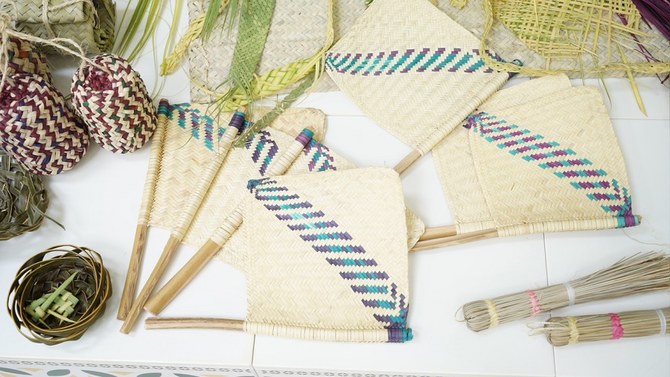
Among the cultural offerings that the pavilion boasts are workshops aimed at teaching international guests and children traditional Saudi crafts, including palm leaf weaving and Al-Qatt Al-Asiri. 

Al-Qatt Al-Asiri is an art form deeply rooted within the identity of the Kingdom’s southern region — and it is practiced exclusively by women.

To demonstrate this art form, Saudi artist Afaf Dajam was on site this week painting on a clay pot to demonstrate how these beautiful objects are created. 

In an interview with Arab News, the artist said that she particularly looking forward to praciting the craft with the children who visit Expo 2020, adding that she had created templates for children to paint on using various coloring techniques, including water paint and acrylics.

Dajam fascination with Al-Qatt Al-Asiri was sparked when the art form was added to the UNESCO Representative List of the Intangible Cultural Heritage of Humanity in 2017. After that, she undertook extensive research into the craft.

“This research turned to love and passion,” she said. “I started searching for it in old homes in Asir, and I documented it in my own studio.” 

Her “documentation” examined how the art form started and how it developed. “Around 100 years ago, they used to only use two colors: black and red… Now, they use the five famous colors for Al-Qatt Al-Asiri: yellow, red, green, white and blue,” she told Arab News.  

To teach visitors about the craft of the palm leaf weaving, the pavilion invited Saudi creative Habib Abdullah Al-Farhan to display colorful baskets, bowls and mats.

The artist, who has created more than 5,000 items in his career, first started weaving when he was 13-years old, before he took a hiatus. For the past 14 years, he has dedicated his career to creating versatile objects from palm leaves.

Al-Farhan has worked with regional restaurants and international brands, including Mothercare and Turquoise Mountain. 

The workshops take place every day from 10 a.m. to 1 p.m. at the pavilion’s Palm Garden and from 5 p.m. to 9:40 p.m. in the building’s Open Square.  


Producer Zainab Azizi hopes ‘Send Help’ will be a conversation starter

Updated 31 January 2026
Follow

Producer Zainab Azizi hopes ‘Send Help’ will be a conversation starter

DUBAI: Afghan American film producer Zainab Azizi cannot wait for audiences to experience Sam Raimi’s new horror comedy “Send Help.”

In an interview with Arab News, the president at Raimi Productions kept returning throughout her interview to one central theme: the communal thrill of horror.

“I started watching horror from the age of six years old. So, it’s kind of ingrained in my brain to love it so much,” she said, before describing the formative ritual that still shapes her work: “What I loved about that was the experience of it, us cousins watching it with the lights off, holding hands, and just having a great time. And you know, as an adult, we experience that in the theater as well.”

Asked why she loves producing, Azizi was candid about the mix of creativity and competition that drives her. “I’m very competitive. So, my favorite part is getting the film sold,” she said. “I love developing stories and characters, and script, and my creative side gets really excited about that part, but what I get most excited about is when I bring it out to the marketplace, and then it becomes a bidding war, and that, to me, is when I know I’ve hit a home run.”

Azizi traced the origins of “Send Help” to a 2019 meeting with its writers. “In 2019 I met with the writers, Mark and Damien. I was a fan of their works. I’ve read many of their scripts and watched their films, and we hit it off, and we knew we wanted to make a movie together,” she said.

From their collaboration emerged a pitch built around “the story of Linda Little,” which they developed into “a full feature length pitch,” and then brought to Raimi. “We brought it to Sam Raimi to produce, and he loved it so much that he attached to direct it.”

On working with Raimi, Azizi praised his influence and the dynamic they share. “He is such a creative genius. So, it’s been an incredible mentorship. I learned so much from him,” she said, adding that their collaboration felt balanced: “We balance each other really well, because I have a lot of experience in packaging films and finding filmmakers, so I have a lot of freedom in the types of projects that I get to make.”

When asked what she hopes audiences will take from “Send Help,” Azizi returned to the communal aftermath that first drew her to horror: “I love the experience, the theatrical experience. I think when people watch the film, they take away so many different things. ... what I love from my experience on this film is, especially during test screenings, is after the film ... people are still thinking about it. Everybody has different opinions and outlooks on it. And I love that conversation piece of the film.”