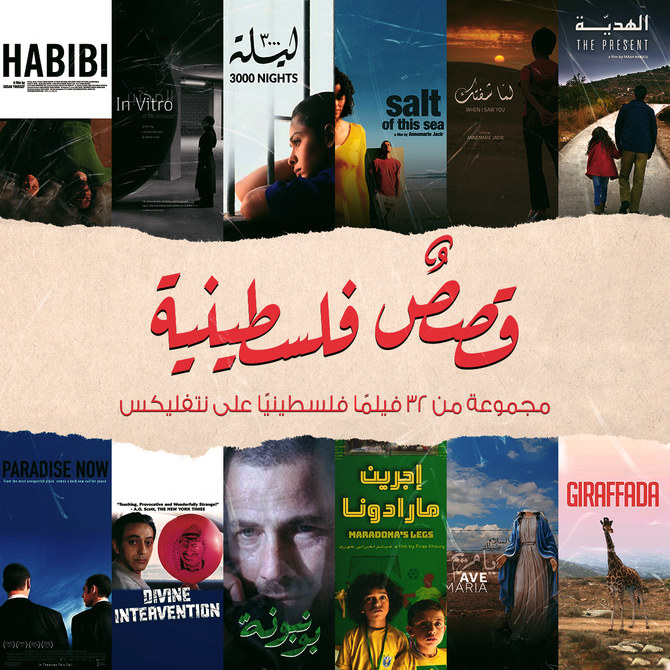
Netflix launches Palestinian Stories collection with award-winning films

The collection includes a lineup of award-winning films that are either made by Palestinian filmmakers or feature Palestinian stories. (Supplied)
Short Url
Updated 12 October 2021
Follow

Netflix launches Palestinian Stories collection with award-winning films

  • The entertainment company will launch a collection of 32 films including titles such as “A Man Returned” and “The Crossing”

DUBAI: Netflix will launch a Palestinian Stories collection on Oct. 14, showcasing films from some of the Arab world’s finest filmmakers.

Available in markets around the world, the collection includes a lineup of award-winning films that are either made by Palestinian filmmakers or feature Palestinian stories. At launch, the collection will include 32 films with more to be added over the next few weeks.

Featuring the works of critically acclaimed directors such as Annemarie Jacir, Mai Masri, Mahdi Fleifel, Susan Youssef, May Odeh and Farah Nabulsi, the collection is a tribute to the creativity and passion of the Arab film industry as Netflix continues to invest in stories from the Arab world.

Last year, Netflix struck a five-year exclusive partnership with Saudi Arabian animation studio Myrkott to produce Saudi-focused shows and films.

It also partnered with Saudi Arabian production and financing group Telfaz11 to produce eight new films, after the success of a collaboration between Telfaz11 and Netflix on the award-winning collection of short films “Six Windows in the Desert.”

“The diversification of our content sits close to my heart as Netflix works to become the home of Arabic cinema, a place where anyone in the world can access great Arab stories,” said Nuha El Tayeb, director, content acquisitions, Middle East, North Africa and Turkey, at Netflix.

“We believe that great stories travel beyond their place of origin, are told in different languages and enjoyed by people from all walks of life and, with the Palestinian Stories collection, we hope to amplify these beautiful stories to a global audience,” she said.

The collection includes films such as Annemarie Jacir’s “Like 20 Impossibles,” which was the first short film from the Arab world to premiere in Cannes and went on to become a national finalist for the Academy Awards as well as winning best film at Palm Springs, Chicago, IFP/New York, Nantucket, and Mannheim-Heidelberg film festivals; Elia Suleiman’s “Divine Intervention,” which secured two wins and a nomination at Cannes, while “3000 Nights” by Mai Masri won the jury prize at the 2016 International Film Festival and Forum on Human Rights.

“I’m glad to finally have alternative Palestinian films accessible to wide audiences through Netflix. We all in the Palestinian film industry have been eager to share our narrative with the world through our authentic creative productions as an alternative to news reporting,” said May Odeh, director of “The Crossing.”

Some of the films, such as “Present,” “Pomegranate and Myrrh,” and “It Must Be Heaven,” are already on Netflix but will now be hosted under the Palestinian Stories collection.

The majority of the titles will stream globally, and all films will include subtitles relevant to the country where they are being streamed.


Trending: BBC report suggests sexual abuse and torture in UAE-run Yemeni prisons

Updated 02 February 2026
Follow

Trending: BBC report suggests sexual abuse and torture in UAE-run Yemeni prisons

  • The investigation was produced by British-Yemeni BBC journalist Nawal Al-Maghafi

LONDON: A recent BBC video report diving into what it says was UAE-run prison in Yemen has drawn widespread attention online and raised fresh questions about the role of the emirates in the war-torn country.

The report, published earlier this month and recently subtitled in Arabic and shared on social media, alleged that the prison — located inside a former UAE military base — was used to detain and torture detainees during interrogations, including using sexual abuse as a method.

The investigation was produced by British-Yemeni BBC journalist Nawal Al-Maghafi, who toured the site, looking into cells and what appear to be interrogation rooms.

Al-Maghafi said the Yemeni government invited the BBC team to document the facilities for the first time.

A former detainee, speaking anonymously, described severe abuse by UAE soldiers: “When we were interrogated, it was the worst. They even sexually abused us and say they will bring in the doctor. The ‘so-called’ doctor was an Emirati soldier. He beat us and ordered the soldiers to beat us too. I tried to kill myself multiple times to make it end.”

Yemeni information minister, Moammar al Eryani also appears in the report, clarifying that his government was unable to verify what occurred within sites that were under Emirati control.

“We weren’t able to access locations that were under UAE control until now,” he said, adding that “When we liberated it (Southern Yemen), we discovered these prisons, even though we were told by many victims that these prisons exist, but we didn't believe it was true.”

The BBC says it approached the UAE government for comment, however Abu Dhabi did not respond to its inquiries.

Allegations of secret detention sites in southern Yemen are not new. The BBC report echoes earlier reporting by the Associated Press (AP), which cited hundreds of men detained during counterterrorism operations that disappeared into a network of secret prisons where abuse was routine and torture severe.

In a 2017 investigation, the AP documented at least 18 alleged clandestine detention sites — inside military bases, ports, an airport, private villas and even a nightclub — either run by the UAE or Yemeni forces trained and backed by Abu Dhabi.

The report cited accounts from former detainees, relatives, civil rights lawyers and Yemeni military officials.

Following the investigation, Yemen’s then-interior minister called on the UAE to shut down the facilities or hand them over, and said that detainees were freed in the weeks following the allegations.

The renewed attention comes amid online speculation about strains between Saudi Arabia and the UAE over Yemen.