

Facebook wrongfully suppressed Palestinians during May violence, says HRW

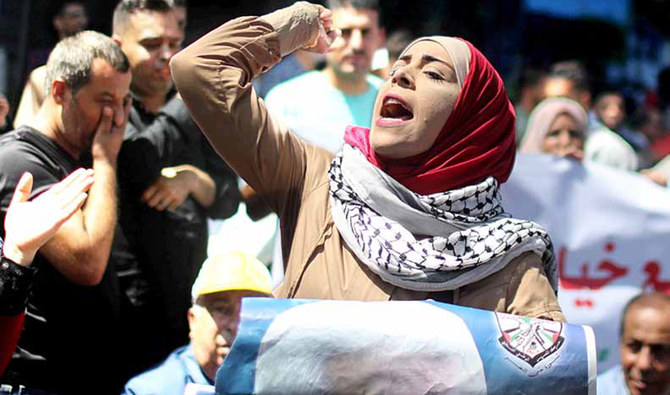
During the fierce escalation in fighting between Palestinian militants and Israeli troops, many Palestinians took to social media to highlight injustices. (Reuters/File Photo)
Short Url
Updated 08 October 2021
Follow

Facebook wrongfully suppressed Palestinians during May violence, says HRW

  • Facebook, which owns Instagram and WhatsApp, censored content documenting alleged human rights violations by Israel
  • In one case, Facebook’s automatic censor removed content because it mentioned al-Aqsa mosque

LONDON: An investigation by Human Rights Watch has found that social media giant Facebook wrongfully silenced Palestinian content, including documentation of Israeli human rights violations, during the flare-up in violence that occurred in May this year.

“Facebook has wrongfully removed and suppressed content by Palestinians and their supporters, including about human rights abuses carried out in Israel and Palestine during the May 2021 hostilities,” HRW said on Friday.

During the fierce escalation in fighting between Palestinian militants and Israeli troops, many Palestinians took to Facebook and other social media platforms, such as Instagram — which is owned by Facebook — to document what they viewed as violations of human rights by Israeli forces.

But soon, observers noticed that engagement on their content was low, and in some cases, posts were removed entirely from the networks.

In one instance, HRW said, Instagram deleted a photograph of a destroyed building, which was captioned: “This is a photo of my family’s building before it was struck by Israeli missiles on Saturday May 15, 2021. We have three apartments in this building.”

In another case, Instagram “removed the reposting of a political cartoon whose message was that Palestinians are oppressed and not fighting a religious war with Israel.”

Following an internal investigation, Facebook admitted that it made errors in some of its decisions, but HRW said the “company’s acknowledgment of errors and attempts to correct some of them are insufficient and do not address the scale and scope of reported content restrictions.”

Nor do they “adequately explain why they occurred in the first place,” HRW added.

In one perplexing instance, Instagram removed a screenshot of headlines and photos from three New York Times opinion articles for which the Instagram user added commentary that urged Palestinians to “never concede” their rights. 

HRW said that the post “did not transform the material in any way that could reasonably be construed as incitement to violence or hatred.”

All those uploads were removed for containing hate speech or symbols of hate speech. “These removals suggest that Instagram is restricting freedom of expression on matters of public interest,” HRW said.

In other instances, Facebook attached warnings of “upsetting” content to some posts that raised awareness of human rights issues and did not include violence or racism.

Some seemingly well-intentioned filtering tools ultimately contributed to the silencing of Palestinian voices. According to Buzzfeed News, some posts were censored for mentioning “Al-Aqsa mosque” — one of the holiest sites in Islam and the most revered place for Muslims in Jerusalem — because there is a terrorist group named the Al-Aqsa Martyrs Brigade. 

“This kind of automatic content removal hampers journalism and other writing, and jeopardizes the future ability of judicial mechanisms to provide remedy for victims and accountability for perpetrators of serious crimes,” said HRW.

Deborah Brown, senior digital rights researcher and advocate at HRW, said: “Facebook has suppressed content posted by Palestinians and their supporters speaking out about human rights issues in Israel and Palestine.

 “With the space for such advocacy under threat in many parts of the world, Facebook censorship threatens to restrict a critical platform for learning and engaging on these issues.”

HRW suggested that Facebook conducts an independent investigation into the censorship during the conflict, and said that the social media company must make the findings of any investigation available to the public.


Semafor targets Gulf expansion after first profitable year

Updated 09 January 2026
Follow

Semafor targets Gulf expansion after first profitable year

  • Digital news brand generates $2m in earnings on $40m of revenue in 2025, and raises $30m in new financing
  • Platform aims to be the ‘business and financial news brand of record for the Gulf,’ CEO says, and to ‘blanket the world’ within 2 years

DUBAI: Digital news platform Semafor generated $2 million in earnings in 2025 before interest, taxes, depreciation and amortization, on revenue of $40 million, marking its first year of profitability.

It also closed $30 million in new financing, which it plans to use to grow its editorial operations and live events business.

These achievements are particularly notable at a time when the global news industry is facing declining revenues and the erosion of audience trust, the company said.

Justin B. Smith, the company’s co-founder and CEO, told Arab News that Semafor’s model and approach is distinguished by several factors, which can be encapsulated by its vision of building a news product to “serve consumers that are increasingly not trusting news, but also designed with a business model that could deliver sustainable economic advantage.”

Following its first profitable year and armed with new funding, Semafor, founded in 2022, now plans an accelerated phase of global expansion with a focus on scaling editorial output and global convenings.

The company said it will broaden its publication schedule in the year ahead. Semafor Gulf and Semafor Business will become daily publications as the platform increases the frequency of its “first-read” services, which are daily briefings designed to showcase “front page” news and intended to serve as the “first read” for audiences, Smith said.

The Gulf edition of Semafor launched in September 2024, with former Dow Jones reporter Mohammed Sergie as editor. In 2025 Matthew Martin was appointed its Saudi Arabia bureau chief.

Semafor’s brand slogan is “intelligence for the new world economy” and “the Gulf is the epicenter of the new world economy,” Smith said. Currently, its Gulf operation employs eight journalists, based in the UAE and Saudi Arabia, and as it moves to a daily publishing schedule it plans to significantly bolster its editorial team, both in existing markets and new ones, such as Qatar.

Semafor is “obsessed with the business, financial and economic story” in the region and aims to become “the business and financial news brand of record for the Gulf,” Smith said.

In the US, Semafor DC, currently published daily, will move to a twice-a-day format in March. In addition, the company’s flagship annual Semafor World Economy platform in Washington will expand this year from a three-day event to five days, with extended programming. The event, in April, is expected to attract more than 400 global CEOs, more than double the number that took part in 2025.

In addition to the US and the Gulf, Semafor currently operates in Africa. It held its first event in the Gulf region last month, during Abu Dhabi Finance Week, and said it is now looking to grow its events footprint across the Gulf, and into Asia. It will launch a China edition next month, its first foray into Asia, and plans to launch in Europe in 2027, followed eventually by Latin America.

Within the next two years, Semafor aims to have “blanketed the whole world” and become a mature, global intelligence and news brand competing with the “greatest legacy business and financial news brands in the world,” Smith said.

“Our goal is to become the leading global intelligence and news company for the world, founded on independent, high-quality content and convenings,” he added.