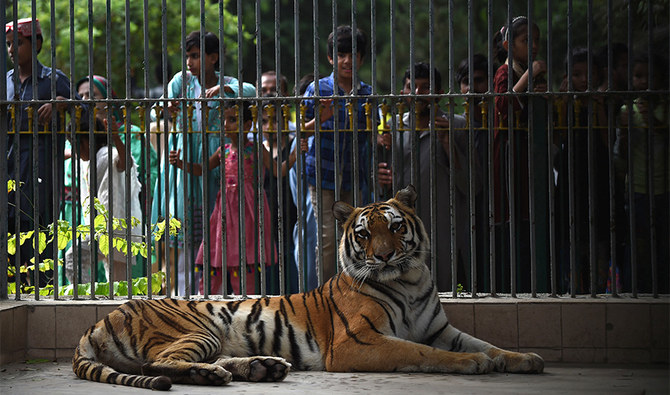

KARACHI: The Karachi Zoological and Botanical Gardens would soon be expanded to offer better living conditions to animals, its management said on Friday, as animal rights activists complained the inhabitants of the facility were not getting their natural habitat.
The Karachi Zoo is the country’s largest animal sanctuary which was established in 1878 and was called the Mahatma Gandhi Gardens. The facility was renamed after Pakistan’s independence, and it currently shelters 834 different varieties of animals and birds.
The place has made headlines in recent years for various negative developments, including the death of several animals and their poor living conditions.
In October last year, about 40 petitioners filed a case in the Sindh High Court after a video of a 20-year-old Syrian brown bear at the zoo went viral, making many social media users claim that she looked “exhausted.”
The animal was later moved to a bigger cage where she could sit in the shadow of a big tree.
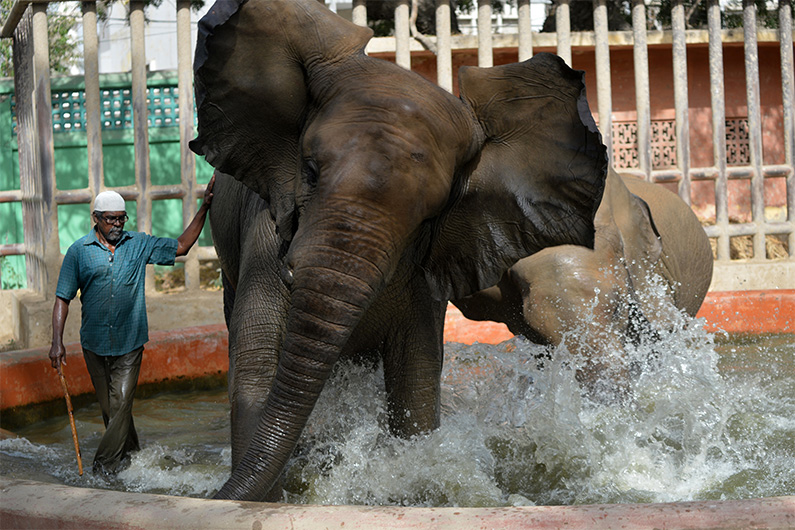
A zookeeper gives a bath to elephants inside their enclosure at Karachi Zoo during a heatwave, in Karachi, Pakistan, on March 31, 2021. (AFP)
“Three new habitats are ready while a total of 107 cages will be constructed,” Khalid Hashmi, the director of the facility, said on Friday. “This will offer animals living conditions that are closer to their habitat.”
Hashmi added the uplift was part of the Sindh government’s mega project in the seaside metropolis of Karachi.
A petition filed in March this year accused the Karachi Metropolitan Corporation (KMC) — the organization responsible for running the zoo — of neglecting four elephants who were allegedly chained in small cages and denied medical care.
The Sindh High Court in September permitted Dr. Frank Goëritz, the head veterinarian at the Leibniz Institute for Zoo and Wildlife Research, to travel to Pakistan and check the health of the elephants.
Mahera Omar, cofounder of the Pakistan Animal Welfare Society (PAWS) and one of the petitioners, said Goëritz would arrive in the country in the foreseeable future.
Murtaza Wahab, KMC administrator and spokesperson for the Sindh government, however, rejected the claim that proper care of animals was not taken by the relevant authorities.
“It is totally wrong to say that animals are not kept in a good condition at the Karachi Zoo since our new measures have brought about considerable improvement,” he told Arab News, adding: “In the past, too, such a perception was created. However, this proved to be baseless and the citizens of Karachi were witness to it.”
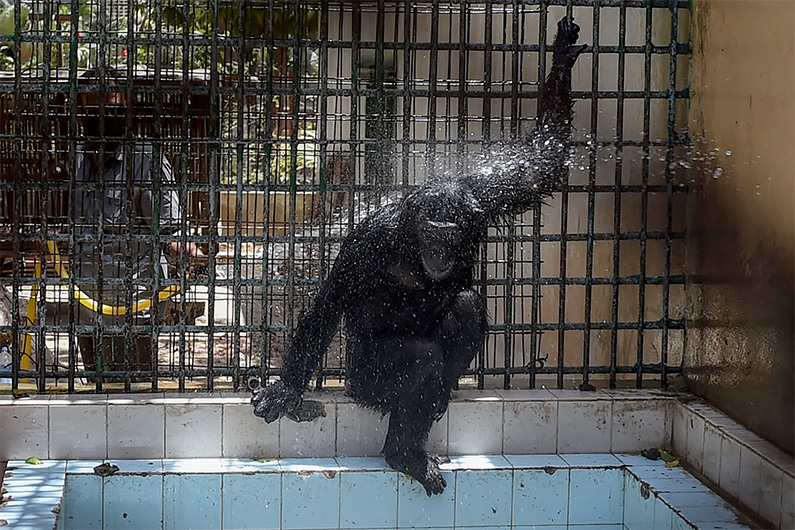
A caretaker sprays water on a chimpanzee to cool off at Karachi Zoo during a heatwave in Karachi, Pakistan, on May 6, 2020. (AFP)
The Sindh government, Wahab continued, had taken several important measures to improve the living conditions of animals at the Karachi Zoo, adding it had procured more varieties of them and brought them to the facility.
He added the provincial government had earmarked Rs2 billion to renovate and improve the sanctuary.
Hashmi said a large number of cages were empty and several animals, including a tiger, lion and bear, were living alone, making the authorities issue a tender for the purchase of more of these animals.
“The animals will not only get better homes but those who are lonely will also get their partners,” he added.
However, the cofounder of PAWS said zoo animals mostly lived in miserable conditions, adding that such facilities had a dark history of displaying the human’s dominion over wild animals from exotic lands.
“In this modern day and age, with its dwindling biodiversity, shrinking habitats and a climate crisis, our focus should be on nature-led ecological restoration,” she said. “Let’s keep our wildlife wild and free to exhibit their natural behavior in the habitat where they belong, and not confine them to a life of misery in zoos.”
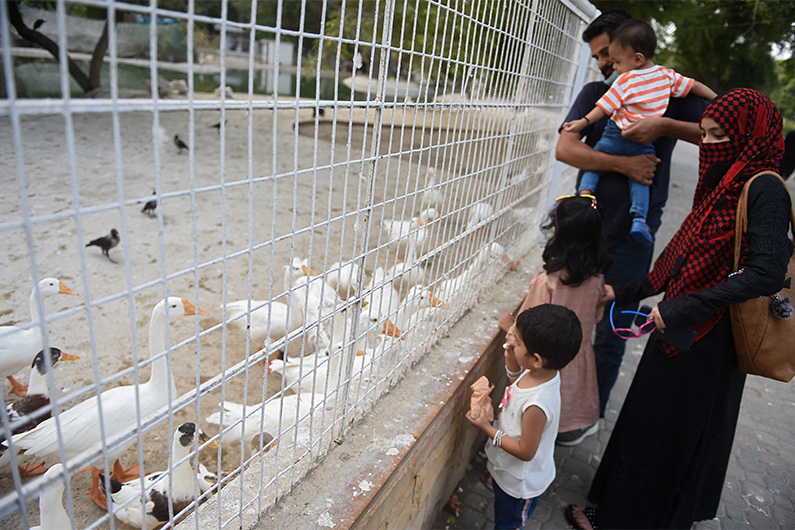
A caretaker sprays water on a chimpanzee to cool off at Karachi Zoo during a heatwave in Karachi, Pakistan, on May 6, 2020. (AFP)
Last week, Chief Justice of Islamabad High Court Justice Athar Minallah heared a petition which maintained that animals had natural rights and should not be subjected to unnecessary pain and suffering.
However, the architect working on the renovation of the Karachi Zoo, Shahid Sayeed Khan, told Arab News he had designed open enclosures to replace the cages.
“The new design of the facility has no cages,” he said. “Instead, the animals will be kept in open enclosures of different sizes as per International standards.”
“The concept,” he continued, “is to keep animals in open spaces, except for primates.”