

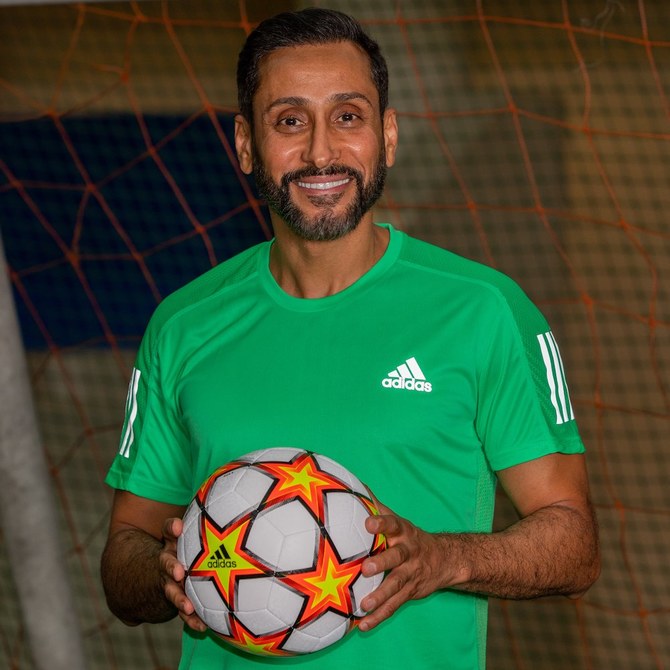
Saudi football legend Sami Al-Jaber joins Adidas as brand ambassador

Sami Al-Jaber is one of Saudi Arabia’s greatest footballers having represented the country in four World Cup finals. (adidas)
Short Url
Updated 26 September 2021
Follow

Saudi football legend Sami Al-Jaber joins Adidas as brand ambassador

  • The former national captain joins Salman Al-Faraj for the “Impossible is Nothing” campaign

Saudi Arabian football legend Sami Al-Jaber has been announced as an ambassador for Adidas, becoming the latest addition to the growing list of local players from the Kingdom to have signed with the brand, including current Saudi national football team captain Salman Al-Faraj.

The announcement came as the nation celebrated its 91st National Day.

This partnership is part of the brand’s “Impossible Is Nothing” campaign and looks to empower and celebrate athletes and iconic sportspeople in the region, as well as ensure that regional and local sports communities are well represented and supported.

“It’s a feeling of immense pride and excitement to be joining the Adidas family,” Al-Jaber said. “Adidas’ brand attitude ‘Impossible Is Nothing’ is a message that really resonates with me both at a personal and professional level. Special thanks to Adidas for the continuous support to develop and engage local and regional communities through sport. Seeing possibilities in sport is key to achieving our purpose of changing lives.”

Al-Jaber is one of Saudi Arabia’s and the Middle East football’s greatest players, having scored 173 goals in 376 appearances for Al-Hilal, and 43 times in 163 matches for the national team. He also competed in four FIFA World Cups and scored three goals, more than any other Arab footballer.



Arab Cup 2025 attendance surpasses recent AFCON and AFC Asian Cup

Updated 5 sec ago
Follow

Arab Cup 2025 attendance surpasses recent AFCON and AFC Asian Cup

  • The tournament, held under FIFA jurisdiction for the second time, achieved a record average attendance of 38,644 fans per match
  • Total attendance more than doubled since 2021, with Algeria vs. UAE quarter-final pushing it past one million spectators

RIYADH: For a tournament often dismissed by critics as little more than a friendly or “B-team” competition, the 2025 Arab Cup delivered a compelling response.

A total of 1,236,600 people attended the 32 matches across the tournament, an average of 38,644 spectators per game, as the Arab Cup returned to Qatar for a second consecutive time after its successful staging in 2021. That earlier tournament, initially launched as a Confederations Cup-like test event ahead of the World Cup, drew 571,605 spectators in total.

Despite those figures, the Arab Cup has faced persistent criticism. Questions have been raised around the quality of play and refereeing standards, with some supporters – both within and beyond the Arab world – branding the tournament “meaningless.”

Yet when placed alongside recent continental competitions, the attendance figures tell a different story.

The 2023 African Cup of Nations in Ivory Coast attracted 1,109,593 fans across 52 matches, an average of 21,338 per game. Meanwhile, the 2023 AFC Asian Cup, also hosted in Qatar, recorded 1,507,790 spectators over 51 matches — roughly 29,565 per game, the highest average in the competition’s history.

Direct comparisons, however, require context. Continental — as opposed to regional — competitions draw support from across vast geographies, while the Arab Cup benefits from strong expatriate communities based in the host nation. Expecting the same travel patterns from fans in East Asia or West Asia would be, to say the least, unrealistic.

Even so, the attendance of more than 38,000 fans per game is significant. The Arab Cup was not always popular, with the attendance in 2021 struggling to rise above an average of 17,000 per game. Only four games at the 2025 edition fell below the 20,000 mark.

Historical context further underlines this shift. The 2011 AFC Asian Cup in Qatar, along with multiple editions of the West Asian Football Federation Championship held across the region, struggled to surpass a figure of 13,000 fans per game.

While Morocco will bask in the glory of the 2025 Arab Cup, the tournament itself has shown a broader shift in football engagement across the Arab World — one no longer driven solely by interest in European leagues, but by growing confidence in domestic teams, national projects and regional competitions.

From Saudi Arabia’s ambitions in club football to Morocco’s recent international success and Qatar’s continued role as a host, momentum continues to build across the Middle East and North Africa, with the Arab Cup one of the latest competitions offering tangible evidence of that change.