

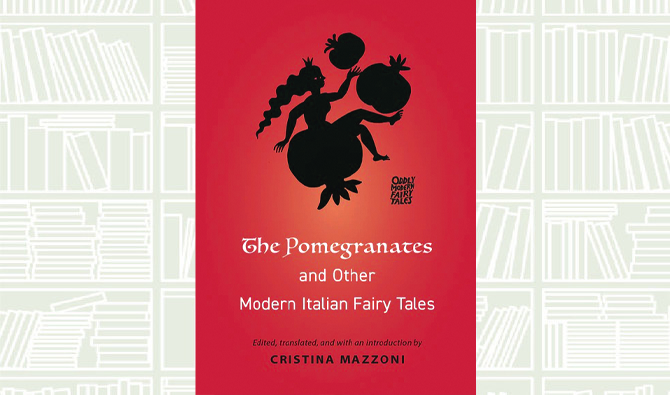
What We Are Reading Today: The Pomegranates and Other Modern Italian Fairy Tales by Cristina Mazzon

Short Url
Updated 21 September 2021
Follow

What We Are Reading Today: The Pomegranates and Other Modern Italian Fairy Tales by Cristina Mazzon

The Pomegranates and Other Modern Italian Fairy Tales presents 20 magical stories published between 1875 and 1914, following Italy’s political unification. In those decades of political and social change, folklorists collected fairy tales from many regions of the country while influential writers invented original narratives in standard Italian, drawing on traditional tales in local dialects, and translated others from France.

This collection features a range of these entertaining jewels from such authors as Carlo Collodi, most celebrated for the novel Pinocchio, and Domenico Comparetti, regarded as the Italian Grimm, to Grazia Deledda, the only Italian woman to have received the Nobel Prize in Literature. With one exception, all of these tales are appearing in English for the first time.

The stories in this volume are linked by themes of metamorphosis: A man turns into a lion, a dove, and an ant; a handsome youth emerges from a pig’s body; and three lovely women rise out of the rinds of pomegranates.


What We Are Reading Today: Elites and Democracy by Hugo Drotchon

Updated 08 January 2026
Follow

What We Are Reading Today: Elites and Democracy by Hugo Drotchon

A central paradox of democracies is that they are always ruled by elites. What can democracy mean in this context? Today, it is often said that a populist revolt against elites is driving democratic politics throughout the West.

But in “Elites and Democracy,” Hugo Drochon argues that democracy is more accurately and usefully understood as a perpetual struggle among competing elites—between rising elites and ruling elites.

Real political change comes from the interaction between social movements and elite political institutions such as parties. But, although true democracy—the rule of the people—may never be achieved, striving toward it can bring about worthwhile democratic results.

Moving away from conceptions of democracy, “Elites and Democracy” develops a dynamic theory of democracy.

At the turn of the 20th century, Gaetano Mosca, Vilfredo Pareto, and Robert Michels put forward “elite” theories of democracy and gave us terms such as the “ruling class” and “elites” itself.