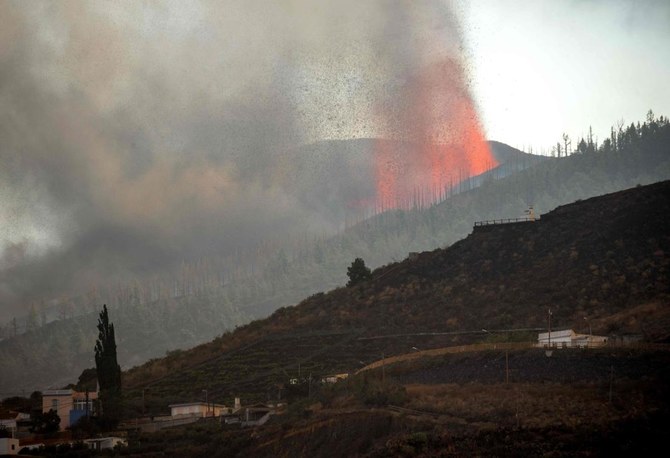
LOS LLANOS DE ARIDANE, Spain: Throwing a handful of belongings into her car alongside goats, chickens and a turtle, Yahaira Garcia fled her home just before the volcano erupted, belching molten lava down the mountainside.
She and her husband, who live near the Bodegon Tamanca winery at the foot of La Cumbre Vieja volcano on the Spanish island of La Palma, decided to leave on Sunday afternoon just before the eruption kicked off.
“We decided to leave even before they gave the evacuation order after a really terrible night of earthquakes... my house shook so much it felt like it was going to collapse,” the 34-year-old told AFP by phone.
“We were on our way when we realized the volcano had erupted.” He left in his car and she took hers to go and pick up her parents and their animals: four goats, two pigs, 20 chickens, 10 rabbits, four dogs and a turtle.
“I am nervous, worried, but we are safe,” Garcia said.
In residential areas flanking the volcano, hundreds of police and Guardia civil officers were charged with evacuations, with the work continuing well into the night, police footage showed.
“This is the police. This is not a drill, please vacate your homes,” they shouted through loud speakers, their vehicles flashing blue lights on the drive through dark streets.
Elsewhere, the footage showed officers evacuating goats in pick-up trucks in an area which is above all agricultural.
They also filmed the slow collapse of a building whose walls caved in under a wall of red hot lava.
Although some 5,500 people have been evacuated and “around 100 homes destroyed,” there have so far been no reports of injuries.
As the lava beat an unstoppable path down the mountainside, Angie Chaux, who wasn’t home when the alarm was raised, rushed back to try and salvage some possessions.
“When we got there, the road was closed and the police gave us three minutes to get our things,” said the 27-year-old.
It was 4:30 am and there were people and cars everywhere.
“Right now, we’re watching the news and the lava is 700 meters from our home. I’m really worried because I don’t know what’s going to happen to it.”
Miriam Moreno, another local resident, said they had been ready to leave when the order came with emergency backpacks stocked with food and water.
“You can hear a rumble as if planes were flying overhead and see smoke out of the window although at night you could actually see the lava about two kilometers away,” she said, admitting they were worried about “toxic gases.”
For the evacuees, it is an anguished wait to see what happens with no-one sure when they will be able to go home — or what they will find when they get there.
“The worst of it is the anxiety about losing your home. My house on the beach is fine for the moment but I don’t know when I’ll be able to go back,” said 70-year-old Montserrat Lorenzo from the coastal village of El Remo.
And experts do not know how long the volcano will remain active nor when the flow of lava, which officials said was “about six meters (20 feet) high,” will stop.
“Now they are saying the volcano could continue erupting for three months... we don’t know when the volcano will settle down,” said Garcia.
Volcanology expert Stavros Meletlidis from Spain’s National Geographic Institute said it was too early to say.
“There are volcanoes in the Canary Islands that have erupted for days and others that have continued for several years,” he told Spain’s public television.


![]()

Canary islanders flee as volcano vents its fury
Short Url
https://arab.news/whkwt
Canary islanders flee as volcano vents its fury
- In residential areas flanking the volcano, hundreds of police and Guardia civil officers were charged with evacuations
- Although some 5,500 people have been evacuated and "around 100 homes destroyed", there have so far been no reports of injuries


Latest updates


Recommended


© 2026 SAUDI RESEARCH & PUBLISHING COMPANY, All Rights Reserved And subject to Terms of Use Agreement.