

Malaysia’s top tourist destination reopens despite country’s ongoing COVID-19 crisis

1 / 4
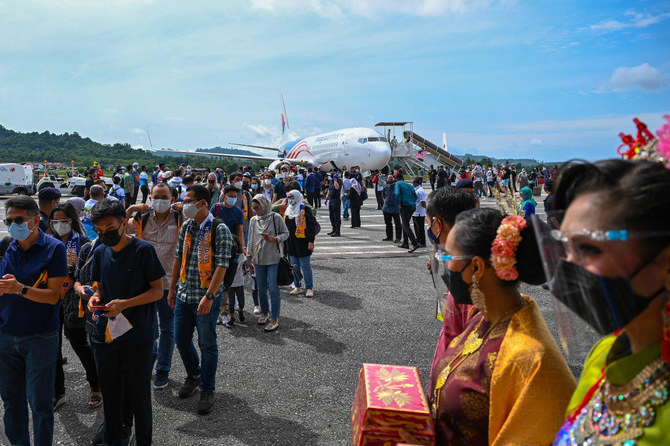
Domestic tourists disembark from a Malaysia Airlines Boeing 738 aircraft after landing in Langkawi from Kuala Lumpur on Sept.16, 2021. (Photo by Mohd Rasfan / AFP)
2 / 4
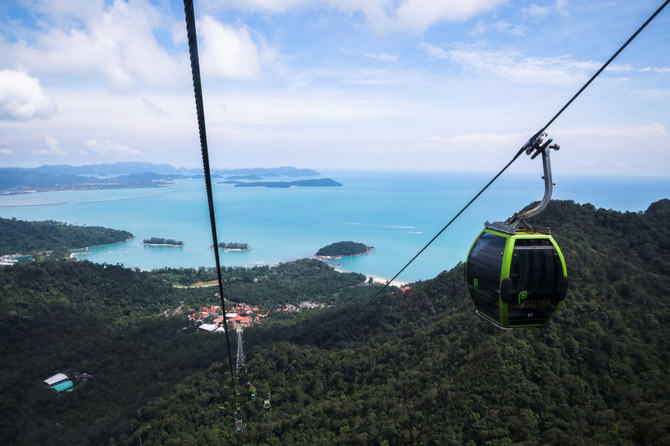
A cabin of a cable car is seen on its way up to Sky Bridge in Langkawi, Malaysia on Sept. 16, 2021, as it reopens to domestic tourists. (REUTERS/Lim Huey Teng)
3 / 4
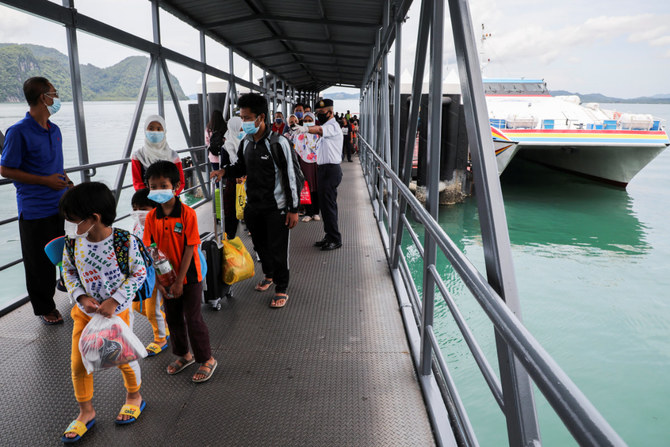
Tourists arrive at the jetty as Langkawi in Malaysia reopens to domestic tourists on Sept. 16, 2021amid the COVID-19 pandemic. (REUTERS/Lim Huey Teng)
4 / 4
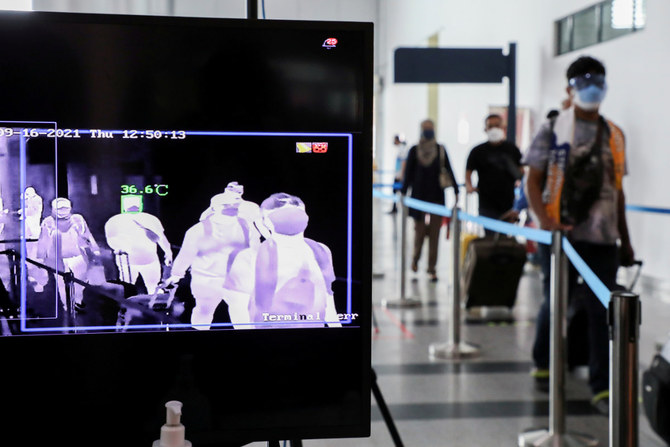
Tourists walk past a thermal scanner at the jetty as Langkawi in Malaysia reopens on Sept. 16, 2021 to domestic tourists amid the COVID-19 pandemic. (REUTERS/Lim Huey Teng)
Short Url
Updated 17 September 2021
Follow

Malaysia’s top tourist destination reopens despite country’s ongoing COVID-19 crisis

  • Reopening of Langkawi part of domestic tourism bubble strategy to restore Malaysia’s reeling visitor sector
  • Only fully vaccinated domestic travelers allowed to visit island resort as 30,000 tourists expected in next 2 weeks

KUALA LUMPUR:  The Malaysian holiday resort of Langkawi on Thursday welcomed its first visitors in months as part of a government pilot project to revive the country’s coronavirus disease (COVID-19) pandemic-ravaged tourism sector.

Langkawi has been reopened as a domestic tourism bubble in the face of Malaysia’s ongoing battle against the virus.

The government strategy is aimed at giving a much-needed shot in the arm to the hospitality and tourism industry — one of the top contributors to the Malaysian economy — after months of local travel curbs and if successful it could lead to other holiday destinations following suit.

Tight restrictions have been put in place and only fully vaccinated domestic tourists will be allowed to visit the island resort off the country’s northwestern coast.

Malaysia has so far recorded more than 2 million COVID-19 cases among its population of 32 million — one the of highest per capita infection rates in Asia — and new daily case figures remain high at around 20,000.

The country’s director general of health, Noor Hisham Abdullah, told Arab News the Langkawi Travel Bubble Task Force had divided the island into three zones to monitor developments. “All preparations have been made and we hope for the best,” he said.


A cabin of a cable car is seen on its way up to Sky Bridge in Langkawi, Malaysia on Sept. 16, 2021, as it reopens to domestic tourists. (REUTERS/Lim Huey Teng)

Local officials said they were ready to receive more than 30,000 tourists in Langkawi over the next two weeks.

Nasaruddin Abdul Muttalib, chief executive officer of the Langkawi Development Authority, said: “We have put in proper procedures so that there is no spread of the virus.

“Passengers will be screened at entry points. If they show any symptoms, they must isolate, and necessary steps will be taken. We have thought of all the scenarios.”

Authorities are banking on the full cooperation of visitors as the project’s success could be key to Malaysia’s return to normal.

Tourism Langkawi chairman, Pishol Ishak, said: “Everybody has a role to play. If everybody works together hand-in-hand, this measure will be very successful and can be replicated in other parts of Malaysia.”

For Langkawi business owners and travelers flying to the resort, famed for its white sandy beaches, the reopening represents a big first step toward a return to normality.

Sheba Gumis, a 33-year-old tourist from Kuala Lumpur, told Arab News: “We have been cooped up in Kuala Lumpur for over a year now. Life was put on hold for so long. The virus will continue to live with us.”

Ahmad Firdaus, a car rental company owner in Langkawi, said it was high time tourism reopened for the sake of the industry’s survival.

“We have to go on doing businesses in this new norm. We need tourist spots to be open to gain income. Even if the situation is bad, we must learn to live with it,” he added.


Russian cyclist finds warm welcome on Saudi Arabia’s roads 

Updated 20 January 2026
Follow

Russian cyclist finds warm welcome on Saudi Arabia’s roads 

  • Anna Rodnishcheva’s ride through Kingdom is defining chapter in solo expedition
  • Rodnishcheva cycled to Aqaba, crossed the border into Saudi Arabia, and has since traveled through Tabuk, AlUla, Madinah, Jeddah, and Taif on her way to Riyadh

MAKKAH: Solo adventurer Anna Rodnishcheva, 27, has undertaken an ambitious journey that spans countries, climates and cultures — on a bicycle. 

Born and raised in Moscow and trained as a biologist before becoming an event photographer, she now finds herself pedaling thousands of kilometers across unfamiliar landscapes in pursuit of discovery, connection, and the simple joy of movement.

In her conversation with Arab News, Rodnishcheva offered a detailed account of her ongoing route in Saudi Arabia, describing how the expedition is her third major cycling adventure.

After previously riding from Moscow to Sochi and later from Vladivostok to Sochi — a route that stretches across the entirety of Russia — she felt compelled to explore foreign lands by bicycle.

She set off from Moscow heading south last June, passing through Russia, Georgia, and Turkiye before flying from Antalya to Amman. She cycled to Aqaba, crossed the border into Saudi Arabia, and has since traveled through Tabuk, AlUla, Madinah, Jeddah, and Taif on her way to Riyadh.

Rodnishcheva explained that physical preparation played only a small role in her planning. She began slowly and allowed her body to adapt naturally over the first month. 

The true challenge, she said, was in the mental and financial preparation. She spent a year and a half planning the journey, even though she originally intended to postpone it for several more years. 

Ultimately, her belief that “life is short” convinced her to start with the resources she already had. Although she sought medical evaluations and additional vaccinations, she was unable to complete them all and decided to continue regardless.

Her journey through Georgia and Turkiye presented unexpected difficulties. Simple tasks such as finding groceries or locating bicycle repair shops became more challenging outside of Russia, where she knew how to navigate on a budget. 

She also encountered language barriers, though the situation improved when a local cyclist joined her in Georgia. The intense midsummer heat added another layer of difficulty, but she had prepared herself for such conditions.

One of the most striking moments of her trip occurred as she crossed from Jordan into Saudi Arabia. She described the experience as surreal and emotionally overwhelming, likening it to the adventures of a literary hero traveling across the Arabian Peninsula. 

Her anxiety eased unexpectedly when she got a flat tire at the border, bringing her back to the present. 

Despite being warned that crossing by bicycle would be prohibited, the process went smoothly, and she was struck by the friendliness of both Jordanian and Saudi officials. She expressed particular surprise at meeting a female Saudi passport officer, an encounter that challenged her previous assumptions about women’s roles in the Kingdom.

Rodnishcheva said the hospitality she had experienced in Saudi Arabia surpassed anything she had encountered on previous journeys. Drivers frequently stop to offer her water, fruit, or sweets, and several families have generously hosted her in their homes or guest flats. 

She emphasized that she feels completely safe traveling across the Kingdom, especially on the open roads between cities, noting the strong and visible security presence.

She has also observed significant differences in weather. While the stretch from the border to Jeddah was hot despite being winter, the climate changed dramatically after climbing Al-Hada in Taif, turning cooler and windier — a climate she compared to Russian summers.

Rodnishcheva documents her travels primarily through Russian-language platforms such as VK and Telegram. Although she maintains YouTube and Instagram accounts, she explained that her schedule left little time for frequent updates.

Offering a message to women around the world who dream of embarking on similar adventures, she said such journeys were “not as scary as they seem before you start,” though they may not suit everyone.

Her closing advice? “Listen to your heart.”