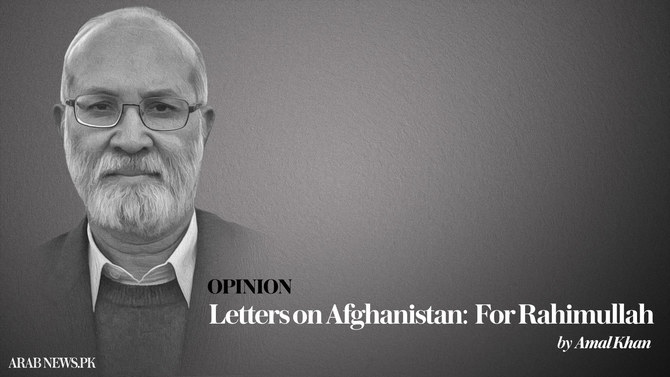
Letters on Afghanistan: For Rahimullah

Short Url
Updated 10 September 2021
Follow

Letters on Afghanistan: For Rahimullah

As an Op-Ed editor, I know that people are deeply attached to the opinions they put down on paper. They’ve worked on every comma and capital letter. I’ve edited the words of ex-Presidents, ex-army chiefs, sitting ministers, diplomats, experts and journalists. I have fought hard battles just to edit the titles of pieces, to move a paragraph up or down, to cut out a line. All my writers are distinguished and knowledgable, and so all of them prefer their work published a certain way. All writers, maybe all people, have a natural vanity about their opinions.
All of them that is, except Rahimullah Yusufzai.
Rahimullah, who died on Thursday, was an award-winning Pakistani journalist, and spent his life reporting on Afghanistan. He was the stoic narrator of its long theatre of war, his credentials faultless and his word held in the highest esteem by people on all sides of that conflict. Famously, he interviewed both Mullah Omar and Osama Bin Laden, and the iconic 1998 photograph of bin Laden smiling inside a neon green tent was taken by his hand. It is not a stretch to say only a few other journalists are as high an authority on Afghanistan as Rahimullah was. 
But side by side, Rahimullah was a reporter in the truest sense. He would call me up, because he wanted to ‘hear from his editor.’ He would send updates to his columns late into the night. He would pitch his pieces for me to assign.
“Is my topic fine, editor?” he would ask.
I’d laugh. 

‘For Amal,’ was the title of his columns. As though he had written it only for me. A letter, not a column, on Afghanistan.

Amal Khan

“Sir, you were in Kandahar reporting on these guys when I was in kindergarten,” I told him.
“But you are still the editor,” he said.
Rahimullah never questioned the edits, he never protested about the titles, the extracts, the tweets. He did his work, he wrote his reports and his columns, and then he passed on his 800 words to ‘the editor’ with ultimate faith. It was his faith not in me, but in the institution of journalism. 
In January last year, Rahimullah lost his wife and didn’t write for three weeks. He sent me an apology and an explanation as straightforward as his reporting. 
“It was Allah's will and we have no say in these matters,” he said. 
Throughout his illness, he continued to write for us at Arab News. When Kabul fell to the Taliban last month, all of us naturally turned to him for his point of view. It could be nobody else. Who else but Rahimullah could write on the most important development in Afghanistan in two decades. Though seriously ill and very frail, when asked he said simply, “Yes, I will write.” 
His last piece was published with us on Wednesday, only a day before he died.
Rahimullah always emailed his pieces untitled. Instead, the document was named after myself and my colleague, Iraj. Perhaps this was the result of decades of typing up quick copies for the wires. 
‘For Amal,’ was the title of his columns. As though he had written it only for me. A letter, not a column, on Afghanistan.
Well, I now have three years worth of letters written by one of the greatest reporters of our time, addressed to me. 
It has been the honor of my life to work with Rahimullah, and though there will be many Afghanistan columns falling into my inbox in the months and years to come, never again will one be as true or as humble-- or be written only for me. 
Rest in peace, sir.

– The writer is an editor, Arab News Pakistan.
Tweets @amalkhan


EDITORIAL: Jeddah floods a reminder of why we need the anti-corruption drive

Saudi drivers take a flooded street in Jeddah on Tuesday. (AFP)
Updated 22 November 2017
Follow

EDITORIAL: Jeddah floods a reminder of why we need the anti-corruption drive

It has happened again. The roads, streets and many underpasses in Jeddah were flooded with rainwater on Tuesday. Many areas were turned into lakes because of the heavy, though forecast, downpour. In some areas, water was knee-deep while in others it was chest-deep. People were stuck in their vehicles and many were seen pushing their vehicles to the side of the roads with great difficulty. In low-lying areas, citizens struggled to remove their belongings from flooded houses.

For the residents of Jeddah, rain has, more often than not, brought trouble and devastation. Whenever the skies open up, thoughts go back to that “Black Wednesday” of November 25, 2009, when more than 100 people lost their lives and property worth billions of riyals was destroyed. An investigation was opened into the disaster and some of the guilty were taken to court and tried; some of the small fry were even jailed. As has been the case in the past, the mighty arm of the law could barely touch those at the top who enjoyed immunity from prosecution.

And so it was business as usual until the rain began to wreak havoc again, reminding us that the laws of nature take their course and that hiding your head in the sand does not chase the clouds away.

Having said that, it must be admitted that, yes, lessons were learned. A disaster management team was set up. The weather forecast department became active in issuing alerts. In fact, Tuesday could have been far worse had it not been for the timely alert from the Presidency of Meteorology and Environment (PME) and a prompt decision by the Ministry of Education to suspend classes, schools and universities in and around Jeddah. That helped in keeping people and vehicles off the streets. At noon on Tuesday, it looked as if the city were under some kind of curfew.

The questions that are on everyone's minds right now are: Why is it that rain renders the city helpless and immobile at this time every year? Why have efforts to create effective rainwater drainage systems not borne fruit despite pumping billions of riyals into new projects such as dams and canals? Why is it that the authorities are found wanting whenever heavy rain occurs? More importantly, what is the solution?

Here is the answer. These floods are a stark reminder of why the current drive against corruption is so essential. It is required in order to instill the fear of law into high-ranking officials and heads of construction companies and civic bodies who have failed in their responsibilities. Those who have cut corners and have pocketed public money, those who have not delivered on the projects and who have provided substandard services must pay for their sins of omission.

This is exactly what is happening. No one is above the law. The guilty, whoever they are, however high up they are, will have to pay — and they are. In this new era of transparency and accountability — initiated by Crown Prince Mohammed bin Salman — word has gone down from top to bottom that no one is immune. If you are guilty you will be punished. Those responsible for the havoc of the floods on Tuesday will have no rest either.