

Lebanese fear end to fuel subsidies as Arab ministers discuss energy rescue plan

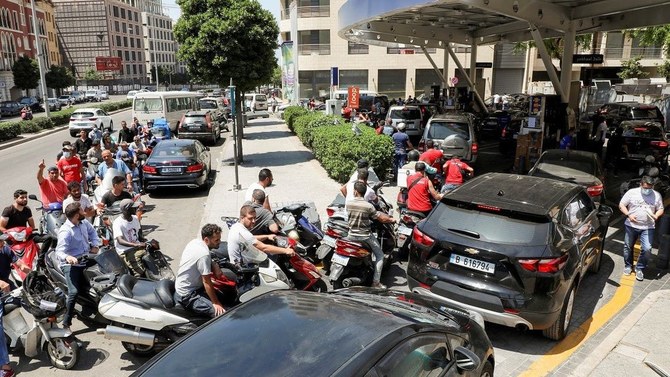
Motorbike and car drivers wait to get fuel at a gas station in Beirut, Lebanon, June 29, 2021. (Reuters)
Short Url
Updated 09 September 2021
Follow

Lebanese fear end to fuel subsidies as Arab ministers discuss energy rescue plan

  • Any decision to axe subsidies could lead to price hikes of almost all commodities in Lebanon, further adding to the deep economic and political crises already gripping the country
  • Georges Brax, a member of the gas station owners’ syndicate, said: “The $225 million allocated to subsidize fuel and electricity has basically dried up.”

BEIRUT: Fears were on Wednesday growing among Lebanese business leaders and citizens over the threat of an end to subsidies on all fuel products.

Concerns were raised as ministers from Jordan, Egypt, Syria, and Lebanon discussed a road map toward opening up vital supply lines for gas and electricity to the Lebanese.

Any decision to axe subsidies could lead to price hikes of almost all commodities in Lebanon, further adding to the deep economic and political crises already gripping the country.

More than 12 months after the Lebanese government resigned and with the nation teetering on the brink of collapse, politicians have still to agree on the formation of a new administration.

Georges Brax, a member of the gas station owners’ syndicate, said: “The $225 million allocated to subsidize fuel and electricity has basically dried up.

“If Lebanon’s central bank approves new credit lines, subsidies will persist, otherwise, subsidies will be lifted and then we will have to import fuel according to the dollar price on the black market.”

The dire social and economic situation in Lebanon has left many people and businesses without access to electricity, medicine, gasoline, or diesel and the collapse of the local currency has impacted on hospital supplies and services and led to sharp food-price rises.

Lebanese officials recently started talks with Syria over the transit of Egyptian gas and Jordanian electricity through its territory.

Hala Adel Zawati, Jordan’s minister of energy and mineral resources, invited her Egyptian, Syrian, and Lebanese counterparts to a four-way meeting in Amman on Wednesday that was also attended by experts and technicians from Lebanon’s electricity company and energy ministry.

At a joint press conference, she revealed that the meeting’s participants had agreed on “a road map to provide Lebanon with natural gas from Egypt.”

She said: “The meeting was preliminary and went very well. The infrastructure is almost ready to transit Egyptian gas to Lebanon, but we still have to check the network and gas facilities. We must verify that everything is ready to start the pumping as soon as possible.

“The next meetings will discuss the damaged infrastructure in Syria to transport electricity to Lebanon. Every Arab country will be responsible for the required cost to ensure the transit of gas to Lebanon,” Zawati added.

Ghassan Al-Zamil, Syria’s energy minister, said: “We will support any joint Arab effort that serves the Arab nation.”

And Raymond Ghajar, Lebanon’s caretaker energy minister, thanked “the brotherly countries” for their cooperation.

He said: “Lebanon today is in desperate need for the support of vital sectors. This step will enable us to benefit 450 power-generation plants and will enable the importation of electricity from Jordan in the future.”

Ghajar added that he hoped “to receive enough gas to generate 450 megawatts of electricity in Lebanon. We are working with the World Bank to secure financing for energy supplies.”

Egyptian minister of petroleum, Tarek Al-Mala, said: “After the interruption of the Arab Gas Pipeline for the past 10 years, we must check the whole network and gas facilities. We must also review some of the contractual terms.”

He added that a road map was being drawn up “with the participating ministers and Egyptian technical teams to repump gas via the Arab Gas Pipeline to Lebanon as soon as possible.”

However, head of the Syndicate of Private Hospital Owners in Lebanon, Suleiman Haroun, said: “A health crisis is about to hit the country in the next two weeks if subsidies on fuel are lifted. Even the rich would not have access to hospitals. We have reported that imports of medical supplies have stopped.

“The current tariffs force hospitals to bill patients for the price difference, which has become extravagant. I have previously warned that hospitals would only become accessible for the rich,” he added.

In a tweet on Wednesday, Issam Araji, head of Lebanon’s health parliamentary committee, said: “The financial collapse and greed have led to billing patients in US dollars or Lebanese pounds according to the exchange rate on the black market.

“Insurance companies cannot increase the tariff. Patients are the victims. They are paying 85 percent of the bill and companies are only covering 15 percent. The only solution is a rescue government. Otherwise, God knows what might happen.”



Sudan defense minister dismisses ‘intelligence document’ as fabrication after convoy strike

Updated 12 February 2026
Follow

Sudan defense minister dismisses ‘intelligence document’ as fabrication after convoy strike

  • Gen. Hassan Kabroun tells Arab News claims that army hid weapons in aid convoy are “completely false”

RIYADH: Sudan’s defense minister has firmly denied reports attributed to Sudanese intelligence alleging that a convoy targeted in North Kordofan was secretly transporting weapons under the cover of humanitarian aid.

Gen. Hassan Kabroun described the claims as “false” and an attempt to distract from what he called a militia crime.

The controversy erupted after news reports emerged that a document attributed to Sudan’s General Intelligence Service claimed the convoy struck in Al-Rahad on Friday was not a purely humanitarian mission, but was instead carrying “high-quality weapons and ammunition” destined for Sudanese Armed Forces units operating in the state.

The report further alleged that the convoy had been outwardly classified as humanitarian in order to secure safe passage through conflict zones, and that the Rapid Support Forces had destroyed it after gathering intelligence on its route and cargo.

Kabroun categorically rejected the narrative.

“First of all, we would like to stress the fact that this news is false,” he told Arab News. “Even the headline that talks about the security of the regions, such as Al-Dabbah, is not a headline the army would use.”

He described the document as fabricated and politically motivated, saying it was designed to “cover up the heinous crime they committed.”

The minister affirmed that the area targeted by drones is under full control of the Sudanese Armed Forces and does not require any covert military transport.

“Second, we confirm that the region that was targeted by drones is controlled by the army and very safe,” Kabroun said. “It does not require transporting any military equipment using aid convoys as decoys because it is a safe area controlled by the army, which has significant capabilities to transport humanitarian aid.”

According to the minister, the Sudanese military has both the logistical capacity and secure routes necessary to move equipment openly when needed.

“The army is professional and does not need to deliver anything to Kadugli or Dalang on board aid convoys,” he said. “The road between Dalang and Kadugli is open. The Sudanese forces used that road to enter and take control of the region. The road is open and whenever military trucks need to deliver anything, they can do so without resorting to any form of camouflage.”

Kabroun further rejected any suggestion that the military uses humanitarian operations as cover.

“Aid is transported by dedicated relief vehicles to the areas in need of this assistance,” he said. “Aid is not transported by the army. The army and security apparatus do not interfere with relief efforts at all, and do not even accompany the convoys.”

He stressed that the Sudanese Armed Forces maintains a clear institutional separation between military operations and humanitarian work, particularly amid the country’s crisis.

“These are false claims,” he said. “This fake news wanted to cover up the heinous crime they committed.”

Sudan has been gripped by conflict since April 2023, when fighting broke out between the Sudanese Armed Forces and the Rapid Support Forces, plunging the country into what the United Nations has described as one of the world’s worst humanitarian disasters.

The latest dispute over the convoy comes amid intensified fighting in South Kordofan, a strategically sensitive region linking central Sudan with the contested areas of Darfur and Blue Nile.

The false report suggested that intelligence monitoring had enabled the RSF to strike what it described as a military convoy disguised as humanitarian aid. But Kabroun dismissed that version outright.

“The intelligence agency is well aware of its duties,” he said. “The Sudanese Army has enough weapons and equipment to use in the areas of operations. These claims are completely false.”

He argued that the narrative being circulated seeks to shift blame for attacks on civilian infrastructure and humanitarian movements.

“This shows that they are trying to cover up the atrocities,” he added, referring to the militia.

Kabroun maintained that the army has regained momentum on multiple fronts and remains fully capable of sustaining its operations without resorting to deception.

“The region is secure, the roads are open, and the army does not need camouflage,” he said. “We are operating professionally and transparently.”

“These claims are completely false,” Kabroun said. “The Sudanese Army does not use humanitarian convoys for military purposes.”