

Egypt agrees to send gas to Lebanon amid crippling energy blackouts

Short Url
Updated 08 September 2021
Follow

Egypt agrees to send gas to Lebanon amid crippling energy blackouts

  • Most Lebanese face electricity blackouts of up to 22 hours per day as leaders struggle to secure foreign currency to import fuel and gas

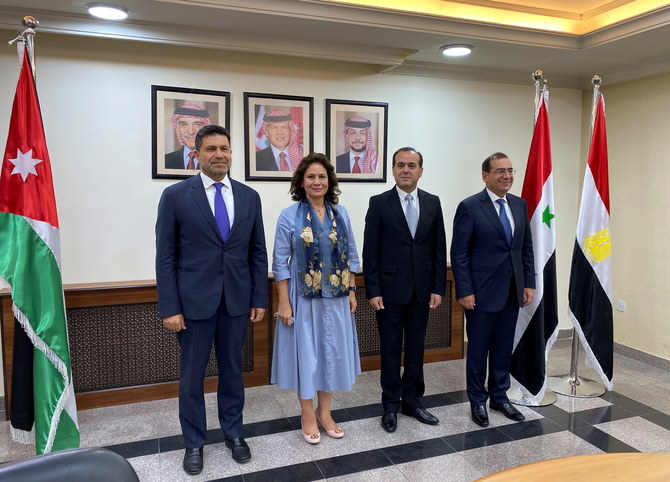
Egypt, Jordan and Syria will help provide Lebanon with up to 17 hours of electricity per day to tackle the crippling energy shortages that have repeatedly plunged the country into darkness.

Energy Ministers of the three countries agreed on Wednesday to draw up a road map to supply Lebanon with Egyptian natural gas to generate power and alleviate energy rationing in the small Mediterranean country.

Most Lebanese face electricity blackouts of up to 22 hours per day as leaders struggle to secure foreign currency to import fuel and gas.

After a meeting between ministers of the four countries held in Jordan, Lebanese caretaker energy minister Raymond Ghajar told a news conference his country was working with the World Bank to secure financing for the scheme and repairs to the country's infrastructure.

He added: "We have one gas plant in Deir Ammar that has 450 megawatts, and we need about 600 million cubic meters of gas annually.

Egyptian Petroleum Minister Tarek El-Molla set out more details, and said:  “We hope to export gas to Lebanon as soon as possible and there is a need to check the gas transportation infrastructure in order to provide Beirut with supplies,”

The ministers also agreed to discuss the situation of the Syrian infrastructure for the transmission of electricity, as Syria has approved gas and electricity transit through its territory to Lebanon.

"The transmission line was damaged but it's repaired and it is now ready and protected by a security company," Syrian Minister Ali Ghanem said.

The launch date of the project was not disclosed.

Once this agreement is implemented, 17 hours of electricity per day will be provided.

According to Ghajar, gas from Egypt will provide 4 hours of electricity, and Jordan is ready to sell the surplus electricity, providing 200 to 400 MW, or about 3 hours, local papers reported.

He also pointed out that Lebanon is receiving oil from Iraq which will be substituted with fuel suitable for the production plants, and this will give about 10 hours of electricity.

Lebanon needs about 3,000 MW to meet the needs of citizens, out of which 1,800 MW are secured from electricity plants and from two Turkish ships, Ghajar said.

The estimated deficit of 1,200 MW is much more because 50 percent of production is wasted due to old generators and the absence of meters to control consumption, he said.


Closing Bell: Saudi stocks slip as Tadawul falls 1% amid broad market weakness

Updated 30 December 2025
Follow

Closing Bell: Saudi stocks slip as Tadawul falls 1% amid broad market weakness

RIYADH: Saudi stocks fell sharply on Tuesday, with the Tadawul All Share Index closing down 108.14 points, or 1.03 percent, at 10,381.51.

The broader decline was reflected across major indices. The MSCI Tadawul 30 Index slipped 0.78 percent to 1,378.00, while Nomu, the parallel market index, fell 1 percent to 23,040.79.

Market breadth was strongly negative on the main board, with 237 stocks falling compared to just 24 gainers. Trading activity remained robust, with 164.7 million shares changing hands and a total traded value of SR3.19 billion ($850.6 million).

Among the gainers, SEDCO Capital REIT Fund led, rising 2.73 percent to SR6.77, followed by Chubb Arabia Cooperative Insurance Co., which gained 2.69 percent to SR20.20.

National Medical Care Co. added 1.72 percent to close at SR141.60, while Alyamamah Steel Industries Co. and Thimar Advertising, Public Relations and Marketing Co. advanced 1.57 percent and 1.13 percent, respectively.

Losses were led by Al Masar Al Shamil Education Co., which tumbled 8.36 percent to SR24.65. Raoom Trading Co.fell 6.75 percent to SR64.20, while Alkhaleej Training and Education Co. dropped 6.60 percent to SR18.12 and Naqi Water Co. declined 5.51 percent to SR54.00. Gulf General Cooperative Insurance Co. closed 5.44 percent lower at SR3.65.

On the announcement front, Chubb Arabia Cooperative Insurance Co. signed a multiyear insurance agreement with Saudi Electricity Co. to provide various coverages, expected to positively impact its financial results over the 2025–2026 period. The deal will run for three years and two months and is within the company’s normal course of business.

Meanwhile, Bupa Arabia for Cooperative Insurance Co. announced a one-year health insurance contract with Saudi National Bank, valued at SR330.2 million, covering the bank’s employees and their families from January 2026. Despite the sizable contract, Bupa Arabia shares fell 0.8 percent to close at SR137, weighed down by the broader market weakness.

In contrast, United Cooperative Assurance Co. revealed an extension of its engineering insurance agreement with Saudi Binladin Group for the Grand Mosque expansion in Makkah. The contract value exceeds 20 percent of the company’s gross written premiums based on its latest audited financials and is expected to support results through 2026. However, the stock came under selling pressure, ending the session down 4.51 percent at SR3.39.