

Pakistan expects inclusive Afghan government with respect for human, women’s rights — army chief 

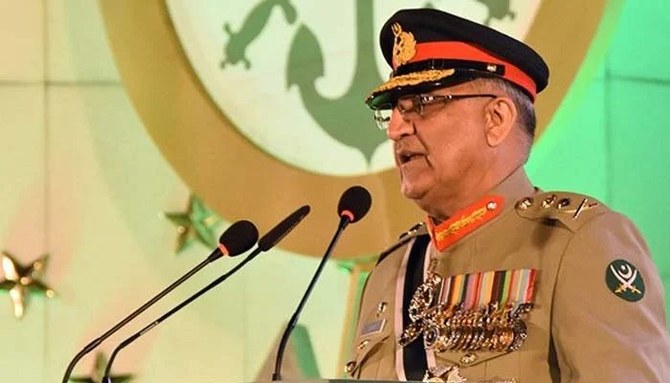
Pakistan’s army chief General Qamar Javed Bajwa addressing at an event organised on the occasion of Defence Day on Sept. 6, 2021. (Photo courtesy: Social Media)
Short Url
Updated 07 September 2021
Follow

Pakistan expects inclusive Afghan government with respect for human, women’s rights — army chief 

  • General Bajwa says Pakistan willing to cooperate with regional and world powers for government formation in Afghanistan 
  • Says situation in Afghanistan both provides opportunity for peace but could be “prelude to more threats and difficulties“

ISLAMABAD: Pakistan’s army chief has said that Islamabad was seeking an inclusive government in Afghanistan which respected human and women’s rights, as the Taliban try to set up a new regime after their lightning takeover of Kabul last month.

General Qamar Javed Bajwa also urged the United Nations and world powers to play a “positive role” for lasting peace in Afghanistan and its new rulers to resolve all issues amicably and lead the Afghan people to peace and prosperity.

The Taliban swept to the Afghan capital on August 15 after making rapid territorial gains across Afghanistan as US-led foreign forces withdrew from the country.

Since then, talks have been underway to form a new government, with Taliban spokesperson Zabihullah Mujahid saying on Monday that the group would make the announcement “in the next few days.”

“We also expect a stable and inclusive government in Afghanistan that [ensure] human rights, including women’s rights,” Bajwa told a gathering at the army’s General Headquarters in the garrison city of Rawalpindi, on the occasion of Defense Day, on Monday.

Islamabad has for long been persuading the Taliban to include representatives from its Pashtun, Hazara, Tajik, Uzbek and other ethnic groups in its new regime.

Ethnic diversity has been at the center of politics and conflicts in Afghanistan, with no single group enjoying a decisive majority in the country of 38 million people.

Bajwa said that Pakistan expects major powers of the region and the world to play a positive role in forming the new Afghan government and that Islamabad was “willing to cooperate” for this.

“While the situation [in Afghanistan] provides an opportunity for peace and stability, it could also be a prelude to more threats and difficulties,” Bajwa warned.

He added that Pakistan’s armed forces were keeping a close watch on developments in Afghanistan after the chaotic withdrawal of foreign troops in the past few weeks.

Earlier on Monday, in a meeting with Italy’s Foreign Minister Luigi Di Maio in Islamabad, Prime Minister Imran Khan said that Pakistan had “suffered enormously” due to the protracted conflict and instability in Afghanistan.

“At this critical juncture, it was vital to stabilize the security situation in Afghanistan, take steps to consolidate peace, and preclude any mass exodus of refugees,” he said.

There are officially 1.4 million Afghan refugees living in Pakistan, with the number of unregistered refugees expected to be much higher. 

“In this context, preventing a humanitarian crisis and stabilizing the economy were the most urgent priorities,” PM Khan said.

Dozens killed as security forces repulse separatist attacks in Pakistan’s Balochistan

Updated 4 sec ago
Follow

Dozens killed as security forces repulse separatist attacks in Pakistan’s Balochistan

  • The attacks unfolded early Saturday when outlawed Baloch Liberation Army members attacked several cities in the restive region
  • Security official says 37 militants, 10 security personnel killed in skirmishes that revived memories of similar attack in 2024

QUETTA/ISLAMABAD: Dozens of militants and security personnel and policemen were killed as Pakistani security forces repulsed coordinated attacks by separatist militants in the southwestern Balochistan province, officials said on Saturday, in the latest incident of violence in the insurgency-hit region.

Separatist militants, affiliated with the Balochistan Liberation Army (BLA), launched “coordinated” attacks in several cities of Balochistan early Saturday, according to a senior police official, who requested anonymity.

The attacks in the provincial capital of Quetta began at around 6am with a powerful explosion, followed by intense gunfire that lasted for two hours along with multiple explosions. Residents of Dalbandin and Nuhski said they heard explosions and gunfire, while similar attacks were launched in Mastung, Gwadar, Pasni and Turbat.

A security official said Pakistani forces had repulsed the attacks and killed 37 “Indian-backed militants,” who were in continuous contact with “their handlers in Afghanistan.” Islamabad has frequently blamed such attacks on India and Afghanistan, an allegation consistently denied by Kabul and New Delhi.

“The terrorists of Fitna Al-Hindustan (Indian-backed Baloch separatist groups) launched coordinated attacks this morning at more than 12 locations, including Quetta, Noshki, Dalbandin, Pasni, and Gwadar,” the security official said.

“In these attacks, 37 terrorists have been eliminated. Throughout the operation, the terrorists were reportedly in continuous contact with their handlers in Afghanistan. Ten security personnel were martyred while few others were injured.”

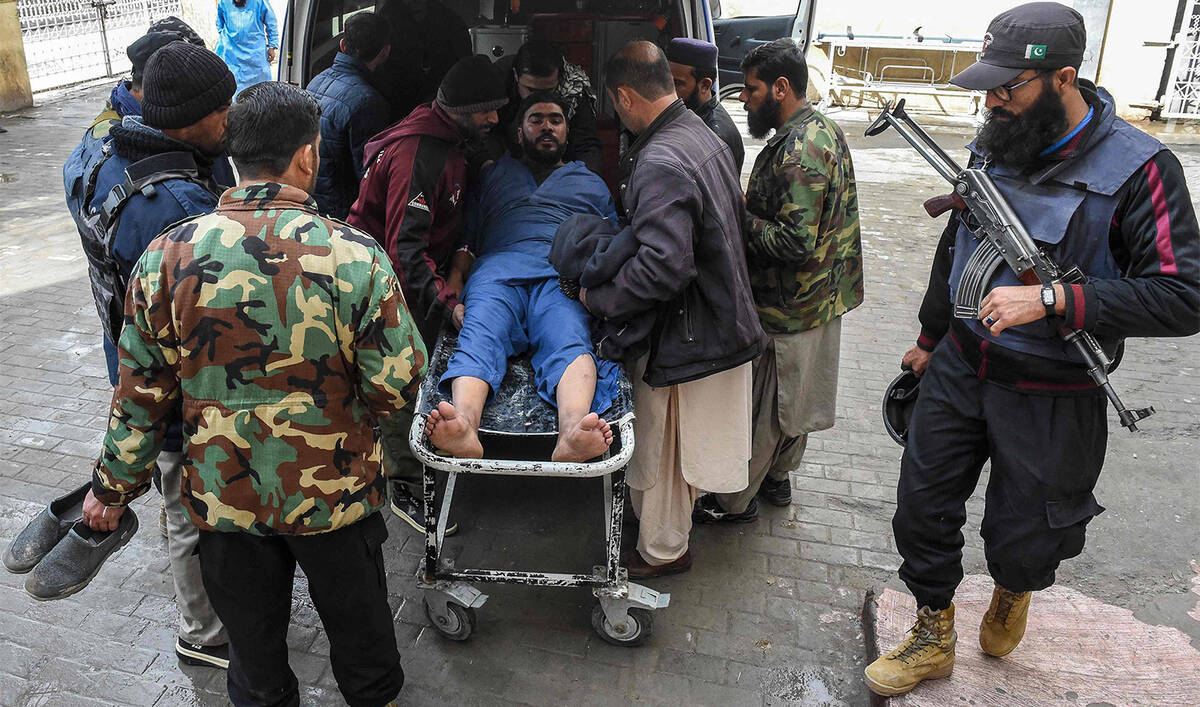
Security personnel shift an injured man at a hospital in Quetta on January 31, 2026, following an attack by Baloch separatists. Ethnic Baloch separatists launched "coordinated" attacks across Pakistan's Balochistan province on January 31, killing at least four policemen, officials said, the latest violence in insurgency-hit southwest region. (AFP)

A senior official at the Civil Hospital in Quetta told Arab News they had received 15 bodies, including nine policemen.

“Eight injured with bullet wounds were brought to the hospital,” said the official, who spoke on condition of anonymity. “Five of them were later shifted to the Combined Military Hospital (CMH) Quetta.”

Balochistan, which borders Iran and Afghanistan, is the site of a decades-long insurgency waged by Baloch separatist groups who often attack security forces and foreigners, and kidnap government officials.

Shahid Rind, the Balochistan chief minister’s aide for media and political affairs, said police and paramilitary Frontier Corps (FC) had foiled the attacks and were chasing the assailants.

“After the killing of more than 70 terrorists at different places in Balochistan in the last two days, terrorists have attempted to attack at a few places in Balochistan, which have been foiled by timely action by the police and FC,” he said on X.

“At present, the pursuit of the fleeing terrorists is underway. More details will be revealed very soon.”

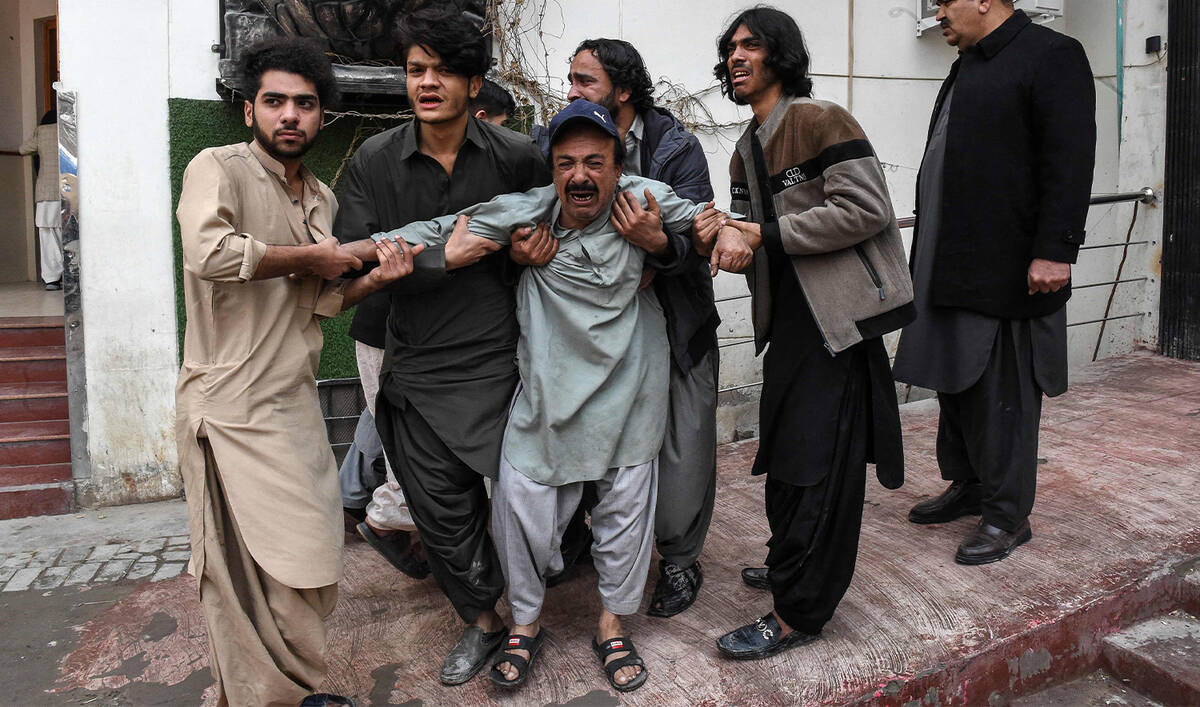
Family members mourn the death of a relative killed in an attack by Baloch separatists, at a hospital in Quetta on January 31, 2026. Ethnic Baloch separatists launched "coordinated" attacks across Pakistan's Balochistan province on January 31, killing at least four policemen, officials said, the latest violence in insurgency-hit southwest region. (AFP)

In a statement issued on Saturday, BLA said the group had launched ‘Operation Herof 2.0,’ which included a series of attacks in multiple cities of Balochistan.

Saturday’s attacks follow coordinated attacks carried out by the group in Aug. 2024 in various districts of Balochistan which killed dozens of people.

The separatists accuse the central government of stealing the region’s resources to fund development elsewhere in the country. The Pakistani government denies the allegations and says it is working for the uplift of local communities in Balochistan.

Pakistan Railways suspended train service from Balochistan to other parts of the country for a day, following Saturday’s attacks.

“Quetta-Peshawar bound Jaffar Express, and Quetta-Chaman passenger trains have been canceled due to the prevailing security situation in Balochistan,” Muhammad Kashif, the railways controller in Quetta division, told Arab News.