JAKARTA, Indonesia: Attackers believed to be West Papua rebels killed four soldiers and wounded two others in an attack on a military post in Indonesia’s troubled easternmost region, authorities said Thursday.
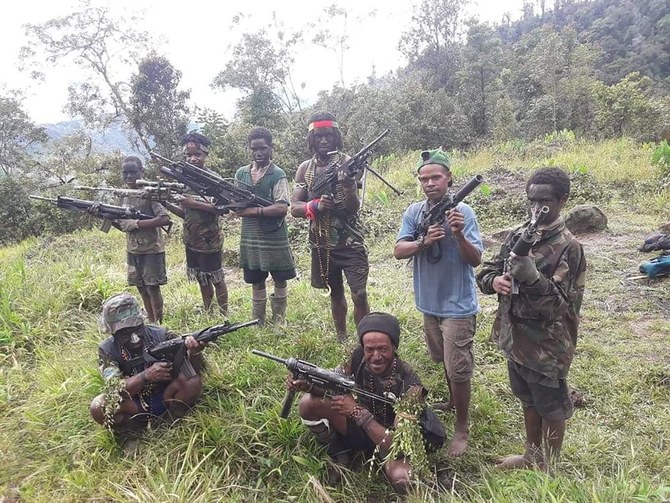
About 50 attackers believed to be members of the West Papua Liberation Army, the military wing of the Free Papua Organization, stormed the post and attacked the six soldiers with arrows, machetes and axes early Wednesday, the West Papua regional military command spokesman Hendra Pesireron said in a statement.
The two badly injured soldiers were evacuated from the post in Kisor village of Maybrat district for treatment, Pesireron said.
More than 30 military and intelligence forces joined together to find the attackers, he said.
A spokesperson for the rebels couldn’t immediately be reached for comment.
Conflicts between indigenous Papuans and Indonesian security forces are common in the impoverished Papua region, a former Dutch colony in the western part of New Guinea that is ethnically and culturally distinct from much of Indonesia.
Papua was incorporated into Indonesia in 1969 after a UN-sponsored ballot that was widely seen as a sham. Since then, a low-level insurgency has simmered in the mineral-rich region, which is divided into two provinces, Papua and West Papua.
Rebel attacks have spiked in the past year, with dozens of rebels, security forces and civilians killed.
Police on Wednesday arrested 4 suspected members of the separatist Liberation Army group and accused them of involvement in the killings of two construction workers in Yahukimo district, where the two bodies were found burned at a bridge project in Aug. 23.
Four other workers were killed days earlier in the same district.


![]()


4 soldiers killed in attack in Indonesia’s Papua region
Short Url
https://arab.news/g465r
4 soldiers killed in attack in Indonesia’s Papua region
- More than 30 military and intelligence forces joined together to find the attackers


Greece backs coast guard after latest deadly migrant crash
ATHENS: The Greek government has firmly backed its coast guard, insisting it is “not a welcoming committee” as questions grow over a collision in the Aegean Sea this week that killed 15 asylum seekers.
The deadly crash occurred late Tuesday when the high-speed boat the migrants were traveling in collided with a coast guard patrol vessel off the Greek island of Chios, not far from the Turkish coast.
Four women were among the dead, while 24 survivors have been admitted to hospital in Chios.
Rights groups and international media have repeatedly accused Greece of illegally forcing would-be asylum seekers back into Turkish waters, backing their claims with video and witness testimonies.
Greek media and opposition parties have questioned the details of Tuesday’s crash, and the country’s ombudsman has called for “an impartial and thorough investigation,” stressing that the priority should always be “the protection of human life.”
On Thursday, the government said it fully backed the maritime agency.
“We have full confidence in the coast guard and we support them,” government spokesman Pavlos Marinakis told reporters.
Conservative Prime Minister Kyriakos Mitsotakis said he was expecting “a full investigation” into the crash.
In the meantime, he argued that preliminary details showed that “essentially, our coast guard ship was rammed by a much smaller boat.”
“This is a situation that happens quite frequently in the Aegean,” he told Foreign Policy, arguing that smugglers were endangering migrants’ lives.
Had Greek authorities not been present, more people would probably have died, he alleged.
The coast guard was “not a welcoming committee” for people seeking asylum in the European Union, he told the magazine.
- Questions -
Following the crash the coast guard said the pilot of the migrant boat had ignored signals and “made a U-turn maneuver” before colliding with the Greek patrol boat.
“Under the force of the impact, the speedboat capsized and then sank, throwing everyone on board into the sea,” the agency said.
So far, none of the hospitalized survivors have testified directly.
One of them, a 31-year-old Moroccan man, was to be questioned by police as a possible smuggler.
Several Greek media outlets, including To Vima and private TV channel Mega, have reported the victims died of severe head injuries.
Some news organizations have questioned why the patrol boat’s thermal camera was not switched on.
“The captain of the patrol boat judged it unnecessary because the migrants’ speedboat had already been detected by a camera on shore and a spotlight,” government spokesman Marinakis said.
The port police released photos of the coast guard patrol vessel showing minor damage, but no images of the asylum seekers’ boat.
- ‘Obvious distress’ -
Abusive pushbacks have become the “norm” in Greece, medical charity Doctors Without Borders (MSF) said in 2023.
The crash off Chios was “not an isolated incident,” the Refugee Support Aegean charity said this week.
“Based on the available information and the initial announcement of the Hellenic Coast Guard, it appears that, instead of a search and rescue operation, an interception operation was deployed from the outset,” RSA said in a statement.
“This occurred while the refugees’ boat was in obvious distress, was overcrowded and was located at a short distance from the Greek coast,” the statement added.
It is far from the first time that international organizations have pointed the finger at Greece over how it treats migrant boats.
Eighteen of its coast guard members are being prosecuted for involuntary manslaughter due to negligence in the sinking of the trawler Adriana in June 2023.
The United Nations said around 750 people died in that tragedy — one of the worst migrant shipwrecks in the Mediterranean in the past decade.
In 2022, the European Court of Human Rights condemned Greece for its responsibility in the capsizing of a migrant boat off the islet of Farmakonisi in the Aegean Sea.
Eleven people died, including eight children.
The deadly crash occurred late Tuesday when the high-speed boat the migrants were traveling in collided with a coast guard patrol vessel off the Greek island of Chios, not far from the Turkish coast.
Four women were among the dead, while 24 survivors have been admitted to hospital in Chios.
Rights groups and international media have repeatedly accused Greece of illegally forcing would-be asylum seekers back into Turkish waters, backing their claims with video and witness testimonies.
Greek media and opposition parties have questioned the details of Tuesday’s crash, and the country’s ombudsman has called for “an impartial and thorough investigation,” stressing that the priority should always be “the protection of human life.”
On Thursday, the government said it fully backed the maritime agency.
“We have full confidence in the coast guard and we support them,” government spokesman Pavlos Marinakis told reporters.
Conservative Prime Minister Kyriakos Mitsotakis said he was expecting “a full investigation” into the crash.
In the meantime, he argued that preliminary details showed that “essentially, our coast guard ship was rammed by a much smaller boat.”
“This is a situation that happens quite frequently in the Aegean,” he told Foreign Policy, arguing that smugglers were endangering migrants’ lives.
Had Greek authorities not been present, more people would probably have died, he alleged.
The coast guard was “not a welcoming committee” for people seeking asylum in the European Union, he told the magazine.
- Questions -
Following the crash the coast guard said the pilot of the migrant boat had ignored signals and “made a U-turn maneuver” before colliding with the Greek patrol boat.
“Under the force of the impact, the speedboat capsized and then sank, throwing everyone on board into the sea,” the agency said.
So far, none of the hospitalized survivors have testified directly.
One of them, a 31-year-old Moroccan man, was to be questioned by police as a possible smuggler.
Several Greek media outlets, including To Vima and private TV channel Mega, have reported the victims died of severe head injuries.
Some news organizations have questioned why the patrol boat’s thermal camera was not switched on.
“The captain of the patrol boat judged it unnecessary because the migrants’ speedboat had already been detected by a camera on shore and a spotlight,” government spokesman Marinakis said.
The port police released photos of the coast guard patrol vessel showing minor damage, but no images of the asylum seekers’ boat.
- ‘Obvious distress’ -
Abusive pushbacks have become the “norm” in Greece, medical charity Doctors Without Borders (MSF) said in 2023.
The crash off Chios was “not an isolated incident,” the Refugee Support Aegean charity said this week.
“Based on the available information and the initial announcement of the Hellenic Coast Guard, it appears that, instead of a search and rescue operation, an interception operation was deployed from the outset,” RSA said in a statement.
“This occurred while the refugees’ boat was in obvious distress, was overcrowded and was located at a short distance from the Greek coast,” the statement added.
It is far from the first time that international organizations have pointed the finger at Greece over how it treats migrant boats.
Eighteen of its coast guard members are being prosecuted for involuntary manslaughter due to negligence in the sinking of the trawler Adriana in June 2023.
The United Nations said around 750 people died in that tragedy — one of the worst migrant shipwrecks in the Mediterranean in the past decade.
In 2022, the European Court of Human Rights condemned Greece for its responsibility in the capsizing of a migrant boat off the islet of Farmakonisi in the Aegean Sea.
Eleven people died, including eight children.
Latest updates


© 2026 SAUDI RESEARCH & PUBLISHING COMPANY, All Rights Reserved And subject to Terms of Use Agreement.