

Pakistan condemns ‘snatching’ of body of Kashmiri leader Ali Geelani from his family

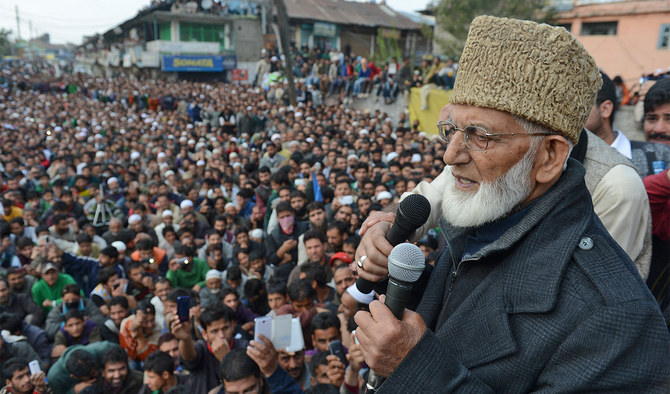
Kashmiri separatist leader, Syed Ali Shah Geelani addresses a public rally in his home town of Sopore, about 48 kms northwest of the capital Srinagar on November 1, 2013. (AFP/File)
Short Url
Updated 02 September 2021
Follow

Pakistan condemns ‘snatching’ of body of Kashmiri leader Ali Geelani from his family

  • Geelani had wanted to be buried at Martyrs Cemetery in Srinagar but authorities rejected request, police source says
  • Residents said authorities acted out of fear of mass mourning turning into unrest, Pakistan to observe day of mourning

ISLAMABAD: Pakistan on Thursday condemned what it called the “snatching” of the remains of Kashmiri leader and former chief of the All Parties Hurriyat Conference (APHC), Syed Ali Geelani, from his family by authorities in Indian-administered Kashmir.
Geelani, who died on Wednesday aged 92, had been a thorn in India’s side since the early 1960s when he began campaigning for the merger of the disputed Himalayan region of Kashmir — administered by India — with Pakistan. The veteran politician was jailed for nearly 10 years after 1962 and often restricted to his home after that.
He was a staunch critic of the sporadic but failed attempts at dialogue between nuclear-armed India and Pakistan who have fought two of their three wars since independence over Kashmir.
According to AFP, Geelani was buried at 4:30 am Thursday at a cemetery near his home in the main city of Srinagar. Only a small number of his relatives were present, including two of his sons, the police source added.
Geelani had wanted to be buried at the Martyrs Cemetery in Srinagar but authorities rejected that request, the police source told AFP.
“Pakistan strongly condemns the barbaric act of snatching of the mortal remains of the iconic Kashmiri leader Syed Ali Shah Geelani from his family,” the foreign office said in a statement, adding that Indian security forces raided the leader’s residence in Srinagar and “snatched” Geelani’s body from his family as it prepared for his final rites.
“They were reportedly told that India would not allow Syed Geelani’s burial at the place of his choosing,” the foreign office said. “Government of India is so afraid of Syed Geelani and what he stood for that they have now resorted to this inhuman act even after his passing away.”
The foreign office called on the international community to take note of this “unprecedented and egregious situation” and hold India to account for what it called a breach of international human rights and humanitarian laws.
Residents in Srinagar said authorities acted out of fear of mass mourning turning into unrest.
“Troops are everywhere, there are barbed wire blockades on every main road,” one resident told AFP.
Meanwhile, Pakistani Prime Minister Imran Khan said Thursday would be observed as a day of mourning and the Pakistani flag would fly at half-mast.


Indian authorities imposed a security clampdown in Indian-administered Kashmir late Wednesday, with troops putting up barbed wire and barricades on roads leading to Geelani’s house in the main city of Srinagar after the family announced the death, AP reported. Hundreds of security forces were immediately deployed and media reports said a curfew would be imposed and Internet services cut.

“If Indian govt thinks by forcing his family to bury him in dead of night will prevent Kashmiris from properly mourning their icon they are mistaken,” Pakistani human rights minister Shireen Mazari said.


Pakistani foreign minister Shah Mahmood Qureshi applauded Geelani for fighting for the rights of Kashmiris “till the very end.”

“May he rest in peace and may his dream of freedom come true,” he tweeted. 


“The nation pays rich tribute to his life-long struggle for justice and freedom,” the Pakistani foreign office said on Twitter, describing Geelani as a “true voice and hero” of the Kashmiris struggle for self-determination.


“May his soul Rest in Peace and may he continue to be an inspiration for those carrying his mission forward,” the statement said. 

Opposition leader in the National Assembly, Shehbaz Sharif, said Geelani personified the Kashmiri struggle for freedom:

“Torture and long periods of incarceration could not sway him from his mission,” he said in a tweet. “Geelani Sahib’s story is one of sacrifice, determination & selflessness. May his soul rest in peace!” 


Opposition Pakistan Peoples Party Chairman Bilawal Bhutto-Zardari called Geelani “another name” for the independence movement in Kashmir, his party said in a tweet. 


Sharing a video message on Twitter, Mushaal Hussein Mullick, the wife of Kashmiri leader Yasin Malik, said the Kashmiri Hurriyat leader would always be remembered for his “bravery and truthfulness.” 


Former Pakistan cricket star Shahid Afridi also expressed his condolences:

“May we carry on their courage and legacy,” he said in his tweet. “May Allah grant Syed Ali Geelani the highest decree in Heaven. Ameen.” 


Islamabad dismisses claims about paying up to 8 percent interest on foreign loans as ‘misleading’

Updated 22 February 2026
Follow

Islamabad dismisses claims about paying up to 8 percent interest on foreign loans as ‘misleading’

  • Pakistan has long relied on external loans to help bridge persistent gaps in public finances and foreign exchange reserves
  • Pakistan’s total external debt, liabilities stand at $138 billion at an overall average cost of around 4 percent, ministry says

KARACHI: Pakistan’s finance ministry on Sunday dismissed as “misleading” claims that the country is paying up to 8 percent interest on external loans, saying the overall average cost of external public debt is approximately 4 percent.

Pakistan has long relied on external loans to help bridge persistent gaps in public finances and foreign exchange reserves, driven largely by a narrow tax base, chronic trade deficits, rising debt-servicing costs and repeated balance-of-payments pressures.

Over the decades, successive governments have turned to multilateral and bilateral lenders, including the International Monetary Fund, the World Bank and the Asian Development Bank, to support budgetary needs and shore up foreign exchange reserves.

The finance ministry on Sunday issued a clarification in response to a “recent press commentary” regarding the country’s external debt position and associated interest payments, and said the figures required contextual explanation to ensure accurate understanding of Pakistan’s external debt profile.

“Pakistan’s total external debt and liabilities currently stand at $138 billion. This figure, however, encompasses a broad range of obligations, including public and publicly guaranteed debt, debt of Public Sector Enterprises (both guaranteed and non-guaranteed), bank borrowings, private-sector external debt, and intercompany liabilities to direct investors. It is therefore important to distinguish this aggregate figure from External Public (Government) Debt, which amounts to approximately $92 billion,” it said.

“Of the total External Public Debt, nearly 75 percent comprises concessional and long-term financing obtained from multilateral institutions (excluding the IMF) and bilateral development partners. Only about 7 percent of this debt consists of commercial loans, while another 7 percent relates to long-term Eurobonds. In light of this composition, the claim that Pakistan is paying interest on external loans ‘up to 8 percent’ is misleading.

The overall average cost of External Public Debt is approximately 4 percent, reflecting the predominantly concessional nature of the borrowing portfolio.”

With respect to interest payments, public external debt interest outflows increased from $1.99 billion in Fiscal Year (FY) 2022 to $3.59 billion in FY2025, representing an increase of 80.4 percent, not 84 percent as reported. In absolute terms, interest payments rose by $1.60 billion over this period, not $1.67 billion, it said.

According to the State Bank of Pakistan’s records, Pakistan’s total debt servicing payments to specific creditors during the period under reference were as follows: the IMF received $1.50 billion, of which $580 million constituted interest; Naya Pakistan Certificates payments totaled $1.56 billion, including $94 million in interest; the Asian Development Bank received $1.54 billion, including $615 million in interest; the World Bank received $1.25 billion, including $419 million in interest; and external commercial loans amounted to nearly $3 billion, of which $327 million represented interest payments.

“While interest payments have increased in absolute terms, this rise cannot be attributed solely to an expansion in the debt stock,” the ministry said. “Although the overall debt stock has increased slightly since FY2022, the additional inflows have primarily originated from concessional multilateral sources and the IMF’s Extended Fund Facility (EFF) under the ongoing IMF-supported program.”

Pakistan secured a $7 billion IMF bailout in Sept. 2024 as part of Prime Minister Shehbaz Sharif’s efforts to stabilize the South Asian economy that narrowly averted a default in 2023. The government has since been making efforts to boost trade and bring in foreign investment to consolidate recovery.

“It is also important to note that the increase in interest payments reflects prevailing global interest rate dynamics. In response to the inflation surge of 2021–22, the US Federal Reserve raised the federal funds rate from 0.75-1.00 percent in May 2022 to 5.25–5.50 percent by July 2023. Although rates have since moderated to around 3.75 percent, they remain significantly higher than 2022 levels,” the finance ministry said.

“The government remains committed to prudent debt management, transparency, and the continued strengthening of Pakistan’s macroeconomic stability,” it added.