

Faction of Pakistani ethnic rights group, Pashtun Tahafuz Movement, launches political party

Mohsin Dawar (c), Pashtun Tahafuz Movement (PTM) leader and a lawmaker from North Waziristan, addresses a press conference during the launch event of the National Democratic Movement (NDM) political party in Peshawar on Sep 1, 2021. (AN photo)
Short Url
Updated 02 September 2021
Follow

Faction of Pakistani ethnic rights group, Pashtun Tahafuz Movement, launches political party

  • Founding member of PTM, Mohsin Dawar, becomes chairman of National Democratic Movement party
  • PTM founder Manzoor Pashteen says he wants the movement to remain apolitical

PESHAWAR: A faction of the Pashtun Tahafuz Movement (PTM), a Pakistani ethnic rights group, on Wednesday launched a political party, the National Democratic Movement (NDM), formally entering Pakistan’s electoral politics.
The PTM emerged after the January 2018 killing by police of Pashtun youth Naqibullah Mehsud in Karachi. Since then, the civil rights group has complained of several thousand such killings having been carried out after Pakistan joined the US-led war on terror and launched major military operations targeting Pakistani Taliban strongholds in the Pashtun majority tribal areas bordering Afghanistan. The group has been a thorn in the side of the military with frequent sit-ins and rallies denouncing alleged abuses. The military denies its accusations.
At a launch ceremony for the NDM in Peshawar, parliamentarian Mohsin Dawar, who is among the founders of the PTM, was sworn in as the chairman of the party. The movement’s founder Manzoor Pashteen has preferred to keep the PTM out of parliamentary politics, but other senior members of the group, including Afrasiab Khattak, Bushra Gohar, and Jamila Gilani, have supported Dawar to launch the party.
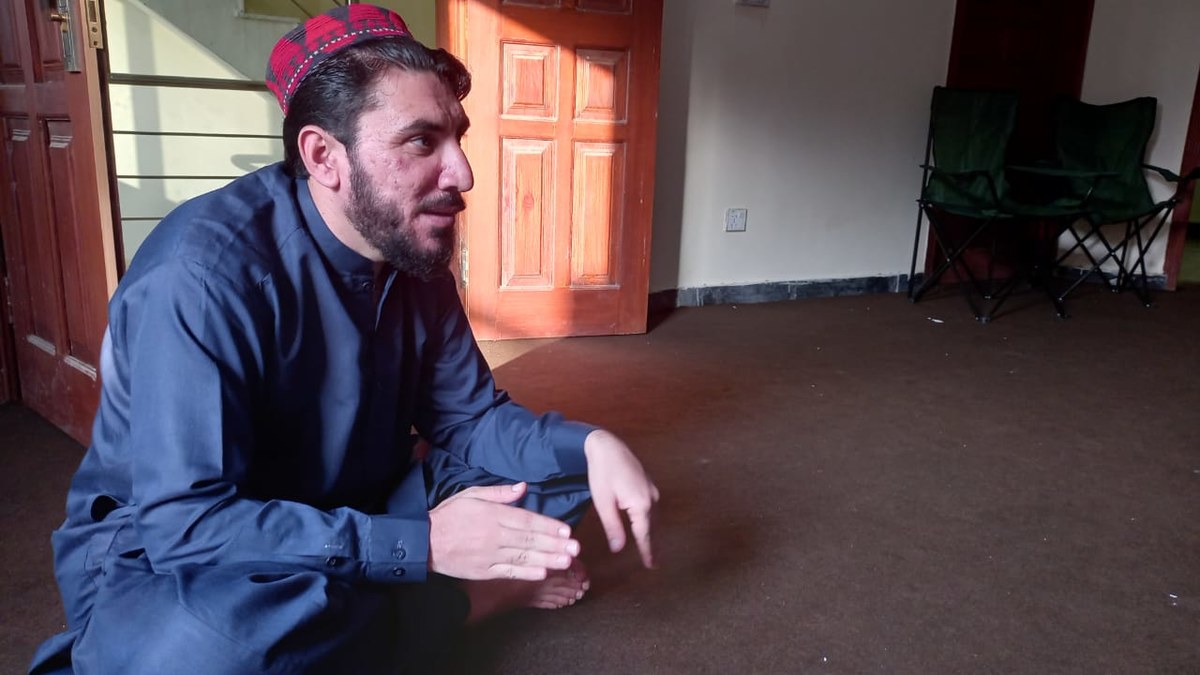


Manzoor Pashteen, the founder of the Pashtun Tahafuz Movement (PTM), talks to Arab News in Peshawar, Pakistan on August 31, 2020. (AN photo)

NDM had no “serious differences” with those members of the PTM who had decided not to enter formal politics, Dawar told Arab News on Wednesday.
“PTM is an apolitical force and I’ll be a supporter of its cause,” Dawar said, “but I don’t think PTM will support our party (NDM).”
Pashteen said PTM would not support or oppose the new party.
“We’ve been at loggerheads for quite some time over the future role of PTM as a force,” he said. “I’m of the firm view that the movement should stay apolitical, which can be more effective.”
Adnan Bhittani, a security analyst in Peshawar, said the political party could end up strengthening the PTM and create more political awareness in Pakistan’s Pashtun majority northwest.
“The new political party would usher an era of political awareness and multiply political activities in the region,” he said. “NDM will prove a strength for Pashteen.”
Bhittani added that the NDM would also present more electoral choices to voters in the northwestern region: “It is a good development and offering people, specifically those of tribal areas an alternate platform to exercise their democratic rights. Previously, only religious parties such as Jamiat Ulama-e-Islam-Fazl (JUI-F) were a single political force dominating there.”


Pakistan urges concessional finance for developing nations to boost clean energy security

Updated 6 sec ago
Follow

Pakistan urges concessional finance for developing nations to boost clean energy security

  • Pakistan has emerged as one of world’s fastest growing solar markets, with 12GWs of off-grid and 6GWs of net-metered capacity in 2025
  • PM’s aide says Islamabad remains committed to Paris Agreement, looks for continued support in building a resilient and low-carbon future

ISLAMABAD: Pakistan has urged international partners to scale up concessional financing for developing countries, the country’s Press Information Department (PID) said on Sunday, citing an aide to Prime Minister Shehbaz Sharif.

The call was made by Sharif’s coordinator on climate change, Romina Khurshid Alam, while delivering Pakistan’s national statement at the 16th International Renewable Energy Agency (IRENA) Assembly in Abu Dhabi.

Pakistan has emerged as one of the world’s fastest growing solar markets, with 12 gigawatts (GWs) of off-grid and over 6GWs of net-metered solar capacity by the end of 2025. Last fiscal year, renewables accounted for a historic 53 percent of total electricity generation, according to Alam.

The prime minister’s aide stressed that affordable funding for developing nations is critical to accelerating their transition to clean energy and strengthening energy security amid rising climate and economic challenges.

“Alam reaffirmed Pakistan’s target of achieving 60 percent renewables in the power mix by 2030,” the PID said in a statement.

“In her call to action, she urged IRENA and Member States to increase concessional finance for developing nations, treat technologies such as energy storage and green hydrogen as global public goods, and strengthen regional cooperation for shared energy security.”

IRENA is a global intergovernmental agency for energy transformation that serves as the principal platform for international cooperation, supports countries in their energy transition, and provides state of the art data and analyzes on technology, innovation, policy, finance and investment. Its membership comprises 170 countries and the European Union (EU).

The 16th session of the IRENA Assembly is taking place on Jan. 10-12 in Abu Dhabi and focuses on the theme of “Powering Humanity: Renewable Energy for Shared Prosperity.” The session has gathered global leaders and energy decision-makers to discuss strategies and underline necessary actions for the acceleration of renewable energy across countries, regions, and the world, driving economic inclusion, equity, and human well-being.

Alam shared that Pakistan is taking action against energy poverty through initiatives like the Punjab Solar Panel Scheme 2026, which provides free or subsidized systems to low-income households.

She highlighted how distributed solar kits have restored power and livelihoods in flood-affected communities and offer a replicable model for climate-resilient recovery.

“Pakistan remains fully committed to the Paris Agreement and looks to IRENA for continued technical and financial support in building a resilient, inclusive, and low-carbon future,” Alam said.

Adopted in 2015 to combat climate change, the Paris Agreement binds nations to hold “the increase in the global average temperature to well below 2°C above pre-industrial levels” and pursue efforts “to limit the temperature increase to 1.5°C above pre-industrial levels.”