


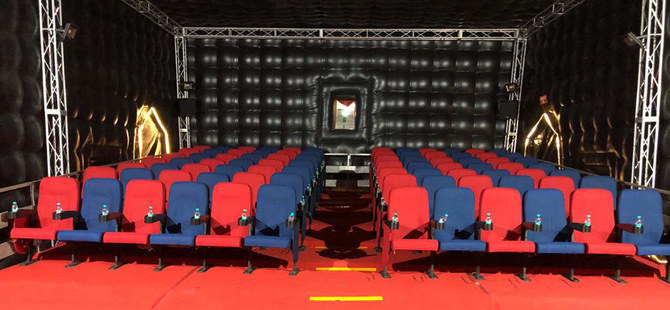

NEW DELHI: An inflatable movie hall in India’s remote Himalayan region of Ladakh is proving to be the height of entertainment for its bored residents by screening the latest films and providing much-needed respite in the “world’s highest altitude cinema theater.”
At 11,562 feet, the mobile facility can seat 120 people in the temperature-controlled theater in Leh, the capital of Ladakh, which borders Chinese-controlled Tibet and lacks access to mainstream cinemas.
PictureTime Digiplex, the private company which installed the theater, said the initiative was an “attempt to bring cinema watching experience to remote areas” in the region.
“It is the world’s first mobile digital movie theater, basically built for new-release films,” Sushil Chaudhary, organizer of the theater and owner of PictureTime Digiplex, told Arab News.
The first film to be screened at the theater was Bollywood’s “Bell Bottom”, starring Akshay Kumar, on Aug. 22, followed by “Sekool,” a Ladakh-based documentary depicting the life of the Changpa nomads in the area.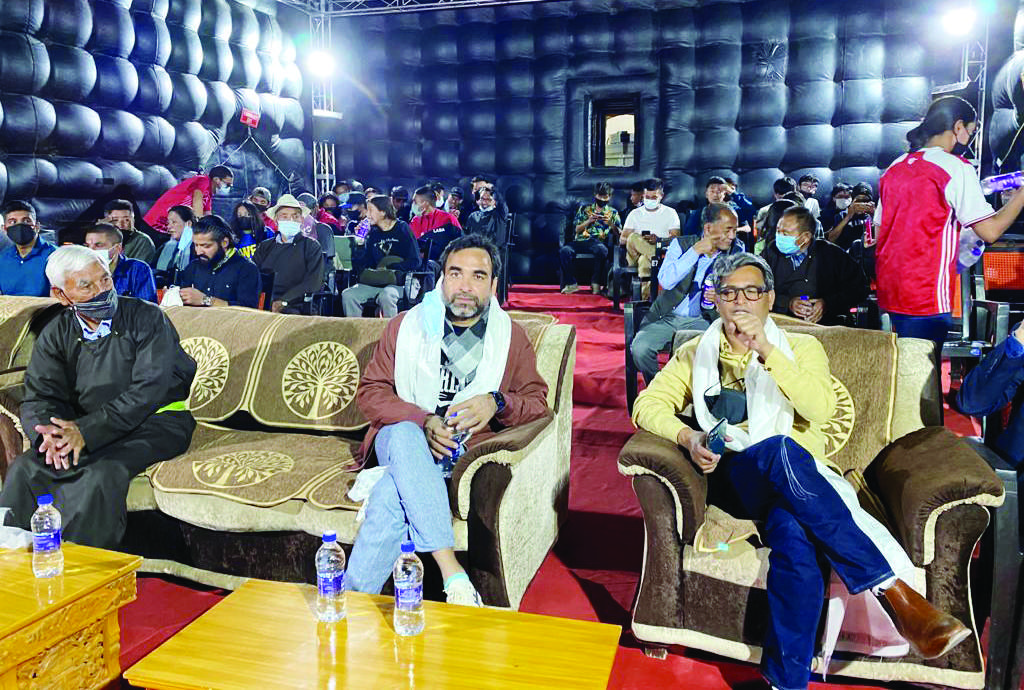
Chaudhary, who initiated the project in 2015 and later patented the idea for an inflatable theater, said the first mobile theater was installed during the 2016 Goa Film Festival.
HIGHLIGHTS
• PictureTime Digiplex, the private company which installed the theater, said the initiative is an ‘attempt to bring cinema watching experience to remote areas’ in the region.
• Ladakh, a federally administered Union Territory of India, is at the center of a territorial dispute between India and China since last year.
It costs $65,000 to set up one roving theater, which Chaudhary funds through his company.
“Right now, we are setting up these theaters in the extremely remote areas of India. We have set up five units in Arunachal Pradesh (a northeastern state bordering China) and plan to set up three more units in Ladakh,” Chaudhary said.
The idea, he explained, is “not just to take popular Bollywood movies” to remote areas but to screen “good, low budget movies and documentaries” which are not released across India, as well.
India, the world’s second-most populous nation with 1.3 billion people, has a massive film industry that turns out about 1,000 films a year, more than a fifth of which are in the dominant Hindi language.
However, since the start of the pandemic last year and the subsequent closure of cinema halls, filmmakers have been making the transition to screen films on digital platforms such as Netflix and Amazon Prime to feed movie-hungry audiences.
Chaudhary says he wants to provide an all-inclusive platform with mobile movie theaters.
“We want to become an even platform for all filmmakers,” he said, adding that the COVID-19 pandemic upended their plans for a commercial launch.
While each theater can seat 120 people, only 80 are allowed entry at the moment as part of social distancing measures and COVID-19 health protocols.
“Next, we plan to set up 100 screens in 100 days, and we will display new movies every day,” Chaudhary said.
“We identified three locations in each district, and the theater will move to the three locations every tenth day,” he added.
For this purpose, the mobile digital theater is mounted on a truck and driven to the next location, where it is dismantled and set up for its next set of viewers. The entire process takes between four to five hours.
The primary source of entertainment for the residents of Ladakh is watching TV at home or in restaurants.
Since the theatre was installed in Leh, it has been at full capacity. It’s affordable too — with tickets costing 70 rupees, about $1, it is at least five times cheaper to watch films at the mobile theatres than at cinemas in cities, and locals such as Tsering Angmo are very pleased. “We don’t have any source of entertainment in Ladakh. To have an experience of multiplex and Dolby sound high up in the mountains is a wonderful experience,” he said.
“Whenever I go to Delhi, I go to the theatre to watch Bollywood movies. Now we have that experience in Ladakh itself. It’s amazing,” he added.
Leh shopkeeper Tsulten Dorjay agrees and said he was excited about “the opportunity to watch local documentary films too.”
Ladakh, a federally administered Union Territory of India, is at the center of a territorial dispute between India and China since last year.
In June, Indian and Chinese troops came to blows in the Galwan Valley of the region, resulting in the deaths of at least 20 Indian soldiers and a few Chinese troops.
Both countries maintain a high mobilization of the troops in the disputed territory.


