Algeria to divert Spain gas supplies away from Morocco pipeline

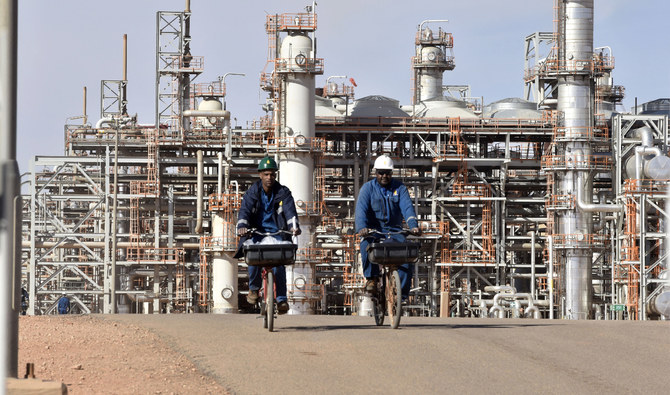
In Amenas gas plant, 1,300 kilometres southeast of Algiers. (AFP/File)
Short Url
Updated 28 August 2021
Follow

Algeria to divert Spain gas supplies away from Morocco pipeline

  • Algeria exports natural gas to Spain via both the Medgaz pipeline and the higher-capacity GME pipeline which runs overland through Morocco

ALGIERS: Algeria has said it is ready to divert all its Spain-bound natural gas exports via an undersea pipeline that bypasses Morocco, state media said, days after Algiers cut ties with its North African rival.
In a meeting with Spanish Ambassador Fernando Moran, Energy Minister Mohamed Arkab stressed “Algeria’s full commitment to cover all of Spain’s natural gas supplies through the Medgaz” pipeline, said a statement quoted by the official APS news agency.
Algeria exports natural gas to Spain via both the Medgaz pipeline and the higher-capacity GME pipeline which runs overland through Morocco.
But on Tuesday Algiers abruptly cut diplomatic relations with its western neighbor over alleged “hostile actions,” accusations Rabat has dismissed as “absurd.”
The rift came just over two months before the GME pipeline, currently owned by Spanish gas giant Naturgy, passes into Moroccan ownership on Nov. 1.
Negotiations over Algeria’s continued access to the pipeline had already been complicated by growing strains in ties between Algiers and Rabat.
Last Saturday, Morocco had said it wanted to keep open the GME pipeline, which carries about half of Algeria’s gas exports to Spain.
But ties have collapsed, particularly after Algeria accused Morocco of complicity in deadly forest fires that killed at least 90 people.
Morocco’s normalization of ties with Israel last year as a quid pro quo for US recognition of Moroccan sovereignty over the Western Sahara also angered Algiers.
The Medgaz pipeline’s capacity of some 8 billion cubic meters per year to Spain is set to be expanded by 25 percent. But this higher capacity alone will not be able to handle what Algeria has historically exported to Spain, according to the Middle East Economic Survey.


Iran FM criticizes Israel for ‘doctrine of domination’

Updated 58 min 7 sec ago
Follow

Iran FM criticizes Israel for ‘doctrine of domination’

  • Doctrine allows Israel to expand its military arsenal while pressuring other countries in the region to disarm
  • His remarks came a day after renewed nuclear talks with Washington in Oman

DOHA: Iran’s Foreign Minister Abbas Araghchi on Saturday criticized what he said was a “doctrine of domination” that allows Israel to expand its military arsenal while pressuring other countries in the region to disarm.
His remarks came a day after renewed nuclear talks with Washington, with previous talks collapsing when Israel launched an unprecedented bombing campaign against Iran last June that triggered a 12-day war.
Araghchi was speaking at the Al Jazeera Forum conference in Qatar but made no reference to Friday’s talks with the United States.
“Israel’s expansionist project requires that neighboring countries be weakened: militarily, technologically, economically and socially,” Araghchi said.
“Under this project Israel is free to expand its military arsenal without limits ... Yet other countries are demanded to disarm. Others are pressured to reduce defensive capacity. Others are punished for scientific progress,” he added.
“This is a doctrine of domination.”
During the 12-day war Israel targeted senior Iranian military officials, nuclear scientists and sites as well as residential areas, with the US later launching its own attacks on key nuclear facilities.
Iran responded at the time with drone and missile attacks on Israel, as well as by targeting the largest US military base in the Middle East, located in Qatar.
On Friday, Araghchi led the Iranian delegation in indirect nuclear talks with US Middle East envoy Steve Witkoff in Muscat.
The top Iranian diplomat later described the atmosphere as having been “very positive,” while US President Donald Trump said the talks were “very good,” with both sides agreeing to proceed with further negotiations.
The talks followed threats from Washington and its recent deployment of an aircraft carrier group to the region following Iran’s deadly crackdown on anti-government protests last month.
The United States has sought to address Iran’s ballistic missile program and its support for militant groups in the region — issues which Israel has pushed to include in the talks, according to media reports.
Tehran has repeatedly rejected expanding the scope of negotiations beyond the nuclear issue.