

Intelligence agencies, including ISI, investigating assault of Lahore TikToker — minister

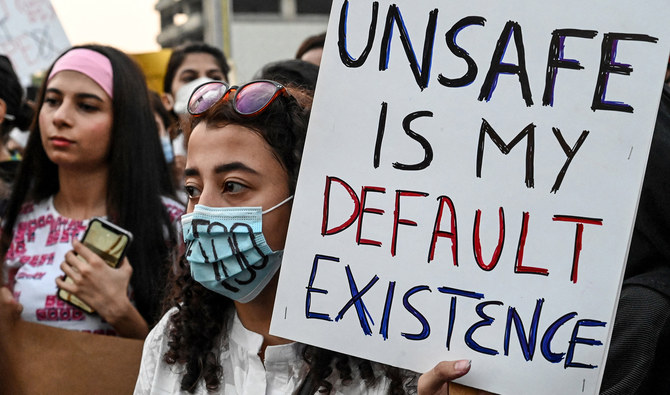
Human rights activists hold placards as they march during a protest against a gang rape of a woman, in Lahore on September 12, 2020. (AFP/File)
Short Url
Updated 21 August 2021
Follow

Intelligence agencies, including ISI, investigating assault of Lahore TikToker — minister

  • Woman says was filming video with friends on August 14 when 400 people attacked the group near Minar-e-Pakistan monument
  • Punjab Information Minister Chohan says investigation underway using geofencing, NADRA data and joint work by military and civilian authorities

LAHORE: Punjab Information Minister Fayazul Hassan Chohan said on Friday all civilian and military intelligence agencies, including Pakistan’s main spy agency, the ISI, were investigating the August 14 public assault of a woman near the Minar-e-Pakistan monument in the central city of Lahore.

The incident, for which 24 people have been arrested so far, sent shock waves across the country after videos of a mob attacking and sexually assaulting the woman, Ayesha Akram, were shared online this week.

“The very scientific way in which we are identifying and carrying out investigations, all civilian and military [intelligence] agencies are involved in it,” Chohan told Arab News in a phone interview. “Both agencies have worked in a positive, effective and scientific way to carry out the investigation, which is why all these people are being arrested and more will be arrested in the future.”

Chohan explained that several of the arrested suspects, as well as others that authorities were still hunting, had been identified using data from the National Database and Registration Authority (NADRA), and through geofencing, in which location data on the internet is trawled to identify people who were in an area when a crime was committed.

He said the ISI, police, NADRA, and the Punjab Forensics Science Agency were all involved in the investigation, adding that the Punjab government had “shown results.”

“20-25 culprits have been arrested, the police officers who committed negligence, DIG [Deputy Inspector General] Operations has been changed, SSP [Senior Superintendent of Police] Operations has been suspended, DSP [Deputy Superintendent of Police],” Chohan said as he listed several officials who had been removed over negligence.

Human rights minister Shireen Mazari said more arrests were expected today, Friday.


The Pakistani military’s media wing declined to comment on Chohan’s statement that military spy agencies were involved in the investigation. Akram, the survivor of the attack, promised Arab News an interview but then declined, citing the “sensitivity” of the case.

In the police report for the incident, which was reported to Lahore’s Lari Adda police station, Akram said she was assaulted, manhandled and robbed by hundreds of men in broad daylight. She said the mob picked her up and tossed her around for hours, and calls to the police emergency helpline at 630pm were not answered until 930pm.

“I was stripped and my clothes were torn off me,” she said in the police report, adding that gold ornaments, cash and her mobile phone were also stolen. “There was no body part of me left without bruises.”

The Greater Iqbal Park is home to the Minar-e-Pakistan monument, built to commemorate the first official call for a separate and independent homeland for the Muslims of British India by the All-India Muslim League Party in 1940. Pakistan became an independent country seven years later, on August 14. Each year, thousands of people flock to the monument to mark independence day.

When questioned about security arrangements at the park on a day as busy as August 14, SSP Investigations Mansoor Awan said high ranking officials had already been suspended for negligence.

“More details will come out tomorrow (Saturday) once the new officials take charge,” he said. “We will find out about the lack in contingency plan and why they [victims] were not responded to on time despite calls.”

Nighat Dad, a lawyer and rights activist, said the onus was now on the state to protect women and restore their confidence.

“The power men hold in all spaces both private and public speaks to a failure of society at every level. It is becoming unsustainable for women and gender minorities to live in this society,” Dad said. “If this continues, and the state fails to intervene, women will lose confidence in any institutions and system, they will stop coming forward. The onus is on the state to respond to this crisis with leadership and vision.”


Fear, shock grip southwestern Pakistan day after deadly separatist attacks

Updated 5 sec ago
Follow

Fear, shock grip southwestern Pakistan day after deadly separatist attacks

  • Separatist militants carrying assault rifles stormed banks, jails, police stations and military installations, killing 31 civilians and 17 security personnel
  • Mobile Internet, train services remained suspended across Pakistan’s Balochistan on Sunday, with major roads and businesses deserted after attacks

QUETTA: Residents in the southwestern Pakistani city of Quetta were in shock and feared more violence, they said on Sunday, following deadly separatist attacks that killed nearly 200 people, including militants, security personnel and civilians, in the Balochistan province.

Authorities in Balochistan are battling one of the deadliest flare-ups in years as ethnic Baloch separatists step up assaults on security forces, civilians and infrastructure in the resource-rich province bordering Iran and Afghanistan.

Separatist militants carrying assault rifles stormed banks, jails, police stations and military installations in a string of coordinated attacks in several cities of Balochistan, including the provincial capital of Quetta, early Saturday.

Officials said the attacks killed 31 civilians and 17 security personnel, while 145 militants were killed in skirmishes and follow-up operations. The assaults were claimed by the Baloch Liberation Army (BLA) separatist group.

“The fear and anger are palpable in the city’s atmosphere following yesterday’s attacks at various locations in Quetta and other cities of Balochistan,” Zain Ali, a resident of Quetta’s Brewery Road, told Arab News on Sunday.

“We used to think that there is insurgency in Balochistan but Quetta is safe but that perception has been shattered.”

Balochistan has long been the site of a separatist insurgency that has intensified in recent years, with the BLA emerging as the most influential of separatist groups operating in the region.

The separatists, who frequently target security forces, foreigners, government officials and non-local Pakistanis, accuse the central government of stealing the region’s resources to fund development elsewhere in the country. The Pakistani government denies the allegations and says it is working for the uplift of local communities in Balochistan.

Saturday’s pre-dawn attacks by BLA targeted high-security government installations in Balochistan’s Quetta, Gwadar, Dalbandin, Pasni, Nushki, Kalat, Turbat and Mastung cities. 

Ali, who teaches at a private school and stepped out of home to buy groceries on Sunday, said he experiences an “unexplainable fear” of a sudden ambush by armed men on his way to downtown Quetta.

“If the capital is not safe, how would you expect security in rural areas of Balochistan,” Zain said. “The government has to take decisive action against these elements.”

On Sunday, mobile Internet and train services remained suspended across the province, with major roads and businesses deserted after the attacks.

Hafiz Ameer Muhammad, a security guard at a government’s run bank in Quetta’s Hazar Ganji area, recounted the horror when the militants stormed the city’s busiest business market, attacking several bank branches and torching goods and equipment.

“They came here at 10am and fired upon the gate but we didn’t let them in,” he told Arab News. “They broke the window and got inside and threatened us to hand over the weapons or face death.”

Dr. Mansoor Tareen, a dentist at Quetta’s Liaquat Bazar, said he feared more such attacks.

“Unfortunately, the government is limited to media and newspapers,” he said.

Pakistan’s military said the attacks were launched by “Indian-sponsored Fitna al Hindustan,” a reference it uses for Baloch separatist groups. India has denied any involvement.

In a statement on Saturday, the BLA said it had launched “Operation Herof 2.0,” claiming responsibility for attacks at multiple locations across Balochistan. Saturday’s assaults were similar to coordinated attacks carried out by the group in Aug. 2024, which killed dozens of people in various districts of Balochistan.

Balochistan Chief Minister Sarfraz Bugti has vowed his government would not surrender and would fight the militants until they are eliminated.

“We will fight this war for 1,000 years,” he said on Sunday. “This country is ours. This is our motherland. We will fight for it.”