Southeast Asian countries need more help securing COVID-19 vaccines, as the region struggles to contain record infections and deaths driven by the Delta variant, the International Federation of Red Cross and Red Crescent Societies said.
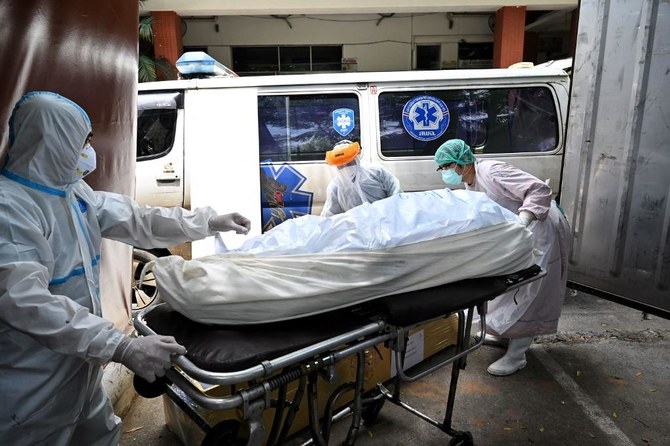
The region escaped the worst when the pandemic erupted last year, but in recent weeks has seen the highest deaths globally, as soaring infections push fragile health care systems to the brink and expose sluggish vaccination rollouts.
“This COVID-19 surge driven by the Delta variant is claiming a tragic toll on families across Southeast Asia and it’s far from over,” Alexander Matheou, Asia Pacific Director, International Federation of Red Cross and Red Crescent Societies, said in a statement.
It noted that most Southeast Asian countries including Vietnam, Thailand and Indonesia have been posting record COVID-19 infections or fatalities.
Malaysia on Wednesday reported 22,242 coronavirus cases, a daily record, while Thailand announced 312 deaths, a record increase for a second day in a row. Indonesia reported 1,128 fatalities, down from its worst levels above 2,000 late last month, but still the highest daily death toll for any country in the world.
Yet while countries like Canada, Spain and Britain have fully vaccinated more than 60 percent of their people, and the United States more than 50 percent, Southeast Asian countries are well behind, according to a Reuters COVID-19 tracker.
By contrast, Indonesia and Philippines, the most populous countries in Southeast Asia, have only fully vaccinated around 10-12 percent of their people, while Vietnam sits at below 2 percent.
“In the short-term, we need much greater efforts by richer countries to urgently share their millions of excess vaccine doses with countries in Southeast Asia, said Matheou, adding that vaccine companies and governments also needed to share technology and boost production. “These coming weeks are critical for scaling up treatment, testing and vaccinations, in every corner of all countries in Southeast Asia,” he said, adding that there must be a target for vaccination rates of 70-80 percent.

Red Cross: Southeast Asia needs coronavirus vaccine access to curb record deaths
https://arab.news/92bgt
Red Cross: Southeast Asia needs coronavirus vaccine access to curb record deaths
- ‘This COVID-19 surge driven by the Delta variant is claiming a tragic toll on families across Southeast Asia and it’s far from over’
Ukraine toils to restore power and heat, Zelensky warns of new attack
- Russia has systematically attacked Ukraine’s energy system since it invaded its neighbor in 2022 and the air strikes have intensified in recent months
KYIV: Emergency crews toiled to restore heat and power to beleaguered Kyiv residents on Monday, more than three days after Russian strikes on energy targets, and President Volodymyr Zelensky warned that new air attacks could be imminent.
Officials said hundreds of apartment blocks in the capital remained without heat despite round-the-clock efforts by the crews. Humanitarian centers, dubbed “resilience points,” were open for people to keep warm and charge electronic devices.
Russia has systematically attacked Ukraine’s energy system since it invaded its neighbor in 2022 and the air strikes have intensified in recent months.
Zelensky, speaking in his nightly video address, said a program was being launched to raise wages and provide support for participants in emergency work brigades.
He issued a new warning to heed air raid alerts as night-time temperatures sank to minus 15 Celsius (5 F) or lower.
“There is intelligence information. The Russians are preparing a new massive strike,” he said.
“Drones to exhaust air defense systems and missiles. They want to take advantage of the cold. The strike may occur in the coming days. Please take care of yourselves. Protect Ukraine.”
Deputy Prime Minister Oleksiy Kuleba, writing on Telegram, said 90 percent of Kyiv’s apartment buildings have had heating restored, leaving fewer than 500 dwellings still to be connected.
Mayor Vitali Klitschko put the number with no heating at 800, most on the west bank of the Dnipro River. He said a meeting of the Kyiv city council would be convened on Thursday to debate the most pressing issues facing residents.
Prime Minister Yulia Svyrydenko, presenting the program for bonus payments, said the work conducted by emergency crews stood “at the very limit of human endurance, often involving life-threatening risks across the entire country.
“This applies to specialists who, in freezing conditions, go directly to the sites of strikes and restore supplies of heat, electricity, water and gas.”
Residents made their way to one of the humanitarian centers on the east bank of the river in the evening — two tents pitched on a small area of open ground.
They charged their devices and chatted, while outside, the din of whining generators filled the air.
“It’s dark in the apartment. I have an electric stove, so it’s impossible to heat up lunch or dinner, or make tea,” said Kateryna Zubko, 67, an engineer who has lived without power, heating and water since the latest attack.
“We support each other. Ukrainians are such resilient people, I think that this war will end someday, it can’t go on forever.”


