Southeast Asia on full alert in bid to stop spread of deadly Chinese coronavirus

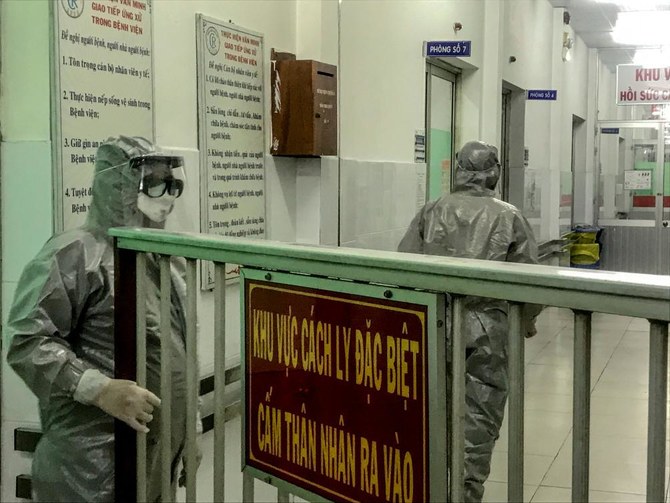
Medical workers enter an isolation area to visit the first two cases of the new coronavirus infection, in Cho Ray hospital in Ho Chi Minh City on January 23, 2020. (AFP)
Updated 26 January 2020
Follow

Southeast Asia on full alert in bid to stop spread of deadly Chinese coronavirus

  • Indonesia installs thermal scanners at ports of entry as first case confirmed in Singapore
  • Lockdown measures being put in place throughout China’s Hubei province and its regional capital Wuhan, where coronavirus first emerged

JAKARTA: Hospitals and passenger transport hubs throughout southeast Asia have been put on full alert in a bid to prevent the spread of a killer new Chinese virus.

With lockdown measures being put in place throughout China’s Hubei province and its regional capital Wuhan, where coronavirus first emerged, and first infections already starting to be reported in Asia, authorities in countries including Indonesia, Singapore and Malaysia are preparing to deal with an outbreak.

Globally, there are more than 500 confirmed cases of the virus, which has so far killed 17 people in China, and it has begun spreading abroad.

There was a false alarm on Thursday in the Indonesian capital Jakarta, when an employee in a building housing Chinese tech giant Huawei was reported ill with symptoms similar to the virus. Indonesia’s Minister of Health Terawan Agus Putranto later told journalists that the worker had been “diagnosed as having a sore throat.”

However, he said the government was taking no chances and had installed thermal scanners at international airports and seaports to check visitors arriving from China and other countries where cases had been confirmed.

Singapore’s Ministry of Health announced on Thursday that a case of imported coronavirus had been identified in the city state.

“The case is a 66-year-old male Chinese national from Wuhan who arrived in Singapore with his family on Jan. 20,” a ministry statement said, adding that the patient was being treated in an isolation room at the Singapore general hospital and was in a stable condition.

Health officials also revealed that they had received notification of a female Chinese national, also from Wuhan, who had preliminarily tested positive for the virus. “Both cases were immediately isolated upon presenting to the respective hospitals with clinical symptoms,” the ministry said.

Meanwhile, Malaysia’s Ministry of Health announced on Thursday that it had designated 26 hospitals to screen potential cases and handle any outbreak.

Noor Hisham Abdullah, the Malaysian ministry’s director general of health, said the national Crisis Preparedness and Response Center (CPRC) had received reports of four cases. Three of them had already tested negative and the other person, admitted to a hospital in Sabah state on Wednesday, was in a stable condition, added Abdullah.

An Indonesian Ministry of Health spokeswoman told Arab News that there were around 30 inbound flights from China to Indonesia each day, carrying between 4,500 and 6,000 passengers.

“The health ministry is in cooperation with related agencies to prepare a simulation, including installing 195 thermal scanners in all 135 ports of entry, by air, sea, and land. We are on standby around the clock,” she said.

Blair pressured UK officials over case against soldiers implicated in death of Iraqi

Former British Prime Minister Tony Blair. (File/AFP)
Updated 5 sec ago
Follow

Blair pressured UK officials over case against soldiers implicated in death of Iraqi

  • Newly released files suggest ex-PM took steps to ensure cases were not heard in civilian court
  • Baha Mousa died in British custody in 2003 after numerous assaults by soldiers over 36 hours

LONDON: Former UK Prime Minister Tony Blair pressured officials not to let British soldiers be tried in civil courts on charges related to the death of an Iraqi man in 2003, The Guardian reported on Tuesday.

Baha Mousa died in British Army custody in Basra during the Iraq War, having been repeatedly assaulted by soldiers over a 36-hour period.

Newly released files show that in 2005 Antony Phillipson, Blair’s private secretary for foreign affairs, had written to the prime minister saying the soldiers involved would be court-martialed, but “if the (attorney general) felt that the case were better dealt with in a civil court he could direct accordingly.”

The memo sent to Blair was included in a series of files released to the National Archives in London this week. At the top of the memo, he wrote: “It must not (happen)!”

In other released files, Phillipson told Blair that the attorney general and Ministry of Defence could give details on changes to the law they were proposing at the time so as to avoid claims that British soldiers could not operate in a war zone for fear of prosecution. 

In response, Blair said: “We have, in effect, to be in a position where (the) ICC (International Criminal Court) is not involved and neither is CPS (Crown Prosecution Service). That is essential. This has been woefully handled by the MoD.”

In 2005, Cpl Donald Payne was court-martialed, jailed for a year and dismissed from the army for his role in mistreating prisoners in custody, one of whom had been Mousa.

Payne repeatedly assaulted, restrained and hooded detainees, including as part of what he called “the choir,” a process by which he would kick and punch prisoners at intervals so that they made noise he called “music.”

He became the first British soldier convicted of war crimes, admitting to inhumanely treating civilians in violation of the 2001 International Criminal Court Act.