

Discovery reveals Babylonian geometry ‘1,000 years before Pythagoras’

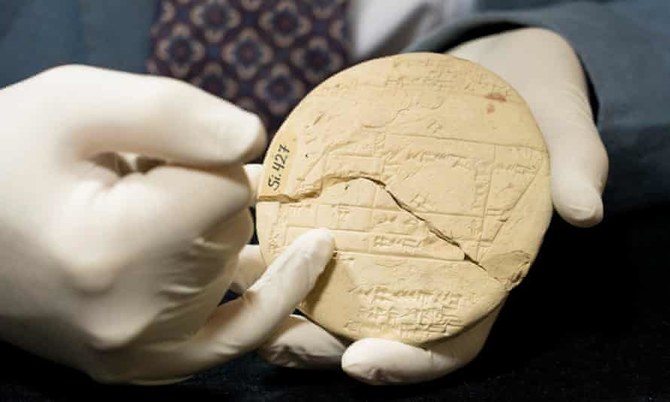
The ancient clay tablet was engraved with a stylus to describe a field containing marshy areas, as well as a threshing floor and nearby tower. (UNSW Sydney)
Short Url
Updated 05 August 2021
Follow

Discovery reveals Babylonian geometry ‘1,000 years before Pythagoras’

  • Researcher: 3,700-year-old clay tablet discovered near Baghdad will ‘change way we view history of maths’
  • The Old Babylonian period lasted between about 1900 and 1600 BC, and saw the advancement of religious, literary and scientific works

LONDON: The sale of a field in ancient Mesopotamia 3,700 years ago has been recognized as the first known use of applied geometry.

It was discovered that the surveyor of the land plot recorded the purchase on a clay tablet about the size of a palm by using complex strings of numbers known as Pythagorean triples.

“It’s a discovery that will completely change the way we view the history of mathematics,” said the lead researcher of the study, Dr. Daniel Mansfield of the University of New South Wales, Australia. “This is more than a thousand years before Pythagoras was born.”

Si.427, the label used by mathematicians to refer to the clay tablet, was first discovered near Baghdad in 1894, but it spent more than 100 years in a museum in Istanbul, left unnoticed by researchers. 

“It’s the only known example of a ‘cadastral’ document from the Old Babylonian period — a plan used by surveyors to define land boundaries,” Mansfield said.

“In this case, it tells us legal and geometric details about a field that was split after some of it was sold off.”

The Old Babylonian period lasted between about 1900 and 1600 BC, and saw the advancement of religious, literary and scientific works.

As a result of the Si.427 research, Mansfield believes that Babylonian surveyors would browse an array of Pythagorean triples and use one that best represented a rectangular plot to formulate a sales map, often using rope and other measuring devices.

“With this new tablet, we can actually see for the first time why they were interested in geometry: To lay down precise land boundaries,” Mansfield said.

“This is from a period where land started to become private. People started thinking in terms of ‘my land and your land,’ wanting to establish a proper boundary to have positive neighborly relationships. And this is what this tablet immediately says. It’s a field being split and new boundaries being made.”

Riyadh to install 25 new public artworks after conclusion of Tuwaiq Sculpture symposium

Updated 09 March 2026
Follow

Riyadh to install 25 new public artworks after conclusion of Tuwaiq Sculpture symposium

  • Move will extend the impact of the annual art event beyond its conclusion, bringing large-scale contemporary artworks into the city’s streets and parks
  • Artworks produced during the symposium will now become part of Riyadh Art’s permanent collection

RIYADH: Some 25 sculptures created during the seventh edition of the Tuwaiq Sculpture symposium and exhibition will soon be installed across public spaces in Riyadh.

The move will extend the impact of the annual art event beyond its conclusion, organizers said, bringing large-scale contemporary artworks into the city’s streets and parks.

Organized by the Royal Commission for Riyadh City through the Riyadh Art Program, the 2026 edition has ended after nearly two months of live sculpting, exhibitions and public programming.

The artworks produced during the symposium will now become part of Riyadh Art’s permanent collection and will appear across the capital as part of a broader effort to integrate art into everyday urban life.

This year’s symposium began in January and took place along Prince Mohammed bin Abdulaziz Road, widely known as Tahlia Street.

The site was transformed into an open-air studio in which visitors could observe artists carving, welding and assembling sculptures.

The live sculpting phase, which was held between Jan. 10 and Feb. 5, brought together leading Saudi and international artists to produce 25 large-scale works.

The sculptures were created using locally sourced granite and reclaimed metal, highlighting both the region’s natural materials and the creative reuse of industrial elements.

Visitors were able to follow the process of each artwork’s development, from raw materials to finished sculptures, while also interacting with the artists and learning about their techniques and concepts.

The event also featured a wide-ranging community engagement program designed to deepen public understanding of contemporary art.

The program included 10 panel discussions, 105 training workshops and 15 masterclasses exploring sculptural techniques, materials and the role of public art in cities.

Educational outreach formed another key component of the symposium. Organizers hosted 25 educational visits for more than 600 students, while daily guided tours enabled visitors to explore the artworks and gain insight into the creative processes behind them.

After the live sculpting phase, the completed sculptures remained on-site until March 8, giving visitors the opportunity to experience the works in their original setting before their distribution across Riyadh.

The symposium was curated by Lulwah Al-Homoud, Sarah Staton, and Rut Blees Luxemburg, who guided the artistic direction around the theme “Traces of What Will Be,” exploring how sculpture can reflect future possibilities while responding to the city’s evolving identity.