

Delta variant blamed for Bangladeshi surge in COVID-19 infections

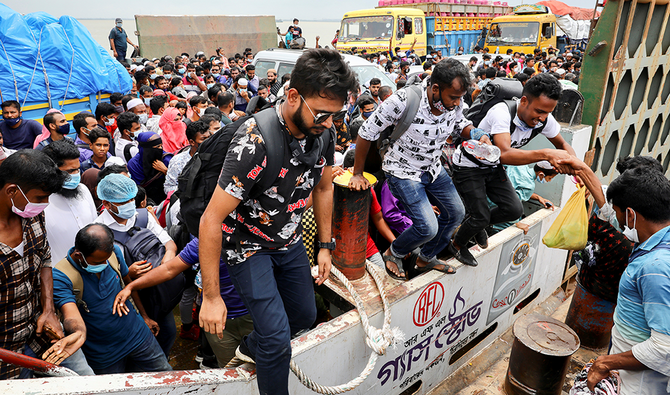
Migrants and workers return to the capital city after the Bangladeshi government decided to reopen export industries amid lockdown. (Reuters)
Short Url
Updated 04 August 2021
Follow

Delta variant blamed for Bangladeshi surge in COVID-19 infections

  • Ramped-up vaccination drive crucial to curbing the outbreak, officials say

DHAKA: More than 50 percent of coronavirus disease (COVID-19) infections and nearly 44 percent of virus-related deaths across Bangladesh have been traced to the highly transmissible delta variant of the disease, health authorities confirmed on Tuesday.

The government’s Directorate General of Health Services (DGHS) on Monday said over 15,000 infections and 246 deaths were reported in the past 24 hours, taking the total caseload to 1,280,317 and death toll to 21,500 since the pandemic began in March last year.

“Some of our organisations, including the Institute of Epidemiology Disease Control and Research (IEDCR), conducted genome sequencing on small-sized samples. It shows that more than 50 percent of recent infections are caused by the delta (variant),” Dr. Mushtuq Hussain, an adviser to the IEDCR, told Arab News, adding: “Of the recent deaths, around 44 percent were infected with the delta variant.”

The worrying trend comes amid several warnings by health experts that the outbreak might worsen after authorities relaxed the COVID-19 curbs ahead of the Eid Al-Adha festival in late July.

Tens of thousands of Bangladeshis traveled from various cities, including the capital Dhaka, to their home villages before lockdown was reimposed for two more weeks until Aug. 5.

Speaking to reporters at the time, Health Minister Zahid Maleque said the crisis was “most difficult,” citing a nearly 90 percent occupancy rate at hospitals, before calling upon the public to follow health restrictions to curb the outbreak.

“We failed to follow the health safety protocols and the lockdown initiative also failed miserably since factories and banks were in operation during those days,” Prof. Robed Amin, a DGHS spokesperson, told Arab News.

“Most people were reluctant to comply with health safety measures, especially wearing masks while going outside. We should have engaged people more in building awareness in this regard,” he said, adding that a strict lockdown was necessary to “reap good results.”

Bangladesh, which shares a long border with India, began experiencing an upward trend in delta variant cases in mid-May, which peaked two months later as the country started recording more than 200 daily deaths in the first week of July.

Dr. Hussain said that while the variant has impacted eight bordering districts, Dhaka remains the “worst affected.”

“If the current trend continues, it may take a couple of weeks to reduce the infection rate,” he said.

However, despite a surge in delta variant cases rattling several parts of the country, Hussain said Bangladesh was “still doing better than other regional countries” grappling with the pandemic.

“Compared to neighboring India, Nepal, and some other regional countries, Bangladesh is not lagging in managing the COVID-19 outbreak. In India, it took three months to contain the surge caused by delta,” he said.

In April, the South Asian nation of nearly 170 million was forced to suspend its nationwide inoculation drive after a halt in exports of the AstraZeneca jabs from India. Bangladesh resumed the vaccination campaign with China’s Sinopharm and the Pfizer vaccine supplied by the Covax facility, a global vaccine sharing initiative.

However, less than 3 percent of the population had been fully vaccinated as of Aug. 1.

Prof. Amin said it was imperative to achieve herd immunity against the deadly virus with a “massive vaccination drive.”

“If we can inoculate around 10 million people per month according to the plan which will begin from next Saturday, the infection rate will reduce soon,” he said.

“In the next two months, we will be able to inoculate around 20 million people with the vaccines sourced from the Covax initiative and purchased by the Bangladesh government.”


Congo-Brazzaville president set to extend decades-long rule

Updated 2 sec ago
Follow

Congo-Brazzaville president set to extend decades-long rule

BRAZZAVILLE: At the age of 82 and after more than 40 years in power, Denis Sassou Nguesso is the clear favorite to win Sunday’s presidential election in Congo-Brazzaville.
With the opposition divided, sidelined and largely absent, observers say voter turnout could slump to a record low in the oil-rich but impoverished central African country.
Sassou Nguesso ranks as one of Africa’s longest-serving leaders, along with Equatorial Guinea’s Teodoro Obiang Nguema and Cameroonian President Paul Biya.
“Honestly, I don’t see the point of voting on March 15. Whether I vote or not, we’ll have the same winner,” said Cyril Massamba, who lives in the capital Brazzaville.
Sassou Nguesso, a career military officer, first led Congo under a one-party system from 1979 to 1992 before losing the first multi-party elections to former prime minister Pascal Lissouba, whom Sassou Nguesso then overthrew in a civil war in 1997.
He has maintained a firm grip over the former French colony, which gained independence in 1960 and has traditionally maintained close ties with both France and Russia.
Six candidates are bidding to unseat him but few have the resources to compete with the ruling Congolese Labour Party (PCT).
The party’s red Soviet-style flags and giant Sassou Nguesso portraits have filled city streets since the campaign began.
Lacking broad support, opposition candidates have been unable to rally behind a single challenger.
The two main opposition parties have chosen not to stand, one of them arguing that conditions for a free and transparent election have not been met, and urging supporters to vote “according to their conscience.”
“Denis Sassou Nguesso controls the entire electoral process,” said Clement Mierassa, an opposition figure, former minister and previous presidential candidate.
He argued that all those running against the president were just placeholders.
Two prominent candidates who challenged Sassou Nguesso in the disputed 2016 election remain in prison, serving 20-year sentences for “endangering state security.”

- Turnout fears, unemployment -

“I’ll go to a polling station the day my own child is a candidate,” joked shopkeeper Monique Ouollo.
Sassou Nguesso has urged his supporters to turn out and vote in Sunday’s first round, telling a rally in Pointe?Noire: “No abstention!” No date has yet been given for a second round of voting.
But many young people in the port city voiced frustration over chronic unemployment and the lack of economic prospects in a country rich in oil and gas.
Despite GDP growth of 2.9 percent in 2025, about half the population of six million lives below the poverty line, according to the World Bank.
Congo-Brazzaville depends heavily on hydrocarbons, which account for more than three-quarters of export earnings.
Authorities say proven oil reserves will last another 25 years at current production rates and aim to reach 500,000 barrels a day by 2030.
Gas production reached three million tons of LNG last year.
Although it has 10 million hectares of arable land, only about four percent is farmed, mostly for low-yield subsistence crops.
The country imports much of its food, leaving households exposed to swings in global prices, shipping costs and exchange rates.
Officials hope Congo’s location — between the Congo Basin and the Atlantic Ocean — will help turn it into a regional trading hub, tapping existing rail and road networks to boost links with neighbors.

- Diplomatic balancing act -

At Sassou Nguesso’s first campaign rally last month, foreign paramilitaries were spotted on rooftops nearby, including a sniper.
Their presence fueled speculation about Russian mercenaries providing security, mirroring arrangements in the Central African Republic.
A ruling party official confirmed to AFP that the men were Russian personnel, without detailing their mission.
Seen as a relatively stable hub in a volatile region, Congo-Brazzaville retains close ties with Paris, its largest development aid donor, and is home to around a hundred French companies.
But Russia is also a longstanding partner: Congo was allied with the Soviet bloc from 1968 to the early 1990s.
Though Sassou Nguesso maintains tight control over the security apparatus, some of his allies acknowledge that fears of a power grab remain.
The president told AFP in an interview in early March that he does not intend to “remain in power forever.”