Bangladeshis rush back to work as factories reopen despite virus surge

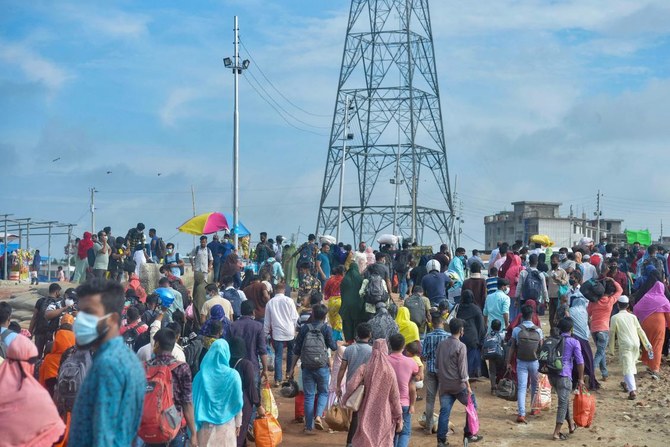
People disembark from a ferry in Sreenagar on July 31, 2021 to resume and return to their work areas post the Bangladesh government relaxed the lockdown norms for all export oriented factories which were earlier imposed to curb the spread of Covid-19 coronavirus. (AFP)
Updated 31 July 2021
Follow

Bangladeshis rush back to work as factories reopen despite virus surge

SHIMULIA: Hundreds of thousands of Bangladeshi garment workers rushed back to major cities Saturday, besieging train and bus stations, after the government said export factories could reopen despite a deadly coronavirus wave.
With the economy badly hit by the pandemic, the government excluded the factories that supply top brands in Europe and North America from a nationwide lockdown order.
Authorities had ordered factories, offices, transport and shops to close from July 23 to August 5 as daily coronavirus infections and deaths hit record levels.
Officially, Bangladesh has reported 1.2 million cases and more than 20,000 deaths. Experts say the real figures are at least four times higher.
The government said however that the country’s 4,500 garment factories, which employ more than four million people, can reopen from Sunday, sparking a rush back to industrial cities.
The influential garment factory owners had warned of “catastrophic” consequences if orders for foreign brands were not completed on time.
Hundreds of thousands who had gone back to their villages to celebrate the Eid al Adha Muslim festival and sit out the lockdown, headed to Dhaka in any available transport — some just walking in the monsoon rain.
At the Shimulia ferry station, 70 kilometers (45 miles) south of Dhaka, tens of thousands of workers waited hours for boats to take them to the capital.
Garment factory worker Mohammad Masum, 25, said he left his village before dawn, walked more than 30 kilometers (20 miles) and took rickshaws to get to the ferry port.
“Police stopped us at many checkpoints and the ferry was packed,” he said.
“It was a mad rush to get home when the lockdown was imposed and now we are in trouble again getting back to work,” Jubayer Ahmad, another worker, told AFP.
Bangladesh is the world’s second largest garment exporter after China and the industry has become the foundation of the economy for the country of 169 million people.
Mohammad Hatem, vice president of the Bangladesh Knitwear Manufacturers and Exporters Association, said up to $3 billion worth of export orders were at risk if factories had stayed closed.
“The brands would have diverted their orders to other countries,” Hatem told AFP.


Zelensky talks with allies en route to US as Russia pummels Ukraine

Updated 4 sec ago
Follow

Zelensky talks with allies en route to US as Russia pummels Ukraine

  • Zelensky will meet Trump on Sunday, with  focus on a new, 20-point plan that would freeze the war on its current front line
  • In a conference call Saturday, the Ukrainian leader briefed EU, NATO and European leaders, who gave him their “full support” 


OTTAWA, Canada: Ukraine’s President Volodymyr Zelensky consulted with allies on Saturday and won renewed expressions of support ahead of a meeting with US President Donald Trump, hours after Russia pummelled Kyiv with drones and missiles in its latest attack on the capital.
During a stopover in Canada en route to Florida for the Trump meeting, the Ukrainian president spoke first with Canadian Prime Minister Mark Carney.
Then, in a conference call, he briefed EU, NATO and European leaders, who gave him their “full support” according to German Chancellor Friedrich Merz.
EU chief Ursula von der Leyen said in a social media post they welcomed “a just and lasting peace that preserves Ukraine’s sovereignty and territorial integrity.”
Zelensky said the Russian onslaught showed Moscow had no intention of ending the invasion it launched in February 2022 and which has killed tens of thousands of people.
“This attack is again, Russia’s answer on our peace efforts. And this really showed that Putin doesn’t want peace, and we want peace,” Zelensky said before meeting the Canadian premier.
Carney said the latest Russian attack underscored the need to stand by Ukraine.
“We have the conditions... of a just and lasting peace, but that requires a willing Russia, and the barbarism that we saw overnight... shows just how important it is that we stand with Ukraine,” said Carney.
Russia has accused Ukraine and its European backers of trying to “torpedo” a previous US-brokered plan to stop the fighting.
Adding to pressure on the battlefield, Russia announced on Saturday it had captured two more towns in eastern Ukraine, Myrnograd and Guliaipole.
“If the authorities in Kyiv don’t want to settle this business peacefully, we’ll resolve all the problems before us by military means,” Russian President Vladimir Putin said Saturday.

‘They do not want to end the war’ 

The overnight barrage of drones and missiles, which targeted Kyiv for about 10 hours, killed two people, wounded dozens and cut power and heating to more than a million of the region’s residents during freezing temperatures, Ukraine authorities said.
Zelensky said some 500 drones and 40 missiles had pounded the capital and its surrounding region.
“Russian representatives engage in lengthy talks, but in reality, Kinzhals (missiles) and Shaheds (drones) speak for them,” he said.
“They do not want to end the war and seek to use every opportunity to cause Ukraine even greater suffering,” he added.
Neighbouring Poland, a NATO member, scrambled jets and put air defenses on alert during the attack, its military said on social media.

‘Security guarantees should be strong’ 

Sunday’s meeting in Florida is to focus on a new, 20-point plan that would freeze the war on its current front line. It could require Ukraine to pull back troops from the east, allowing the creation of demilitarised buffer zones, according to details revealed by Zelensky this week.
The new plan, formulated with Ukraine’s input, is Kyiv’s most explicit acknowledgement yet of possible territorial concessions.
It is a marked departure from an initial 28-point proposal by Washington last month that adhered to many of Russia’s core demands.
Trump, speaking to news outlet Politico on Friday, said of Zelensky’s plan that “he doesn’t have anything until I approve it.” He added: “So we’ll see what he’s got.”
Part of the plan includes separate US-Ukraine bilateral agreements on security guarantees, reconstruction and the economy.
Zelensky said those were changing daily. “As for sensitive issues, we will discuss (the eastern region of) Donbas and the Zaporizhzhia nuclear power plant,” he added.
Zelensky said his meeting with the US leader was aimed at reducing unresolved issues to a minimum.
“Of course, today there are red lines for Ukraine and Ukrainian people. There are compromise proposals. All of these issues are very sensitive,” he said on X.
Meanwhile, Ukraine needed European and US support to acquire weapons and funds, both of which were insufficient, Zelensky said — “in particular for the production of weapons and, most importantly, drones.”
In negotiations, Ukraine’s “most important consideration — if we take certain steps — is that security guarantees should be strong and we should be protected,” he said.
Ukraine is working with the US on a roadmap for the country’s reconstruction, said Zelensky, which will require between $700 billion and $800 billion.