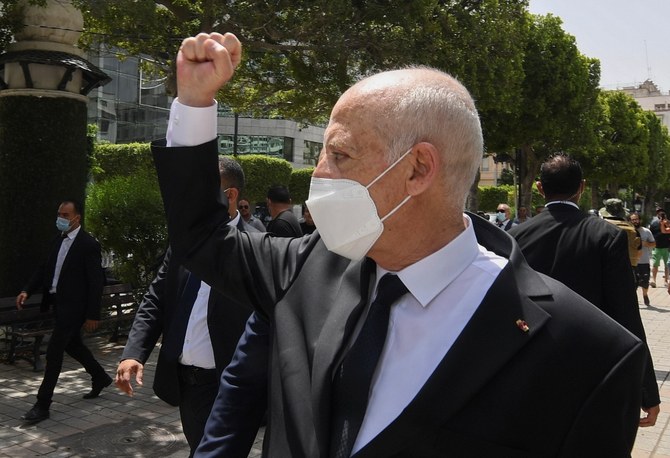
TUNIS, Tunisia: A day after naming a new economy minister, President Kais Saied on Tuesday added Tunisia’s ambassador to the United States to a rash of dismissals.
Yet he has to say who will replace the prime minister he fired less than two weeks ago or when.
Saied, who took on executive powers July 25 and began ruling by decree, has also undertaken globe-spanning consultations, meeting Tuesday with the foreign minister of Egypt, a critical ally in the Middle East.
Local polls say there is large support for Saied’s controversial actions, which importantly included freezing Tunisia’s parliament,
The North African country has been cementing its democracy since chasing out its former autocratic ruler a decade ago, triggering the Arab Spring. Tunisia is the only success story to emerge from those chaotic times, and allies, from the United States to Europe and the Middle East, have worried about what comes next.
Tunisia is coping with economic, social and health crises, with the coronavirus pandemic overwhelming its hospitals. Saied, using an article in the constitution that allows a president to step in under grave circumstances, has said he did so to save the country.
In his meeting with Egyptian Foreign Minister Sameh Shukry, the president highlighted “the correlation between Egypt’s and Tunisia’s security and stability,” the official TAP news agency said.
Egypt’s envoy said that Egyptian President Abdel-Fattah El-Sisi backed Saied’s moves with “his full support for the historic steps” of the Tunisian leader, TAP added. “Egypt and Tunisia are working together to ensure stability not only in the two countries, but also across the region,” the agency quoted the foreign minister as saying after the meeting.
The important Economy Ministry got a new acting minister Monday, with the dismissal of Ali Kooli, as did the Communications Technology ministry.
The rash of firings that began when Saied assumed all executive power continued Tuesday. Tunisia’s ambassador to Washington, Nejmeddine Lakhal, was the latest dignitary terminated, the official news agency said. No explanation was given. Also Tuesday, the president fired the governor of the important Sfax region in eastern Tunisia.
Some lawmakers have not been spared, snared by judicial officials on complaints that could not be prosecuted earlier. The president lifted the immunity of the parliamentary body when he took on all powers, and a handful have been summoned to answer to charges they had escaped.

Tunisia leader fires ambassador to US in rash of dismissals
Short Url
https://arab.news/nw33g
Tunisia leader fires ambassador to US in rash of dismissals
- President Kais Saied has to say who will replace the prime minister he fired less than two weeks ago
- Local polls say there is large support for Saied’s controversial actions
Germany will keep supporting Lebanon after UN peacekeepers leave, German president says
BEIRUT: Germany moved to assure Lebanon on Monday that it will support the Lebanese government even after pulling out German troops deployed as part of UN peacekeepers along the Lebanon-Israel border when their mission ends later this year.
German President Frank-Walter Steinmeier made the announcement during a news conference at the presidential palace near Beirut. Germany’s navy, he said, is already training Lebanese troops as they boost their presence in the country’s south following the 14-month war between Israel and the Lebanese militant Hezbollah group.
The mission of the multinational UN peacekeeping force in southern Lebanon, known as UNIFIL, concludes at the end of 2026, nearly five decades after it was deployed. The force has played a significant role in monitoring the security situation in the region, including during the Israel-Hezbollah war last year.
Over the past months, Beirut has said that Lebanon will need a follow-up force to fill the vacuum in southern Lebanon once the UN peacekeepers leave.
“After the end of UNIFIL’s mission, Germany will stay by the side of your country to boost state authority,” Steinmeier said, without elaborating. It remains unlikely German troops — tasked with preventing arms smuggling by sea and helping the Lebanese army monitor the country’s sea border — would remain in Lebanon.
UNIFIL currently numbers about 7,500 peacekeepers, including 179 Germans.
“The Lebanese armed Forces are, of course, the backbone of stability in Lebanon and this means that after UNIFIL’s mission we have to think how to strengthen” the army, Steinmeier said.
Steinmeier added that the process of disarming Hezbollah — which was part of a November 2024 US-brokered ceasefire that halted the fighting — should move ahead and that Israel should fully withdraw from Lebanese territory.
Lebanese President Joseph Aoun said Lebanon paid a high price for the Hezbollah-Israel war, which Hezbollah started by firing rockets into Israel a day after the militant Palestinian group Hamas attacked southern Israel on Oct. 7, 2023, triggering the war in Gaza.
Israel expanded its attacks that included bombardment and a ground operation in September 2024, severely weakening Hezbollah.
The Israel-Hezbollah conflict killed more than 4,000 people in Lebanon, including hundreds of civilians, and caused an estimated $11 billion in damage and destruction, according to the World Bank. In Israel, 127 people died, including 80 soldiers.
“We were forced to live through violent conflicts we did not choose and we bore their burdens. We are no longer able to do so,” Aoun said of the Israel-Hezbollah war.
Aoun also said he had asked Steinmeier to have Germany assume a “main role” after UNIFL, without elaborating what that would entail, and to also ask Israel to abide by the ceasefire and withdraw from Lebanon. He made no mention of Hezbollah’s withdrawal from southern Lebanon.
German President Frank-Walter Steinmeier made the announcement during a news conference at the presidential palace near Beirut. Germany’s navy, he said, is already training Lebanese troops as they boost their presence in the country’s south following the 14-month war between Israel and the Lebanese militant Hezbollah group.
The mission of the multinational UN peacekeeping force in southern Lebanon, known as UNIFIL, concludes at the end of 2026, nearly five decades after it was deployed. The force has played a significant role in monitoring the security situation in the region, including during the Israel-Hezbollah war last year.
Over the past months, Beirut has said that Lebanon will need a follow-up force to fill the vacuum in southern Lebanon once the UN peacekeepers leave.
“After the end of UNIFIL’s mission, Germany will stay by the side of your country to boost state authority,” Steinmeier said, without elaborating. It remains unlikely German troops — tasked with preventing arms smuggling by sea and helping the Lebanese army monitor the country’s sea border — would remain in Lebanon.
UNIFIL currently numbers about 7,500 peacekeepers, including 179 Germans.
“The Lebanese armed Forces are, of course, the backbone of stability in Lebanon and this means that after UNIFIL’s mission we have to think how to strengthen” the army, Steinmeier said.
Steinmeier added that the process of disarming Hezbollah — which was part of a November 2024 US-brokered ceasefire that halted the fighting — should move ahead and that Israel should fully withdraw from Lebanese territory.
Lebanese President Joseph Aoun said Lebanon paid a high price for the Hezbollah-Israel war, which Hezbollah started by firing rockets into Israel a day after the militant Palestinian group Hamas attacked southern Israel on Oct. 7, 2023, triggering the war in Gaza.
Israel expanded its attacks that included bombardment and a ground operation in September 2024, severely weakening Hezbollah.
The Israel-Hezbollah conflict killed more than 4,000 people in Lebanon, including hundreds of civilians, and caused an estimated $11 billion in damage and destruction, according to the World Bank. In Israel, 127 people died, including 80 soldiers.
“We were forced to live through violent conflicts we did not choose and we bore their burdens. We are no longer able to do so,” Aoun said of the Israel-Hezbollah war.
Aoun also said he had asked Steinmeier to have Germany assume a “main role” after UNIFL, without elaborating what that would entail, and to also ask Israel to abide by the ceasefire and withdraw from Lebanon. He made no mention of Hezbollah’s withdrawal from southern Lebanon.
© 2026 SAUDI RESEARCH & PUBLISHING COMPANY, All Rights Reserved And subject to Terms of Use Agreement.