Germany pledges continued support for Lebanon after UNIFIL withdrawal

1 / 2
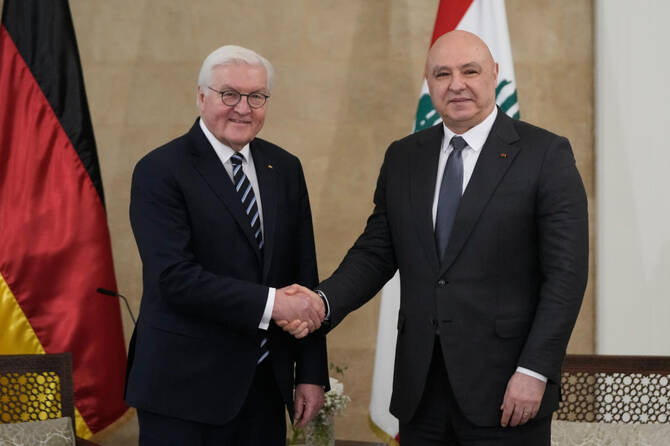
Lebanese President Joseph Aoun, right, shakes hands with his German counterpart Frank-Walter Steinmeier, at the presidential palace in Baabda, east of Beirut, Lebanon, Monday, Feb. 16, 2026.(AP)
2 / 2
German President Frank-Walter Steinmeier, left, speaks during a press conference with his Lebanese counterpart Joseph Aoun, at the presidential palace in Baabda, east of Beirut, Lebanon, Monday, Feb. 16, 2026. (AP)
Short Url
Updated 17 February 2026
Follow

Germany pledges continued support for Lebanon after UNIFIL withdrawal

  • Challenges impeding disarmament plan highlighted during cabinet meeting

BEIRUT: Germany would continue to support Lebanon’s armed forces and state institutions even after the planned withdrawal of UN peacekeepers in 2027, President Frank-Walter Steinmeier said on Monday, reaffirming Berlin’s long-term commitment to boost state authority and security in the country’s south.

Speaking after talks with Lebanon’s President Joseph Aoun at the presidential palace in Baabda, Steinmeier said Germany would “stay by Lebanon’s side” beyond the end of the UN Interim Force in Lebanon’s mandate.

“The ceasefire between Israel and Hezbollah is an opportunity to achieve stability in the region, and we call for adherence to it,” Steinmeier said.

He stressed that “the disarmament of Hezbollah must proceed apace, and Israeli forces must withdraw from southern Lebanon,” reiterating Berlin’s position that Israel’s “permanent occupation of Lebanese territories is unacceptable and must be ended.”

His remarks come amid ongoing diplomatic efforts to reinforce the Nov. 24 ceasefire agreement and expand the Lebanese army’s deployment in the south, as well as growing international discussion over UNIFIL’s future role.

In response to questions, the German president described the Lebanese Armed Forces as the “backbone of stability” in Lebanon.

“When UNIFIL’s mission comes to an end, we will need to determine how best to reinforce that backbone.”

Steinmeier, who began a three-day official visit to Lebanon, is scheduled to inspect a German frigate serving within UNIFIL’s maritime task force, and inaugurate, alongside Aoun, the naval academy where Lebanese and German forces cooperate on training programs.

According to the Lebanese presidency, Aoun told Steinmeier that Germany’s contribution to training Lebanon’s naval personnel has been “fundamental” in strengthening operational capacity and professional expertise.

He described the German president’s visit as “a message of hope for the Lebanese” at a time of mounting regional uncertainty.

The two leaders first held a 20-minute one-on-one meeting before being joined by senior Lebanese and German officials.

This marks Steinmeier’s second visit to Lebanon, following his 2018 trip — the first by a German president in nearly 120 years — underscoring Berlin’s sustained diplomatic and military engagement in the country.

Aoun said Israel’s continued presence in occupied positions in southern Lebanon has so far prevented the Lebanese army from fully deploying up to the internationally recognized borders.

He noted that the potential continued presence of German and other European forces in the south following UNIFIL’s withdrawal could help reinforce security and provide social and humanitarian support to local communities.

Contacts, he added, would be established with European countries willing to maintain part of their contingents in order to agree on an appropriate framework for their role.

Aoun emphasized that the state’s decision to establish a monopoly over weapons stems from a domestic Lebanese need rather than external pressure. He said authorities would continue implementing the policy in coordination with relevant parties, while safeguarding stability and civil peace.

At a joint press conference, Steinmeier reaffirmed Germany’s long-term backing for Lebanon, stressing Berlin’s support for state institutions, particularly the security agencies. He also praised Lebanon for hosting large numbers of Syrian and Palestinian refugees despite its economic strain.

Steinmeier pointed to what he described as a moment of fragile transition in the region, including a delicate ceasefire in Gaza, the release of hostages by Hamas, and political shifts in neighboring Syria, saying both Germany and Lebanon share an interest in achieving lasting peace and stability.

He also thanked Lebanon for pursuing diplomatic channels to secure and maintain the ceasefire between Hezbollah and Israel, urging all sides to adhere to the agreement.

For his part, Aoun stressed Lebanon’s role as a “platform for dialogue,” reaffirming the country’s commitment to “absolute peace.”

“On behalf of all Lebanese, we can no longer bear the conflicts of others. We seek nothing but the well-being of our people, the prosperity of our nation, and a secure future for our children,” he stated.

Disarmament plan

Lebanon’s cabinet on Monday reviewed a monthly report by Army Commander Gen. Rodolphe Haykal outlining the next phases of the plan to place weapons under exclusive state control north of the Litani River.

A ministerial source told Arab News that Haykal confirmed that operations are continuing both south and north of the Litani, but said there is no fixed timetable for completing the mission due to the vast geographical scope and the scale of work and equipment required.

The army chief detailed the challenges facing the operation, particularly in the south, citing continued Israeli attacks, the occupation of certain areas, and limited financial and logistical resources. Political constraints were also highlighted as complicating factors.

The source added that the army’s roadmap for the next phase follows a gradual approach designed to avoid direct confrontation with Hezbollah, focusing instead on containing and collecting weapons and ammunition in stages.

Speaking from Munich on the sidelines of the recent security conference, Lebanon’s Prime Minister Nawaf Salam reiterated that the government “is not seeking confrontation with Hezbollah, but we will not be intimidated by any party.”

Earlier this month, the Lebanese army uncovered a large Hezbollah tunnel in the town of Al-Halousiya in Tyre district, south of the Litani River. A military source told Arab News that troops are still working to remove significant quantities of weapons, mostly shells, found inside the tunnel.

In parallel, the army reinforced its presence along the border, establishing four new posts in the town of Kfarkela.

Israeli strikes meanwhile have continued. On Monday, a drone strike killed a school bus driver, Mohammad Tahsin Hussein Qashqash, outside his home in Hanine in the Bint Jbeil district.

A day earlier, another drone strike targeted a taxi near the Lebanese-Syrian border on the road to the Al-Masnaa crossing, killing four passengers, including a Syrian national identified as Khaled Mohammad Al-Ahmad.


How Gaza’s shattered fishing industry deepened the enclave’s food security crisis

Updated 6 sec ago
Follow

How Gaza’s shattered fishing industry deepened the enclave’s food security crisis

  • Once a pillar of local food security, Gaza’s fishing sector has been reduced to a fraction of its prewar capacity
  • UN agencies warn the destruction of boats and ports has deepened aid dependence and worsened protein shortages

DUBAI: Gaza’s fishing industry — once a critical source of food, income and affordable protein — has been largely destroyed as a result of Israel’s war with Hamas, worsening the Palestinian enclave’s food security crisis.

According to the UN Food and Agriculture Organization, fishing activity in Gaza now stands at less than 10 percent of prewar levels following the widespread destruction of boats, ports and equipment, combined with prolonged maritime closures enforced under Israel’s naval blockade.

UN and human rights organizations estimate that up to 72 percent of Gaza’s fishing fleet has been damaged or destroyed, alongside near-total devastation of related infrastructure, including landing sites, storage facilities and repair workshops.

Israel's naval blockade has Gaza's fishing industry to decline to about a tenth of pre-war levels. (Reuters photo)

The remaining vessels are small, damaged skiffs capable of operating only meters from shore.

Ramzy Baroud, a journalist, author and editor of The Palestine Chronicle, said the destruction of Gaza’s fishing sector must be understood as part of a deliberate policy aimed at preventing Palestinians from developing independent food-producing systems.

Baroud says Israel had pursued a strategy since 1967 to foster Palestinian dependency — first on the Israeli economy, and later on humanitarian aid entering Gaza through Israeli-controlled crossings — leaving the population permanently vulnerable to economic collapse.

“This vulnerability is functional for Israel, as it allows the Israeli government and military to leverage their control over Palestinian lives through political pressure in pursuit of concessions,” he told Arab News.

Palestinians were prevented from developing local industry through restrictions on imports and exports, while much of Gaza’s arable land was seized or turned into military targets, he said.

“Likewise, the fishing sector was deliberately crippled through direct attacks on fishermen, including arrests, live fire, confiscation of equipment, and the sinking or destruction of boats,” he added.

FAO has documented widespread destruction across Gaza’s coastal fishing areas.

“In Gaza’s fishing areas now lie broken boats, torn nets, and ruined infrastructure, standing in stark contrast to the once-vibrant industry that supported thousands of fishers for generations,” Beth Bechdol, FAO deputy director-general, said in a statement.

Before the war, more than 4,000 registered fishermen worked along Gaza’s 40-kilometer coastline, supporting tens of thousands of family members and contributing to local food security in an enclave heavily dependent on imports.

Today, the majority have been stripped of their livelihoods, as access to the sea has become sporadic, dangerous, or entirely prohibited.

For decades, fishing off Gaza was restricted to shifting maritime zones — typically between three and 12 nautical miles offshore — often tightened or closed entirely during periods of escalation.

Since October 2023, when the Israel-Hamas conflict began, humanitarian organizations say there have been extended periods of total maritime closure, effectively banning fishing and depriving Gaza’s population of one of its few remaining sources of local food production.

Baroud said the assault on Gaza’s fishing sector was not a by-product of war, but part of a deliberate strategy that intensified during the conflict.

“For Gaza, the sea represents freedom,” he said. “All of Gaza’s other borders are controlled by Israel, either directly or indirectly.”

Israel had consistently worked to deny Palestinians access to the sea, he said. And despite commitments under the Oslo Accords to allow fishing up to 20 nautical miles offshore, those provisions were never honored.

“The assault on Gaza’s fishing sector is therefore not incidental,” Baroud said. “It is about severing Palestinians from one of the few spaces not entirely enclosed by walls, checkpoints, and military control.”

Israel has generally rejected or not accepted accusations that it is unlawfully targeting Gaza’s fishermen, framing incidents at sea as enforcement of security zones or as under investigation rather than deliberate attacks on civilians.​

In past lethal incidents at sea highlighted by Human Rights Watch, the Israel Defense Forces have typically said boats “deviated from the designated fishing zone” and that forces fired after warnings were ignored.

According to FAO, rebuilding Gaza’s fishing sector will be impossible without a fundamental change in access and security conditions.

“For Gazans, the sea was not just a source of food, but a source of livelihood and identity,” Bechdol said.

“FAO can assist to help rebuild Gaza’s fishing industry. But for this to happen, peace must first be established and fishers must be allowed to operate their boats and cast their nets without fear of harm.”

Ciro Fiorillo, head of the FAO office for the West Bank and Gaza, said the agency is primed to offer assistance once the security situation improves.

“FAO is ready to restart projects, replenish damaged boats and equipment, and inject emergency funds as soon as these key fishing inputs for production are allowed to enter the Strip, a sustained ceasefire is in place, and access to the sea is restored,” Fiorillo said in a statement.

Since the Oct. 7, 2023, Hamas-led attack on southern Israel triggered the Israeli military assault on Gaza, much of the enclave has been flattened, tens of thousands killed, and some 90 percent of the population displaced.

Even since the ceasefire came into effect with the exchange of hostages and prisoners in October last year, pockets of violence have continued and humanitarian needs remain dire. The collapse of fishing has only compounded an already catastrophic food crisis.

The UN Office for the Coordination of Humanitarian Affairs has repeatedly warned that the destruction of food-producing systems — including agriculture, fisheries and markets — has pushed Gaza toward famine, with households facing extreme shortages of protein and calories.

With farmland destroyed, livestock killed and imports severely restricted, fish was once among the few foods that could still be sourced locally.

Its near disappearance has driven prices beyond reach for most families and increased dependence on limited humanitarian aid.

“This is about denying Palestinians access to life itself — to survival,” said Baroud.

The destruction of fishing forces Palestinians into deeper dependence on humanitarian aid that Israel itself controls, effectively weaponizing food rather than allowing Palestinians to sustain themselves independently, he said.

Human rights groups documenting maritime enforcement report that fishermen attempting to operate — even close to the shore — face gunfire, pursuit, detention and arrest, contributing to a climate in which fishing has become a life-threatening activity rather than a livelihood.

According to rights monitors, the destruction of larger vessels has eliminated the possibility of reaching deeper waters, forcing the few remaining fishermen to operate in unsafe, shallow zones with damaged equipment, limited fuel and no protection.

Baroud said international law clearly obligates an occupying power to protect civilian livelihoods and ensure access to food and means of survival.

“The systematic targeting of fishermen — who are civilians engaged in subsistence activity — cannot be justified as a military necessity, especially when it results in starvation and famine,” Baroud said.

He said the Fourth Geneva Convention prohibits collective punishment, the destruction of civilian infrastructure and the targeting of livelihoods.

The Palestinian Centre for Human Rights has described the restriction of Gaza’s fishing sector as part of a broader assault on civilian survival systems, warning that the denial of access to the sea has direct implications for nutrition, employment and aid dependency.

Baroud said the recovery of Gaza’s fishing sector could not occur in isolation from the broader economy.

“Only a measure of real freedom for Palestinians — freedom of movement, access to land and sea, and the ability to import, export and produce independently — can allow Gaza’s industries and economy to recover,” he said.

Without ending the system of control governing Palestinian life, Baroud said, any discussion of reconstruction or recovery would remain hollow.

As famine warnings intensify, the fishing sector’s collapse stands as a stark example of how Gaza’s food system has fractured.

What was once a daily livelihood is now reduced to occasional, high-risk attempts to secure food.

With no functioning fleet and no safe access to waters, Gaza’s fishermen are operating at the edge of survival.