

Bangladesh imposes strict COVID-19 lockdown after lifting rules for Eid

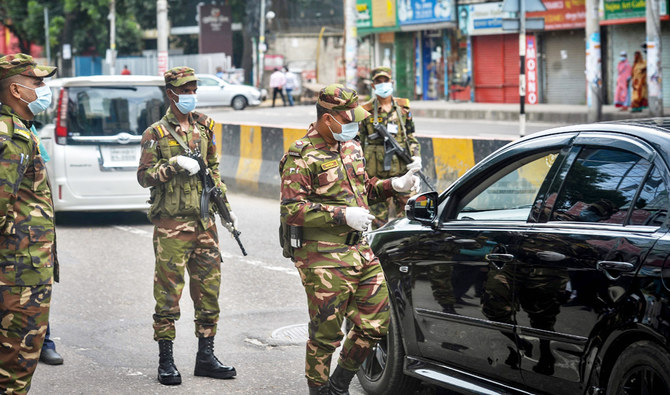
Security personnel positioned on the road to enforce a lockdown imposed by the Bangladesh's government to curb the spread of Covid-19 coronavirus in Dhaka on July 23, 2021. (AFP)
Short Url
Updated 24 July 2021
Follow

Bangladesh imposes strict COVID-19 lockdown after lifting rules for Eid

  • A strict curfew for four weeks and acceleration of mass vaccination may help Bangladesh control the delta variant by September

DHAKA: Bangladesh on Friday imposed a two-week nationwide lockdown after having eased coronavirus disease (COVID-19) restrictions to allow millions of people to travel for Eid Al-Adha celebrations.
Authorities had lifted measures on July 13 in consideration of “the need to maintain normal economic activity” and allow for the second-most important religious holiday in the Muslim-majority country to go ahead relatively unhindered, despite a surge in virus cases and deaths.
The highly infectious delta variant of COVID-19 has contributed toward pushing up the rate of positive tests in the south Asian nation to more than 31 percent.
At least 1.14 million people among Bangladesh’s population of 169 million have contracted the virus since the pandemic outbreak and nearly 19,000 have died, 166 in the past 24 hours. However, figures on recorded cases and deaths are thought to be grossly underreported.
Farhad Hossain, state minister for public administration, said on Thursday the latest lockdown would be stricter than before, with not only all government and private offices shut, but also garment factories. During the previous lockdown, the garment sector, which is the country’s largest source of income, was allowed to operate.

FASTFACT

National 2-week shutdown will see all businesses, including garment sector, close as virus cases, deaths surge.

“Offices, courts, garment factories, and all other export-oriented industries, everything to be precise, will remain closed,” Hossain added.
He pointed out that those who had traveled to their villages for Eid, would not be allowed to return to the cities until Aug. 5.
Although the lockdown is now again in place, health experts fear damage will already have been done by the government’s decision to lift preventive rules for Eid.
Prof. Dr. Alamgir Chowdhury, principal scientific officer of the Institute of Epidemiology Disease Control and Research (IEDCR), told Arab News: “The lockdown restrictions were lifted at a moment when we just started noticing a downward trend in the positivity rate.
“But now it will increase again, as people from the cities rushed to their villages, flouting health and safety protocols in the last week.”
And Prof. Dr. A.S.M. Amanullah, a public health expert at the University of Dhaka, said that while the country was currently recording between 10,000 and 15,000 new daily infections, the real figures were likely to be “much higher.”
“In this situation, lockdown may not work to bring the infection rate down. A strict curfew for four weeks and acceleration of mass vaccination may help Bangladesh control the delta variant by September.
“It was not wise to relax the lockdown restrictions during Eid Al-Adha. Health authorities didn’t care about the advice of the national COVID-19 control committee. As a result, it is only a matter of time before there is a surge in new infections, probably in the next two weeks,” he added.
While businesses are expecting huge losses from the lockdown, especially in the garment industry, some economists claim the situation would have been worse had there been no restrictions.
Dr. Mostafizur Rahman, of the Center for Policy Dialogue, an NGO involved in economic research, said: “Bangladesh needs a circuit-breaker for this second wave of coronavirus. If this wave continues for a longer period, the country may face a negative branding as a hotspot of COVID-19 infections which will be even worse in the long run.”
He noted that the government had taken some difficult decisions, especially as the country had received numerous apparel orders for the coming winter season.
“To make up for the losses of this lockdown, manufacturers may consider increasing working shifts at their factories. Some factories may require air shipments to meet buyer delivery times and the government may facilitate this.
“Port facilities should also be prepared on a high-priority basis for exporting the garment products while the lockdown is lifted,” Rahman added.


Afghanistan launches retaliatory attacks on Pakistan as tensions escalate

Updated 5 sec ago
Follow

Afghanistan launches retaliatory attacks on Pakistan as tensions escalate

  • At least 66 Afghans have been killed by Pakistan’s strikes, Afghan authorities say
  • Afghanistan has called for dialogue while Pakistan ruled out any talks with Kabul 

KABUL: Afghanistan has launched new attacks on Pakistan’s military bases, the Afghan defense ministry said on Saturday, as cross-border clashes escalated between the neighbors after months of tension. 

The latest flare-up erupted after Pakistan’s airstrikes on Afghan territory last weekend triggered a retaliatory offensive from Afghanistan along the border on Thursday. 

The two countries have engaged in tit-for-tat attacks since, marking the most serious development in ongoing tensions between the two countries, which agreed to a ceasefire last October following a week of deadly clashes. 

Afghanistan’s Air Force has “once again launched airstrikes on Pakistani military bases” in Miranshah and Spinwam, the Afghan Ministry of National Defense said on X on Saturday, claiming that the strikes caused “severe damage and heavy casualties.”

“These successful operations were conducted in response to repeated aerial aggressions by the Pakistani military regime,” the ministry said. 

Afghan forces also launched similar strikes against military targets in Islamabad and Abbottabad on Friday, which the ministry said was in retaliation of aerial attacks by Pakistani forces in Kabul, Kandahar and Paktia.

At least 66 Afghan civilians, mostly women and children, have been killed in Pakistani strikes, with another 59 others wounded, according to Hamdullah Fitrat, deputy spokesman for the Afghan government. 

Pakistan has maintained that it is targeting only military targets to avoid any civilian casualties, in compliance with international law. 

Pakistani officials said its forces have killed more than 330 Afghan fighters and targeted 37 military locations across Afghanistan.

Zabihullah Mujahid, chief spokesperson for the Afghan government, earlier called for talks to resolve the crisis. 

“We have always emphasized peaceful resolution, and now too we want the issue to be resolved through dialogue,” he said on Friday. 

However, Pakistan has ruled out any talks with Kabul. 

“There won’t be any talks, there is nothing to talk about. There’s no negotiation. Terrorism from Afghanistan has to end,” Mosharraf Zaidi, spokesperson for Pakistan’s prime minister, said on Friday. 

Pakistan is accusing the Afghan Taliban of sheltering fighters from the banned Tehreek-e-Taliban Pakistan and allowing them to stage cross-border attacks — a charge Afghanistan denies, saying it does not allow its territory to be used against other countries. 

As international calls for mediation grow amid the escalating hostility, Afghans across the country are growing fearful of the violence. 

“Everyone heard the jets. This is the first time since the withdrawal of US invaders that we have heard such a horrible noise and news of damage. It is not good for us,” said Kandahar resident Shahid Zamari. 

“We had forgotten the US war and its bad impact on us, on our families, on our children. And now this has come upon us again — by Pakistan, and in the holy month of Ramadan.” 

When the strikes hit Kabul at around 1:30 a.m. on Friday, Saleema Wardak moved quickly to wake up her six children and escape outside, assuming the strong jolt that shook her house was an earthquake. 

“While standing in the yard, my husband told me it was not an earthquake but an explosion. Then we heard the crazy sounds of planes, and shooting from the mountains against the planes,” she told Arab News. 

“We hid inside, worried another bomb would fall on us. People say Pakistan is targeting civilians on purpose to increase pressure on the Taliban. So we hid … The world is unjust … They do not value the blood of the poor.” 

For Sabawoon, a 23-year-old student from eastern Kunar province’s Asadabad city, the coming days are filled with uncertainties. 

“What to do? Where to go? We have to stay and find our way to survive,” he told Arab News. “God willing, nothing bad will happen to us. If they are bombing us, what can we do?”