

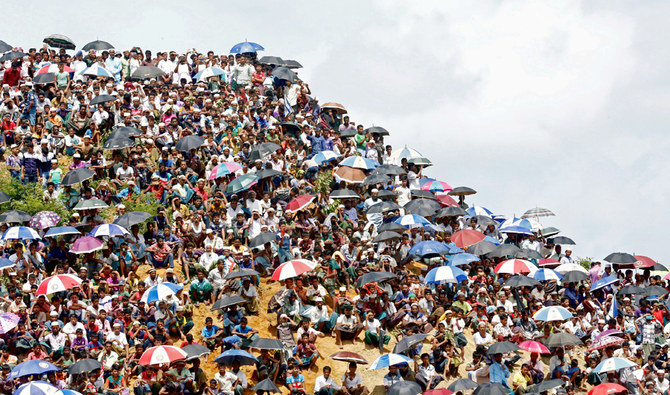

DHAKA: Bangladesh has launched an initiative to provide 5,000 Rohingya refugees with essential tools to earn a living after relocating them to a remote island last year, officials told Arab News on Sunday.
At present, nearly 19,000 Rohingya are residing on Bhasan Char, dubbed Rohingya island, after Dhaka began relocating the refugees from crammed camps in its Cox’s Bazar district to the facility in December.
“Based on a recent assessment, we plan to provide 5,000 Rohingya with livelihood equipment according to their skill set,” Moazzam Hossain, in charge of Bhasan Char camp and additional commissioner of the Refugee Relief and Repatriation Commission, told Arab News.
In the first phase of the project, which was initiated on Friday, 2,500 Rohingya were provided with fishing nets, rickshaw vans, poultry, cobbler tools, sewing machines and repair equipment.
“Many of the Rohingya are experienced in fishing, poultry farming, cattle rearing, and agriculture ... now they can manage to earn a living,” Hossain added.
Located in the Bay of Bengal, 60 km from the mainland, Bhasan Char was built by Dhaka in 2006 using Himalayan silt and sediment to ease the overcrowded camps in the Cox’s Bazar district.
The project cost more than $360 million.
Bangladesh is currently hosting more than 1.1 million Rohingya at Cox’s Bazar refugee camp, believed to be the world’s largest refugee settlement, with plans to relocate 100,000 more to Bhasan Char eventually.
The Rohingya are members of an ethnic and religious minority group, many of whom fled persecution in Myanmar during a military crackdown in 2017.
Buddhist-majority Myanmar considers the Rohingya to be “Bengalis” from Bangladesh, even though their families have lived in the country for generations.
Almost all have been denied citizenship for decades on top of a lack of freedom of movement and fundamental rights.
Since being relocated to Bhasan Char, the Rohingya have primarily relied on government handouts and foreign aid for survival, but have been pushing for financial independence ever since.
Nur Banu, a 37-year-old Rohingya refugee, said Dhaka’s latest initiative would provide her family of four with a new lease of life.
“We received food support (since moving to the island) but didn’t have cash in hand. With this sewing machine, I can make clothes for my children and earn by selling clothes to others too,” she said.
Another Rohingya refugee, 48-year-old Abdul Malek, said he would be banking on his fishing experience in Myanmar to start anew in Bhasan Char.
“It’s a shame to live on alms all the time when I can work. Now, I have the scope for fishing and earning as well. I can stand on my own feet again!” Malek, a father of four, told Arab News.
For Mohammad Ali, 53, the latest project has “become a reason for a double celebration on Eid.”
Eid Al-Adha, which will be celebrated in Bangladesh on Wednesday, is one of the two most important festivals of the Islamic calendar, with Muslims around the world marking the holiday by sacrificing animals such as sheep or goats.
Ali hopes to make the “most of the occasion by setting up a barbershop” on the island with his newly acquired tools.
“I received a set of grooming equipment and expect to open the shop before Eid Al-Adha,” he said.
Experts, however, say the initiative would have been more effective if the Rohingya were allowed to market their products in mainland communities.
“The goods and agricultural products which the Rohingya will produce will be consumed mostly by inhabitants on the island. But if the government took an initiative to market this outside, it would offer the Rohingya a better price,” Prashun Barua, chairman of Social Aid, a local NGO working for developmental projects on Bhasan Char, told Arab News.
“Some NGOs may work on this in collaboration with the government authorities. It will offer the Rohingya a better life.”


