

Startups provide vital shot in the arm for MENA health sector

1 / 3
2 / 3
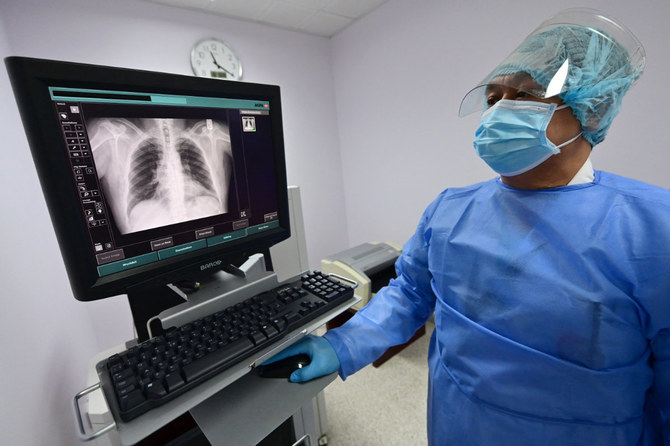
A doctor examines an inmate's X-ray at the medical center of Dubai's Al-Awir central prison amid the COVID-19 pandemic. (AFP file photo)
3 / 3
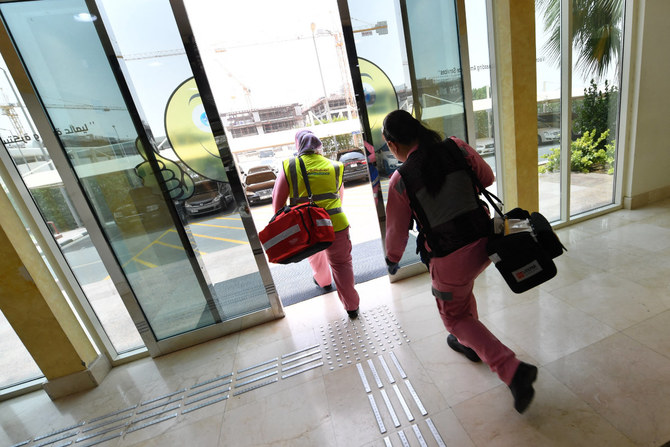
Maria Lagbes, a Filipino doctor who joined the Women Responders team, leaves the ambulance service headquarters after receiving an emergency call on July 13, 2017, in Dubai. (AFP)
Short Url
Updated 26 July 2021
Follow

Startups provide vital shot in the arm for MENA health sector

  • In 2020 alone, 351 digital health startups worldwide attracted a combined $13.8 billion in investment
  • Personal experience inspired some innovators to launch apps that provide culturally relevant solutions

DUBAI: The events of the past year have underscored the urgent need for quality healthcare services as well as innovative solutions. In 2020 alone, 351 digital health startups across the world attracted a combined $13.8 billion in investment, almost double the amount in either 2018 or 2019, according to an estimate by MobiHealthNews.

Among them was Dubai-headquartered Okadoc, a physician-booking platform that landed $10 million in Series A funding to expand into new GCC markets.

Vezeeta, which allows patients to find and access medical services across 50 cities, attracted $40 million in fresh capital.
Bahrain-based Saaya Health aims to bring affordable, culturally relevant mental health solutions to GCC consumers.

The move follows its significant success in the B2B space, where it has employee assistance agreements with pharmaceuticals leader Bayer and cosmetics major L’Oreal.

“Access to good-quality and culturally appropriate mental health support is rare in this market, including corporate mental health and employee assistance programs,” company founder Sarmad Ahmad said.

“There was — and sometimes still is — a stigma around the words ‘mental health.’ The coronavirus pandemic has really put our emotions in sharp focus as we have all had had time for introspection. As people look to improve their relationships, their habits, tackle stress and improve performance at work, the demand is rising for good-quality counsellors and therapists.”

Saaya Health’s services are delivered online in seven countries, with 52 therapists providing counselling in 12 languages, including Arabic, French, Pashto, Malayalam, Hausa and Swahili. With its corporate partnerships, the company offers digital mental health services to more than 700,000 individuals.

“Our long-term goal is to be an impact unicorn, serving a billion people globally. Bahrain, with its strong digital infrastructure, will serve as our base to launch a three-year plan to reach at least 5 million people across the MENA region.”


Maria Lagbes, a Filipino doctor who joined the Women Responders team, leaves the ambulance service headquarters after receiving an emergency call on July 13, 2017, in Dubai. (AFP)

The urge to help a friend can sometimes spark the idea for a new business venture. That was the case with medical device company ProvenMed, whose founders Amine Staali and Souheil Guessoum built an innovative adult urinary incontinence device that is already helping thousands of people across 10 different markets.

Over 200 million people worldwide suffer from the condition. Launched in 2019, ProvenMed’s flagship device, ActviGo, is a reusable and washable system-integrated urinary external catheter for male incontinence management. It eliminates the need for diapers and condom catheters, allowing patients to manage their condition hygienically and discreetly.

The company, based in Abu Dhabi’s HUB71, also produces non-invasive reusable male external catheters, breathable undergarments, leakproof urine collection bags and portable bidets.

ProvenMed launched an online store in 2019 to bypass coronavirus-linked distribution issues, offering worldwide delivery. A winner of August’s Dubai Smartpreneur 5.0 competition, the business now wants to expand into Asia and Europe as well as develop similar incontinence solutions for women, children with bedwetting problems, people with special needs and the military.


A doctor examines an inmate's X-ray at the medical center of Dubai's Al-Awir central prison amid the COVID-19 pandemic. (AFP file photo)

One product in development is a smart device that monitors illnesses remotely and shares data with urologists.

Jordan’s Carers is a mobile platform that enables households to find and access vetted in-home nurses, physiotherapists and childcare specialists. In the process, it creates new jobs for certified care-givers.

The app was named best healthcare solution in 2019 December’s UCAN Awards at the Sharjah Entrepreneurship Festival, a $250,000 contest that recognizes regional entrepreneurs who have created high-impact solutions for the post-COVID-19 world.

“Many people faced the same struggle — how do you trust a stranger or ascertain the right quality of care and experience?” founder Raad Al-Kalha said.

Personal experience inspired Al-Kalha to launch the app in Amman in 2018, starting with 35 care-givers and two services.

“We have expanded our offering to include nursing visits, physiotherapy and blood tests and have a network of 300 care-givers who have provided more than 28,000 hours of care, created 5,000 job opportunities, and achieved 300 percent year-on-year growth from 2019-20,” he said.


AI will never replace human creativity, says SRMG CEO 

Updated 30 January 2026
Follow

AI will never replace human creativity, says SRMG CEO 

  • Speaking to Maya Hojeij, senior business anchor at Asharq with Bloomberg, Jomana R. Alrashid expressed pride in SRMG platforms that had absorbed and adopted AI

RIYADH: Jomana R. Alrashid, CEO of Saudi Research and Media Group, highlighted how AI cannot replace human creativity during a session at The Family Office’s “Investing Is a Sea” summit at Shura Island on Friday. 

“You can never replace human creativity. Journalism at the end of the day, and content creation, is all about storytelling, and that’s a creative role that AI does not have the power to do just yet,” Alrashid told the investment summit. 

“We will never eliminate that human role which comes in to actually tell that story, do the actual investigative reporting around it, make sure to be able to also tell you what’s news or what’s factual from what’s wrong ... what’s a misinformation from bias, and that’s the bigger role that the editorial player does in the newsroom.”

Speaking on the topic of AI, moderated by Maya Hojeij, senior business anchor at Asharq with Bloomberg, the CEO expressed her pride in SRMG platforms that had absorbed and adopted AI in a way that was “transformative.”

“We are now translating all of our content leveraging AI. We are also now being able to create documentaries leveraging AI. We now have AI-facilitated fact-checking, AI facilities clipping, transcribing. This is what we believe is the future.”

Alrashid was asked what the journalist of the future would look like. “He’s a journalist and an engineer. He’s someone who needs to understand data. And I think this is another topic that is extremely important, understanding the data that you’re working with,” she said.

“This is something that AI has facilitated as well. I must say that over the past 20 years in the region, especially when it comes to media companies, we did not understand the importance of data.”


The CEO highlighted that previously, media would rely on polling, surveys or viewership numbers, but now more detailed information about what viewers wanted was available. 

During the fireside session, Alrashid was asked how the international community viewed the Middle Eastern media. Alrashid said that over the past decades it had played a critical role in informing wider audiences about issues that were extremely complex — politically, culturally and economically — and continued to play that role. 

“Right now it has a bigger role to play, given the role again of social media, citizen journalists, content creators. But I also do believe that it has been facilitated by the power that AI has. Now immediately, you can ensure that that kind of content that is being created by credible, tier-A journalists, world-class journalists, can travel beyond its borders, can travel instantly to target different geographies, different people, different countries, in different languages, in different formats.”

She said that there was a big opportunity for Arab media not to be limited to simply Arab consumption, but to finally transcend borders and be available in different languages and to cater to their audiences. 


The CEO expressed optimism about the future, emphasizing the importance of having a clear vision, a strong strategy, and full team alignment. 

Traditional advertising models, once centered on television and print, were rapidly changing, with social media platforms now dominating advertising revenue.

“It’s drastically changing. Ultimately in the past, we used to compete with one another over viewership. But now we’re also competing with the likes of social media platforms; 80 percent of the advertising revenue in the Middle East goes to the social media platforms, but that means that there’s 80 percent interest opportunities.” 

She said that the challenge was to create the right content on these platforms that engaged the target audiences and enabled commercial partnerships. “I don’t think this is a secret, but brands do not like to advertise with news channels. Ultimately, it’s always related with either conflict or war, which is a deterrent to advertisers. 

“And that’s why we’ve entered new verticals such as sports. And that’s why we also double down on our lifestyle vertical. Ultimately, we have the largest market share when it comes to lifestyle ... And we’ve launched new platforms such as Billboard Arabia that gives us an entry into music.” 

Alrashid said this was why the group was in a strong position to counter the decline in advertising revenues across different platforms, and by introducing new products.

“Another very important IP that we’ve created is events attached to the brands that have been operating in the region for 30-plus years. Any IP or any title right now that doesn’t have an event attached to it is missing out on a very big commercial opportunity that allows us to sit in a room, exchange ideas, talk to one another, get to know one another behind the screen.” 

The CEO said that disruption was now constant and often self-driving, adding that the future of the industry was often in storytelling and the ability to innovate by creating persuasive content that connected directly with the audience. 

“But the next disruption is going to continue to come from AI. And how quickly this tool and this very powerful technology evolves. And whether we are in a position to cope with it, adapt to it, and absorb it fully or not.”