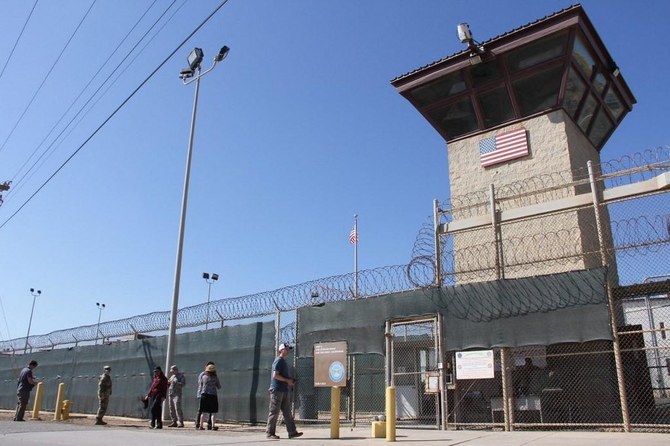
WASHINGTON: The Biden administration on Monday transferred a detainee out of the Guantánamo Bay detention facility for the first time, sending a Moroccan man back home years after he was recommended for discharge.
The Moroccan prisoner, Abdullatif Nasser, who’s in his mid-50s, was cleared for repatriation by a review board in July 2016 but remained at Guantanamo for the duration of the Trump presidency.
The Periodic Review Board process determined that Nasser’s detention no longer remained necessary to protect US national security, the Pentagon said Monday in a statement. The board recommended authorization for Nasser’s repatriation, but that couldn’t be completed before the end of the Obama administration, it said.
The transfer of Nasser could suggest President Joe Biden is making efforts to reduce the Guantanamo population, which now stands at 39. Presidents George W. Bush and Barack Obama supported the prisoner transfer process, but it stalled under President Donald Trump.
Trump said even before he took office that there should be no further releases from “Gitmo,” as Guantanamo Bay is often called. “These are extremely dangerous people and should not be allowed back onto the battlefield,” he said then.
The possibility that former Guantanamo prisoners would resume hostile activities has long been a concern that has played into the debate over releases. The office of the Director of National Intelligence said in a 2016 report that about 17 percent of the 728 detainees who had been released were “confirmed” and 12 percent were “suspected” of re-engaging in such activities.
But the vast majority of those re-engagements occurred with former prisoners who did not go through the security review that was set up under Obama. A task force that included agencies such as the Defense Department and the CIA analyzed who was held at Guantanamo and determined who could be released and who should continue in detention.
The US thanked Morocco for facilitating Nasser’s transfer back home.
“The United States commends the Kingdom of Morocco for its long-time partnership in securing both countries’ national security interests,” the Pentagon statement said. “The United States is also extremely grateful for the Kingdom’s willingness to support ongoing US efforts to close the Guantanamo Bay Detention Facility.”
Nasser initially got news he was going to be released in the summer of 2016, when one of his lawyers called him at the detention center and told him the US had decided he no longer posed a threat and could go home. He thought he’d returned to Morocco soon: “I’ve been here 14 years,” he said at the time. “A few months more is nothing.”
Nasser’s journey to the Cuban prison was a long one. He was a member of a nonviolent but illegal Moroccan Sufi Islam group in the 1980s, according to his Pentagon file. In 1996, he was recruited to fight in Chechyna but ended up in Afghanistan, where he trained at an Al-Qaeda camp. He was captured after fighting US forces there and sent to Guantanamo in May 2002.
An unidentified military official appointed to represent him before the review board said he studied math, computer science and English at Guantanamo, creating a 2,000-word Arabic-English dictionary. The official told the board that Nasser “deeply regrets his actions of the past” and expressed confidence he would reintegrate in society.

Joe Biden transfers first Guantanamo detainee to home country
Short Url
https://arab.news/c2n3u
Joe Biden transfers first Guantanamo detainee to home country
- Moroccan prisoner Abdullatif Nasser was cleared for repatriation by a review board in July 2016
- But he remained detained at Guantanamo for the duration of Donald Trump’s presidency
Ice-cool Rybakina beats Sabalenka in tense Australian Open final
- The big-serving Kazakh fifth seed held her nerve to pull through 6-4, 4-6, 6-4
- Rybakina who was born in Moscow, adds her Melbourne triumph to her Wimbledon win in 2022
MELBOURNE: Elena Rybakina took revenge over world number one Aryna Sabalenka to win a nail-biting Australian Open final on Saturday and clinch her second Grand Slam title.
The big-serving Kazakh fifth seed held her nerve to pull through 6-4, 4-6, 6-4 at Rod Laver Arena in Melbourne in 2hrs 18mins.
It was payback after the Belarusian Sabalenka won the 2023 final between two of the hardest hitters in women’s tennis.
The ice-cool Rybakina, 26, who was born in Moscow, adds her Melbourne triumph to her Wimbledon win in 2022.
“Hard to find the words now,” said Rybakina, and then addressed her beaten opponent to add: “I know it is tough, but I hope we play many more finals together.”
Turning to some Kazakh fans in the crowd, she said: “Thank you so much to Kazakhstan. I felt the support from that corner a lot.”
It was more disappointment in a major final for Sabalenka, who won the US Open last year for the second time but lost the French Open and Melbourne title deciders.
She was into her fourth Australian Open final in a row and had been imperious until now, with tears in her eyes at the end.
“Let’s hope maybe next year will be a better year for me,” Sabalenka said ruefully.
Rybakina fights back
With the roof on because of drizzle in Melbourne, Rybakina immediately broke serve and then comfortably held for 2-0.
Rybakina faced two break points at 4-3, but found her range with her serve to send down an ace and dig herself out of trouble, leaving Sabalenka visibly frustrated.
Rybakina looked in the zone and wrapped up the set in 37 minutes on her first set point when Sabalenka fired long.
Incredibly, it was the first set Sabalenka had dropped in 2026.
The second game of the second set was tense, Rybakina saving three break points in a 10-minute arm-wrestle.
They went with serve and the seventh game was another tussle, Sabalenka holding for 4-3 after the best rally of a cagey affair.
The tension ratcheted up and the top seed quickly forged three set points at 5-4 on the Kazakh’s serve, ruthlessly levelling the match at the first chance to force a deciding set.
Sabalenka was now in the ascendancy and smacked a scorching backhand to break for a 2-0 lead, then holding for 3-0.
Rybakina, who also had not dropped a set in reaching the final, looked unusually rattled.
She reset to hold, then wrestled back the break, allowing herself the merest of smiles.
At 3-3 the title threatened to swing either way.
But a surging Rybakina won a fourth game in a row to break for 4-3, then held to put a thrilling victory within sight.
Rybakina sealed the championship with her sixth ace of the match.
The finalists were familiar foes having met 14 times previously, with Sabalenka winning eight of them.
Sabalenka came into the final as favorite but Rybakina has been one of the form players on the women’s tour in recent months.
She also defeated Sabalenka in the decider at the season-ending WTA Finals.
Rybakina beat second seed Iga Swiatek in the quarter-finals and sixth seed Jessica Pegula in the last four in Melbourne.
Rybakina switched to play under the Kazakh flag in 2018 when she was a little-known 19-year-old, citing financial reasons.
The big-serving Kazakh fifth seed held her nerve to pull through 6-4, 4-6, 6-4 at Rod Laver Arena in Melbourne in 2hrs 18mins.
It was payback after the Belarusian Sabalenka won the 2023 final between two of the hardest hitters in women’s tennis.
The ice-cool Rybakina, 26, who was born in Moscow, adds her Melbourne triumph to her Wimbledon win in 2022.
“Hard to find the words now,” said Rybakina, and then addressed her beaten opponent to add: “I know it is tough, but I hope we play many more finals together.”
Turning to some Kazakh fans in the crowd, she said: “Thank you so much to Kazakhstan. I felt the support from that corner a lot.”
It was more disappointment in a major final for Sabalenka, who won the US Open last year for the second time but lost the French Open and Melbourne title deciders.
She was into her fourth Australian Open final in a row and had been imperious until now, with tears in her eyes at the end.
“Let’s hope maybe next year will be a better year for me,” Sabalenka said ruefully.
Rybakina fights back
With the roof on because of drizzle in Melbourne, Rybakina immediately broke serve and then comfortably held for 2-0.
Rybakina faced two break points at 4-3, but found her range with her serve to send down an ace and dig herself out of trouble, leaving Sabalenka visibly frustrated.
Rybakina looked in the zone and wrapped up the set in 37 minutes on her first set point when Sabalenka fired long.
Incredibly, it was the first set Sabalenka had dropped in 2026.
The second game of the second set was tense, Rybakina saving three break points in a 10-minute arm-wrestle.
They went with serve and the seventh game was another tussle, Sabalenka holding for 4-3 after the best rally of a cagey affair.
The tension ratcheted up and the top seed quickly forged three set points at 5-4 on the Kazakh’s serve, ruthlessly levelling the match at the first chance to force a deciding set.
Sabalenka was now in the ascendancy and smacked a scorching backhand to break for a 2-0 lead, then holding for 3-0.
Rybakina, who also had not dropped a set in reaching the final, looked unusually rattled.
She reset to hold, then wrestled back the break, allowing herself the merest of smiles.
At 3-3 the title threatened to swing either way.
But a surging Rybakina won a fourth game in a row to break for 4-3, then held to put a thrilling victory within sight.
Rybakina sealed the championship with her sixth ace of the match.
The finalists were familiar foes having met 14 times previously, with Sabalenka winning eight of them.
Sabalenka came into the final as favorite but Rybakina has been one of the form players on the women’s tour in recent months.
She also defeated Sabalenka in the decider at the season-ending WTA Finals.
Rybakina beat second seed Iga Swiatek in the quarter-finals and sixth seed Jessica Pegula in the last four in Melbourne.
Rybakina switched to play under the Kazakh flag in 2018 when she was a little-known 19-year-old, citing financial reasons.
© 2026 SAUDI RESEARCH & PUBLISHING COMPANY, All Rights Reserved And subject to Terms of Use Agreement.


