DHAKA: A boat carrying dozens of Rohingya refugees that set sail in February but had been adrift in the Andaman Sea with engine failure has landed on an Indonesian island after a voyage of more than 100 days, a human rights official said on Friday.
The vessel sailed on Feb. 11 from Cox’s Bazar in Bangladesh carrying 90 Rohingya refugees, most of them women and children, with the hope of reaching Malaysia.
But the boat’s engine failed four days after leaving Cox’s Bazar, where refugee camps house hundreds of thousands of Rohingya Muslims who have fled neighboring Myanmar.
“We have learnt that the 81 (refugees) were fine, they landed on Idaman Island in Aceh (Indonesia),” said Chris Lewa, director of the Arakan Project, a group that monitors the Rohingya crisis.
“They are not 100 percent safe there yet. We hope they will not be pushed back,” Lewa told Reuters.
Of the 90 people who set out on the voyage, eight were found dead by Indian Coast Guards who had tracked and later repaired the vessel in February.
Indian authorities provided food and essential supplies to survivors but refused to let them set foot on their shores. Bangladesh, too, denied re-entry to 81 survivors.
Over the last three months, international aid agencies and family members of those onboard have made repeated appeals to India, Bangladesh, Myanmar and Malaysia for information about the fate of the survivors on the boat.
Dwi Prafitria, spokeswoman for the United Nations High Commissioner for Refugees in Indonesia, told Reuters that the refugees currently don’t have a place to stay as it awaits coordination with the local government.
Authorities in Indonesia, including local police and immigration, were not immediately available for comment on Friday.
The Rohingya are a minority group, most of whom are denied citizenship by Buddhist-majority Myanmar, which considers them illegal immigrants from Bangladesh.
More than 1 million Rohingya refugees from Myanmar are living in teeming camps in Bangladesh, including tens of thousands who fled after Myanmar’s military conducted a deadly crackdown in 2017.
Human traffickers often lure Rohingya refugees, persuading them to travel on rickety vessels with the promise of work in Southeast Asian countries like Malaysia.

Rohingya refugee boat lands in Indonesia after 113-day voyage
https://arab.news/vc6e7
Rohingya refugee boat lands in Indonesia after 113-day voyage
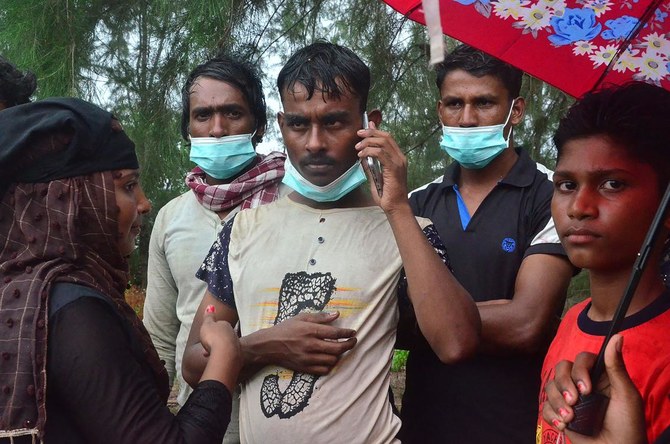
- The vessel sailed on Feb. 11 from Cox’s Bazar in Bangladesh carrying 90 Rohingya refugees
- But the boat’s engine failed four days after leaving Cox’s Bazar
Filipinos worry about future as Manila posts worst economic growth in 15 years
- Philippine economy slowed to weakest pace last quarter, with only 3.0 percent growth
- Filipinos struggle with high prices, increased business cost, reduced savings
MANILA: Over ten years ago, when Fatima Macud brought home roughly 30,000 pesos ($509) a month, the money was enough to cover her expenses and still leave room for savings.
Though she now earns 45,000 pesos, Macud finds herself unable to save any money as she struggles with rising prices to cover daily spending.
“Yes, I got a salary increase, but the thing is, the cost of living here in the city also increased,” the 52-year-old resident of Metro Manila told Arab News on Saturday.
“Now for me, it barely covers my basic needs because the price of commodities just keeps rising — goods, services, everything … Everything feels way too expensive … Now, I can’t save money at all. It’s not enough.”
The Philippine economy has slowed to the weakest pace in nearly 15 years outside of the pandemic, with data from the Philippines Statistics Authority showing just 3.0 percent growth in October to December, compared with 5.3 percent from the same period a year earlier.
The full-year growth in 2025 settled at 4.4 percent, below the 5.7 percent posted in 2024 and lower than the government’s revised target of at least 4.8 percent.
It was the result of “several converging factors,” Economic Planning Secretary Arsenio Balisacan told reporters earlier this week.
“These include the adverse economic effects of weather and climate-related disruptions. Admittedly, the flood control corruption scandal also weighed on business and consumer confidence,” he said.
But on the ground, Filipinos were more concerned about their day-to-day lives, and the state of the economy has begun to spark new worries about the future.
“I am worried about my future, especially my retirement. If the government is in a bankruptcy state or ends up in financial trouble, will they be able to pay my pension? Can I still avail the free health services with full benefits?” Macud said.
“I’m also worried about my family’s future; the rising cost of living and the lack of employment opportunities.”
Olga Resureccion, a 52-year-old worker in Manila, is among those who believes the government has been “trying its best,” and is keeping her hopes alive.
“You can’t lose hope,” she said. “Most people are still able to provide for themselves and their family. Like (me), I’m able to provide. You just really need to work hard.”
Yet for entrepreneurs such as John Paul Maunes, the economic slowdown was taking a toll on his small restaurant in Cebu City, as he struggled with increasing prices of supplies, taxes and cost of government permits.
“I think people from the ground, especially business owners, are really struggling right now. Particularly those who are SMEs (small and medium enterprises),” Maunes said.
“We cannot increase our prices the way we want it because we’ll lose our customers. And at the same time, we are also struggling on how we can cope with the rising prices of commodities. Plus, the government permits and taxes are increasing every year.”
Over the years, the 41-year-old has had to lay off employees to survive, while hoping for more government support and opportunities through economic growth.
“We have this fear of impending doom as small business owners … With the increasing prices and economic impact on us on the ground, it’s a huge challenge,” he said.
“We’re just hoping that better things will come for our government, for our economy.”


