Mina, the City of Tents

1 / 6
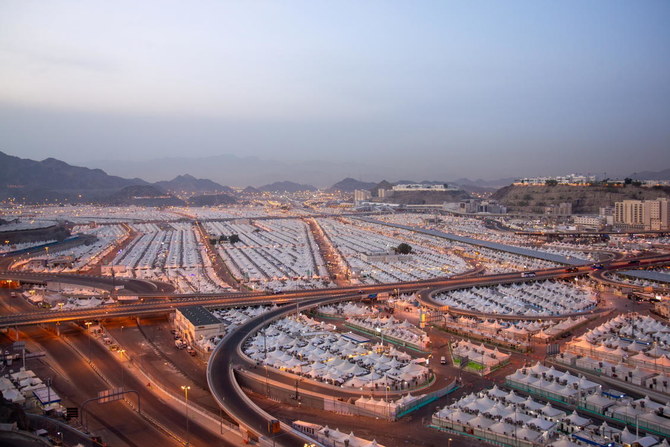
Aerial view of Mina area ahead of the annual Haj pilgrimage, in the holy city of Mecca, Saudi Arabia July 18, 2021. (Reuters)
2 / 6
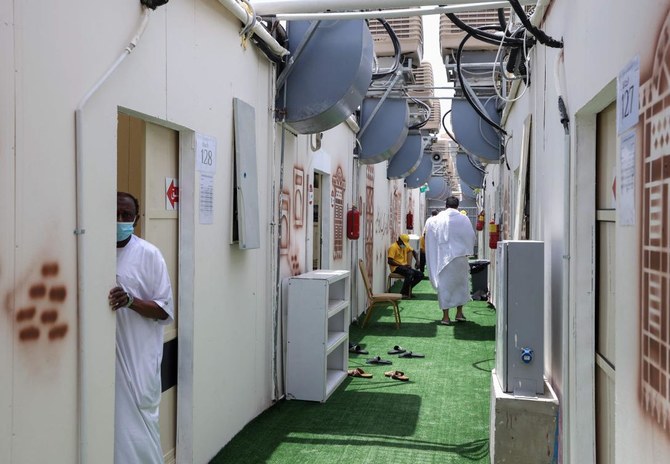
Pilgrims walk in an alley of their camp in Mina, which sits in a narrow valley surrounded by rocky mountains near Makkah, and is transformed each year into a vast encampment for Hajj pilgrims, on July 18, 2021. (AFP)
3 / 6
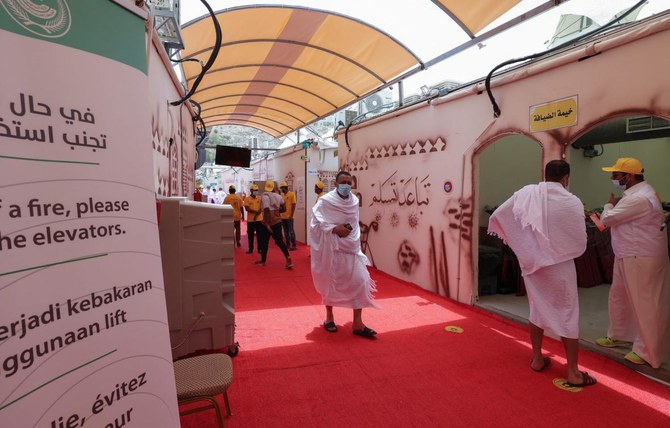
Muslim pilgrims arrive at their tent camp in Mina, near Makkah, Saudi Arabia, Sunday, July 18, 2021. (AP)
4 / 6
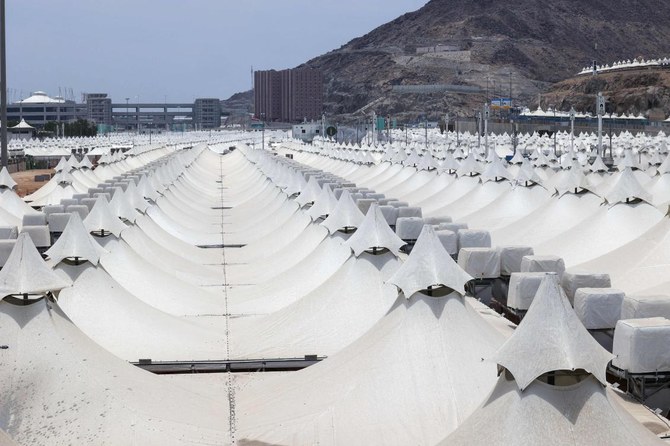
A picture shows pilgrim tents in Mina, which sits in a narrow valley surrounded by rocky mountains near Makkah, and is transformed each year into a vast encampment for Hajj pilgrims, on July 18, 2021. (AFP)
5 / 6
Pilgrims walk in an alley of their camp in Mina on July 18, 2021. (AFP)
6 / 6
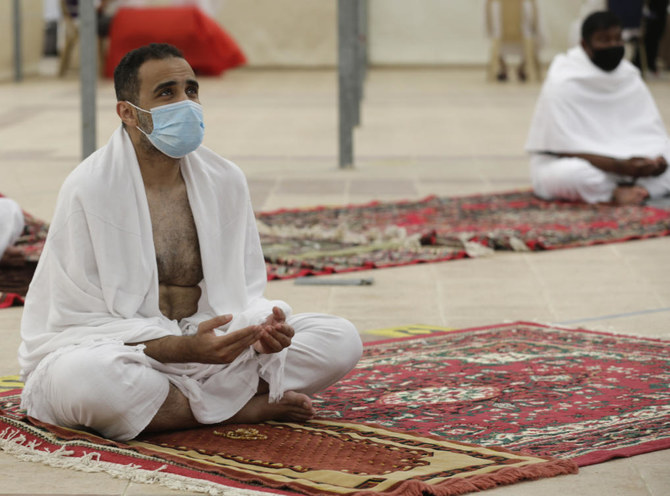
A Muslim pilgrim prays at his tent camp in Mina, near Makkah, Saudi Arabia, Sunday, July 18, 2021. (AP)
Short Url
Updated 19 July 2021
Follow

Mina, the City of Tents

MINA: Mina’s Hajj tent development, known as the City of Tents, is one of the biggest projects executed by the Saudi government to serve pilgrims during the Hajj season to ensure their comfort and security, extending over 2.5 million square meters with a capacity of 2.6 million people.


Pilgrimages in the past used to suffer from regular tent fires in Mina, largely as a result of pilgrims not adhering to safety guidelines. Despite exhaustive efforts to counter this, over the years fires claimed many lives, injured hundreds and resulted in pilgrims losing their property.
These tragedies led to the development of flame retardant tents made of fiberglass tissues covered with Teflon, which are resistant to high heat and ignition, and which prevent the emission of toxic gases.


The tents are linked to each other via paved, illuminated and signposted corridors, and each group of tents is surrounded by metal fences for security, with main gates and emergency exits.
They provide communal areas, toilets and bathrooms, kitchens and electrical outlets, and are equipped with air-conditioning systems, are shaped in accordance with Islamic norms, and are made of flexible parts to ease storage and installation.
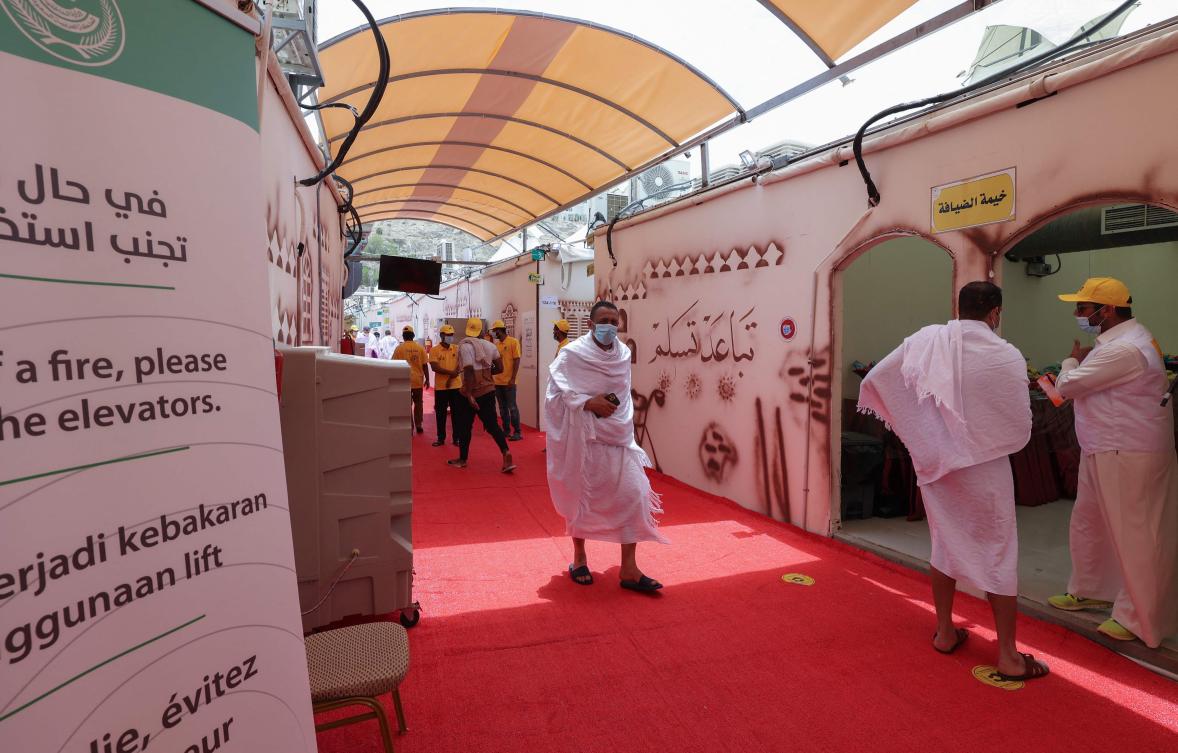

The tents are either 8 square meters in size, 6 by 8 meters or 12 by 8 meters, and fire extinguishers and hoses are distributed across the corridors at approximately one every 100 meters.
Water sprinklers, that operate automatically upon sensing heat, are installed in each tent to extinguish fires, and the moment water is emitted from one, an alarm rings to alert security staff to the danger.
Special water tanks have been installed in tunnels on top of the mountains near Mina, with a capacity of 200,000 cubic meters to be used to extinguish fires.


Saudi Arabia, Estonia strengthen cyber defense cooperation

Updated 09 February 2026
Follow

Saudi Arabia, Estonia strengthen cyber defense cooperation

  • Renowned for its leadership in digital governance, Estonia sees cybersecurity as central to its partnership potential with Saudi Arabia, building on years of regional engagement through its technology firms

RIYADH: Estonia aims to deepen defense, cybersecurity, and artificial intelligence cooperation with Saudi Arabia as both nations look to advance technology‑driven defense and cybersecurity capabilities.

Hanno Pevkur, Estonia’s minister of defense, told Arab News at the World Defense Show in Riyadh on Monday that Estonia’s defense industry is eager to contribute to the Kingdom’s fast‑growing defense ecosystem.

“In the modern world, cooperation built on trust and technology is the best defense,” he said. “It is important for us to be here because we clearly see there is a possibility to increase cooperation, not only bilaterally between Saudi Arabia and Estonia, but across the region.”

At Estonia’s pavilion, a cooperation agreement was signed between an Estonian company and a Saudi firm during the show, he noted.

Pevkur also said Estonia’s defense sector has expanded rapidly in recent years, driven by technological innovation and partnership.

“Our defense industry is growing very rapidly, and we continue to see strong momentum,” he said.

He said Estonia’s strengths lie in digital and smart‑system integration rather than large‑scale weapons production.

“We will not build airplanes or tanks, but what we can do is integrate robotics, automation and drones to make existing systems smarter,” he said.

The minister said effective defense collaboration must link businesses and governments to achieve meaningful results.

“When we want to have real cooperation, we need it on all levels,” he said. “The biggest client for any defense company is the government, so we must treat this as one ecosystem where the public and private sectors work hand in hand.”

Renowned for its leadership in digital governance, Estonia sees cybersecurity as central to its partnership potential with Saudi Arabia, building on years of regional engagement through its technology firms.

Pevkur said several Estonian companies, including Nortal, have already assisted Gulf governments in developing open IT and digital‑service systems.

“As the most digitalized nation in the world, almost every service in Estonia can be done online, except getting married,” he said. “But with such digitalization, we also need strong cyberdefense.”

He said data protection and digital resilience are treated as matters of national sovereignty in Tallinn, the capital of Estonia.

“Data is what we own. When someone steals that data, it becomes a serious threat,” he added. “That is why cyberdefense is not just about technology, it is about trust, sovereignty and protection.”

Pevkur said Saudi Arabia’s advances in AI offer promising opportunities for collaboration.

“I know that Saudi Arabia is doing great work when it comes to AI,” he said. “For us, as a small country with limited human resources, AI is essential not just for defense but for everyday life.”

Pevkur added that Estonia has launched a national AI strategy to promote responsible development and closer coordination between government and industry. One Estonian company, he said, has developed a system that allows a single operator to control hundreds of drones through AI.

“It is quite easy to put a weapon into the hands of a robot, but we also need to define who is accountable for its actions,” he said.

“The big question for the future is whether we can allow a war to be fought entirely by AI, or if humans must always make the final ethical decisions.”

He said in his conclusion that governments must reach a common understanding on how AI will be used and regulated on the battlefield.