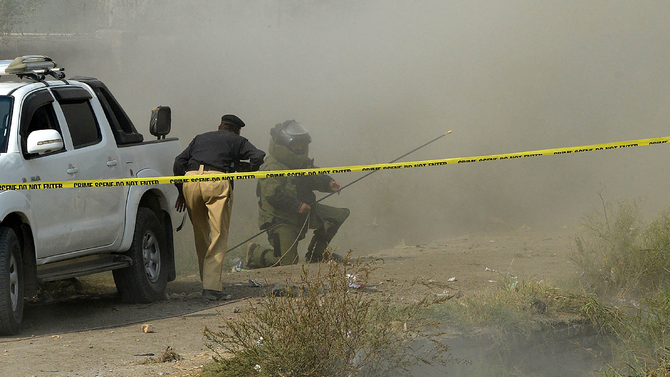
PESHAWAR: Nine Chinese workers were among 13 people killed on Wednesday when a blast on a bus sent it careening down a ravine in north-western Pakistan, officials said.
The bus was carrying Chinese engineers, surveyors and mechanical staff to the Dasu dam site in Khyber Pakhtunkhwa province, which is under construction.
“The blast sparked a fire in the engine plunging the vehicle into a ravine, a local government official told AFP, requesting not be named.
He said a further 28 Chinese nationals were injured.
A senior local police official, who also asked not to be named, confirmed the incident and said “it was a heavy blast but its nature is not known yet.”
The Chinese embassy in Pakistan posted a statement on Wednesday, saying that “a certain project of a Chinese firm in Pakistan suffered an attack, which caused the deaths of Chinese nationals.”
It urged Chinese firms to strengthen their security procedures.
Security of Chinese workers has long been an issue of concern in Pakistan, where Beijing has poured in tens of billions of dollars in recent years, and large numbers of Chinese nationals are now based in the country to supervise and build infrastructure projects.

13 killed, including 9 Chinese nationals, in Pakistan bus blast — officials
https://arab.news/n9f6h
13 killed, including 9 Chinese nationals, in Pakistan bus blast — officials
- Bus was carrying Chinese engineers, surveyors and mechanical staff to Dasu dam site in northwest
- Security of Chinese workers has long been an issue of concern in Pakistan
Pakistani president arrives in Iraq to deepen trade, energy cooperation
- Visit follows recent high-level contacts as Islamabad seeks to expand limited commercial ties with Baghdad
- Talks are expected to cover investment, manpower and facilitation of Pakistani pilgrims visiting holy sites in Iraq
ISLAMABAD: President Asif Ali Zardari arrived in Iraq on Saturday on an official visit aimed at expanding cooperation in trade, energy and investment, as Pakistan seeks to deepen ties with Baghdad after years of limited engagement.
Pakistan and Iraq established diplomatic relations in 1947 and have traditionally maintained cordial ties, though commercial links remain modest, with officials and business groups identifying scope for cooperation in construction services, pharmaceuticals, manpower and agricultural exports.
“President Asif Ali Zardari arrived in Baghdad on a four-day official visit to Iraq,” his office said in a post on X. “He was received by Culture Minister Dr. Ahmed Fakkak Al-Badrani. During the visit, meetings with senior Iraqi leadership are expected to advance cooperation and further strengthen Pakistan-Iraq relations.”
Zardari’s visit follows a series of recent high-level contacts between the two countries, reflecting efforts to broaden bilateral engagement beyond traditional diplomatic ties and explore collaboration across economic, political and people-to-people domains.
According to Pakistan’s foreign office, the president is expected to hold meetings with Iraq’s senior leadership to discuss cooperation in various areas such as trade and investment, energy, technology, education and manpower.
He is also expected to discuss regional and international issues with Iraqi officials.
Earlier this month, Pakistan’s Interior Minister Mohsin Naqvi met his Iraqi counterpart, Abdul Ameer Al-Shammari, on the sidelines of meetings in Brussels, where both sides agreed to enhance cooperation on security and facilitate travel for Pakistani Shia pilgrims to Najaf and Karbala.
The two officials discussed measures to ensure the smoother movement of these pilgrims and their compliance with visa regulations.


