

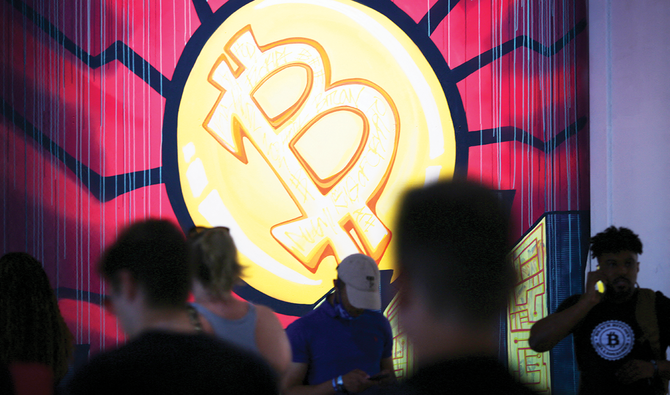
Bitcoin remains in $30-$40k price range for 7th straight week

For the past weeks, Bitcoin has mostly stayed in a range between $30,000 and $40,000 as traders awaited a US inflation report. (AFP)
Short Url
Updated 14 July 2021
Follow

Bitcoin remains in $30-$40k price range for 7th straight week

  • The largest cryptocurrency by market capitalization, Bitcoin, was holding above price support at $32,000, with $36,400 seen as the upside target

RIYADH: Bitcoin traded lower on Tuesday, falling by 2.97 percent to $32,519.49. Ether, the second most traded cryptocurrency, traded at $1,975.41, down by 5.92 percent, according to data from Coindesk.

Below is the main cryptocurrency news:

Bitcoin and most cryptocurrencies declined on Monday. The largest cryptocurrency by market capitalization, Bitcoin, was holding above price support at $32,000, with $36,400 seen as the upside target. 

For the past seven weeks, Bitcoin has mostly stayed in a range between $30,000 and $40,000 as traders awaited a key US inflation report due on Tuesday. Investors see Bitcoin as a potential hedge against inflation, so the release of the June consumer price index reading by the US Department of Labor’s Bureau of Labor Statistics should provide a key data point. Analysts also described the muted activity in spot, derivative and on-chain metrics as the “calm before the storm,” according to the website CoinDesk.

According to a press release on Monday, the Australian government is doling out millions in grants for two blockchain-based pilot projects to investigate the capability of blockchain in supply chain solutions. 

The government said that the research will help ease the burden of regulatory compliance and help increase the productivity and competitiveness of Australia’s metals and food and beverage sectors, according to CoinDesk. Australia has also invested almost $4.1 million into blockchain provenance startup Everledger and tech consultancy.

Woori Financial Group, one of the biggest banks in South Korea, will soon offer cryptocurrency custody services. According to reports from the Korea Economic Daily, Woori will establish a joint venture with Coinplug, a blockchain solutions developing company with more than 300 blockchain patents. 

While South Koreans have traditionally been attracted to cryptocurrency, their regulatory framework forbids them from relying on exchanges for custody. This has spurred interest from banks in stepping up and including cryptocurrency custody in their services.

A Woori official said that in overseas markets, digital asset custody has become a successful, established practice among the new services offered by banks, according to Bitcoin News.


Growing pressure on Arab banks amid complex cross-border contracts, legal risks 

Updated 7 sec ago
Follow

Growing pressure on Arab banks amid complex cross-border contracts, legal risks 

DAMMAM: Arab banks — numbering around 520 this year — are facing mounting challenges, led by the growing complexity of cross-border banking contracts and rising legal risks tied to modern financial products, Wissam Fattouh, secretary-general of the Union of Arab Banks, told Al-Eqtisadiah. 

Fattouh said addressing these challenges, driven by global economic and financial shifts, requires Arab banks — whose combined assets exceed $5.5 trillion — to strengthen risk management, continue structural reforms, and expand cooperation with foreign banks and financial institutions in line with the nature of global financial markets. 

He noted that the “Certified International Arbitrator” credential offered by the UAB to Arab banks is one of the professional tools supporting governance in banking transactions and providing effective, specialized alternatives to traditional litigation, particularly in cross-border disputes. 

Growing complexity of financial products and services 

Fattouh said the certification represents a specialized professional program aimed at preparing qualified banking and legal professionals to handle international commercial and banking disputes, particularly those linked to the financial sector, as financial products and services become more complex, regulations tighten, and global compliance requirements increase. 

In November, the UAB told Al-Eqtisadiah that the assets of 11 Saudi banks included among the 100 largest Arab banks last year, accounted for 24 percent of the total, reaching $1.1 trillion out of $4.5 trillion. 

The top 10 Arab banks were led by Qatar National Bank, followed by First Abu Dhabi Bank, Saudi National Bank, Emirates NBD, Al-Rajhi Bank, Abu Dhabi Commercial Bank, National Bank of Egypt, National Bank of Kuwait, Riyad Bank, and Kuwait Finance House. 

Fattouh said Arab banks have demonstrated a clear ability in recent years to withstand global economic shocks, supported by solid capitalization and liquidity levels, as well as a relative improvement in asset quality, strengthening the sector compared with several other emerging markets. 

Betting on continued development of regulatory frameworks 

Fattouh expects the Arab banking sector to continue playing a pivotal role in financing productive sectors, supporting small and medium-sized enterprises, and contributing to funding the transition toward a green economy, as well as advancing digital transformation across Arab economies. 

He stressed that this role depends on the continued development of regulatory frameworks and stronger risk management, particularly amid rising cyber risks, compliance challenges, and global market volatility. 

He added that digitalization has become essential for improving operational efficiency, noting that the UAB will focus in 2026 on enhancing dialogue between Arab banks and regulators, supporting the development of banking and financial policies, and contributing to regional financial stability. 

He further said that the Union also plans to organize specialized training programs in risk management, compliance, digitalization, and finance.