Pakistan facilitator, not guarantor of peace, army says as fighting surges in Afghanistan

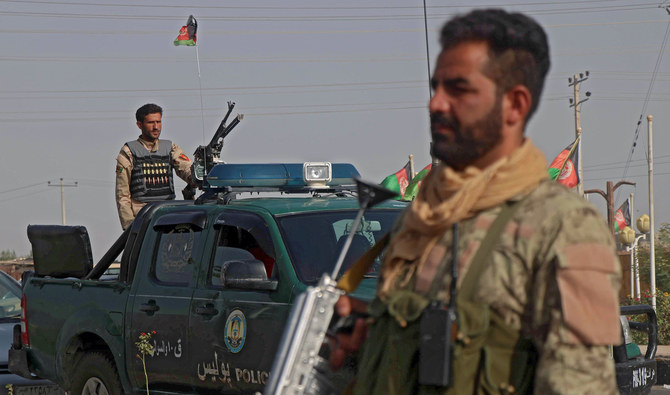
Afghan security forces keep watch at a checkpoint in the Guzara district of Herat province, Afghanistan July 9, 2021. (REUTERS)
Short Url
Updated 10 July 2021
Follow

Pakistan facilitator, not guarantor of peace, army says as fighting surges in Afghanistan

  • Islamabad helped facilitate US-Taliban peace negotiations that resulted in the withdrawal of foreign troops from Afghanistan
  • Peace talks between Kabul the Taliban to negotiate a political settlement in Afghanistan have been stalled for months

ISLAMABAD: Pakistan has played the role of a facilitator in the Afghan peace process, not its guarantor, the Pakistani military said on Saturday, as fighting surges in Afghanistan in the backdrop of the US military withdrawal.

Pakistan has helped facilitate negotiations that resulted in a US-Taliban deal that resulted in the withdrawal and is believed to wield considerable influence with the Taliban. The US and the Kabul government have consistently pushed Islamabad to get the Taliban to agree to a peace plan.

"The Afghan peace process has many aspects where it should be understood that Pakistan was only a facilitator and not a guarantor in the process," Maj. Gen. Babar Iftikhar, director general of the military's media wing, said as quoted by the Associated Press of Pakistan.

He added that the peace process was "at a critical stage" and it was now the Afghan people to decide their future.
 
"Afghans have the capacity and capability to decide their future course themselves," Iftikhar said, adding that Pakistan had "no favorites" among the Afghan stakeholders.

"The decisions (are) to be taken by Afghans and they have to decide their leadership. In case of any deadlock, we can assist. Pakistan has made all-out efforts and could not exceed beyond limits."

Months-old peace talks between the Afghan government and the Taliban to negotiate a political settlement in Afghanistan before foreign troops leave the country have been stalled by a diplomatic stalemate and escalating violence.

In the past week, the Taliban have overrun areas bordering five countries — Iran, Tajikistan, Turkmenistan, China and Pakistan. The group has captured key border crossings through which Afghanistan conducts most of its trade with Iran and Turkmenistan, and on Friday claimed to be in control of 85 percent of Afghanistan.

US-led troops began their last phase of departure in May, almost halting their support for the Afghan forces that have relied on them since 2001, when they invaded the country and toppled the Taliban for protecting Al-Qaeda chief Osama bin Laden, the mastermind of the Sept. 11 attacks on America.

The US combat mission in Afghanistan is expected to end by Aug. 31.


PM calls for tapping gemstone reserves as Pakistan pushes for economic recovery

Updated 8 sec ago
Follow

PM calls for tapping gemstone reserves as Pakistan pushes for economic recovery

  • Pakistan this month approved first national policy framework for precious stones, aiming to lift annual exports to $1 billion
  • PM Shehbaz Sharif directs implementation of new policy framework, completion of Islamabad Gemstone Center by Aug. 2027

ISLAMABAD: Prime Minister Shehbaz Sharif on Monday called for tapping Pakistan’s vast gemstone reserves, Sharif’s office said, as Islamabad seeks to boost their exports to support economic recovery.

The development comes two weeks after Pakistan approved its first national policy framework for gemstones and precious stones, aiming to reform the sector, align it with international standards and lift annual exports to $1 billion within five years.

Pakistan has intensified efforts to monetize its untapped mineral resources, amid fiscal pressures and an International Monetary Fund-backed reform program. Over the past two years, Islamabad has hosted international minerals conferences and signed agreements with countries including the United States, Saudi Arabia and China to attract investment and move up the value chain in mining and minerals processing.

On Monday, PM Sharif presided over a meeting on the promotion of precious stones and minerals in Islamabad, at which he directed seeking services of relevant experts of international repute for the construction of proposed gemstone centers in Islamabad, Gilgit-Baltistan and Azad Kashmir, according to his office.

“There is a need to utilize the potential of gemstone reserves in Pakistan so that valuable foreign exchange can be earned from the exports of these precious stones,” Sharif was quoted as saying by his office.

Despite officials estimating Pakistan’s gemstone reserves at around $450 billion, formal exports remain negligible, at about $5.8 million annually, due to weak certification systems, limited domestic processing capacity, widespread smuggling and fragmented regulation across federal and provincial authorities.

Pakistan’s new policy framework includes geological mapping to accurately assess reserves, the establishment of internationally accredited laboratories and certification regimes and the creation of a dedicated authority to regulate and promote the sector. The government also plans to set up a National Warranty Office and centers of excellence to support training, research and value-added processing.

The prime minister directed the implementation of the policy framework and the completion of Islamabad Gemstone Center by Aug. 2027.

A location has been identified on the Constitution Highway for the establishment of a gemstone center in Islamabad, according to Sharif’s office. The center will provide international standard value addition services, certification, incubation center and trade center facilities.

“Exports should be increased through value addition in the gemstone industry,” he said, urging officials to work together with the governments of all provinces, Gilgit-Baltistan and Azad Kashmir to promote the industry.