
ALEXANDRIA: Yemenis have expressed hope for a deal to end the war, amid reports that UN Secretary-General Antonio Guterres will name a new envoy to the country.
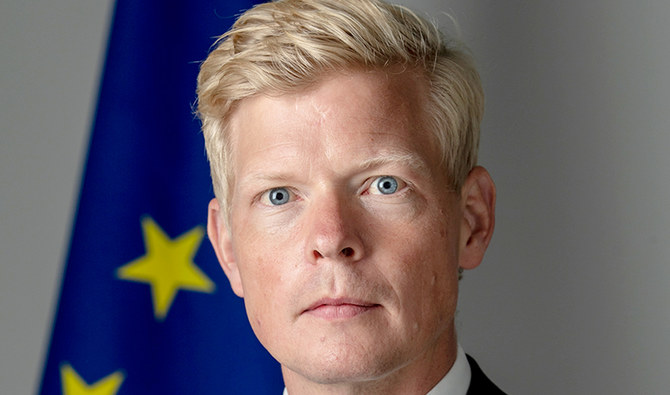
Politicians, rights activists and experts want the new envoy, tipped to be EU Ambassador to Yemen Hans Grundberg, to apply an inclusive approach for mediation between the warring parties.
Abu Bakr Al-Qirbi, Yemen’s former foreign minister, hailed the Swedish national as an experienced envoy with knowledge about the complications of the crisis as he had been working as a diplomat in the country for years.
A good knowledge of the region and its conflicts, a deep understanding of the Yemeni issue as ambassador to the country, and being aware of the obstacles and mistakes of previous envoys may help Grundberg get out of obstacles and failures, Al-Qirbi tweeted. He said the new envoy had to cooperate with regional forces to succeed in reaching an agreement that would end the war.
Activists said the envoy should focus on ending Houthi rights abuses and secure the release of hundreds of war prisoners.
“We strongly demand he personally pay attention to the issue of abducted and detained women in Houthi prisons and to provide them with psychological and legal support,” Amat Al-Salam Al-Hajj, chair of the Mothers of Abductees Association, an umbrella organization for thousands of female relatives of war prisoners, told Arab News.
FASTFACT
The Yemeni government had not been officially informed about the name of the new UN envoy.
The outgoing envoy to Yemen Martin Griffiths was appointed in Feb. 2018 but he, like previous envoys before him, failed to convince the Yemeni parties to strike a deal to end the war.
However his biggest achievement might be brokering the Stockholm Agreement, which defused a major offensive by government forces on the western city of Hodeidah through which most of the country’s humanitarian and food supplies enter.
He also sponsored an inmate swap between the government and Houthis that led to the freedom of more than 1,000 war prisoners.
Yassin Saeed Noaman, Yemen’s ambassador to the UK, said Grundberg would succeed in brokering a peace deal in Yemen if the EU used its relationship with Iran to pressure the Houthis to accept peace initiatives.
“Some hope can be expected that this huge European bloc will play a positive role in its relationship with Iran, which alone has the power to put pressure on the Houthis,” Noaman added.
In Riyadh, the Yemeni government had not been officially informed about the name of the new UN envoy, a senior government official told Arab News on Saturday.
Yemen experts argued that the new envoy would inherit a difficult situation as his predecessor had exhausted all options to convince factions to accept peace ideas.
“The world awaits the announcement of a new envoy whose mandate will be to find a swift path to peace where no obvious one exists,” Elana DeLozier, a fellow at the Washington Institute for Near East Policy, said on Friday. “The path is more likely to be a long, hard slog that requires a renewed focus on laying the groundwork for sustainable peace.”
Others advised the UN to expand talks to end the war beyond the government and Houthis and to include other parties such as women and leaders of military units and politicians.
“The Crisis Group has long advocated for the UN to expand the talks beyond the two-party framework,” Peter Salisbury, a senior Yemen analyst at the International Crisis Group, said last month. “It should include militia leaders and politicians who can make a ceasefire stick, as well as organizations, particularly women-led groups.”
Salisbury advised the new envoy to spend more time shuttling between Yemeni cities, mediating between different factions and groups instead of traveling between regional and international capitals.
“UN member states should press the new envoy to spend as much time in Yemen as possible, consulting widely among, and even mediating between, a range of groups,” he added.