
ADDIS ABABA: Ethiopia has denied blocking humanitarian aid to its northern Tigray region where hundreds of thousands face starvation, and said it was rebuilding infrastructure amid accusations it is using hunger as a weapon.
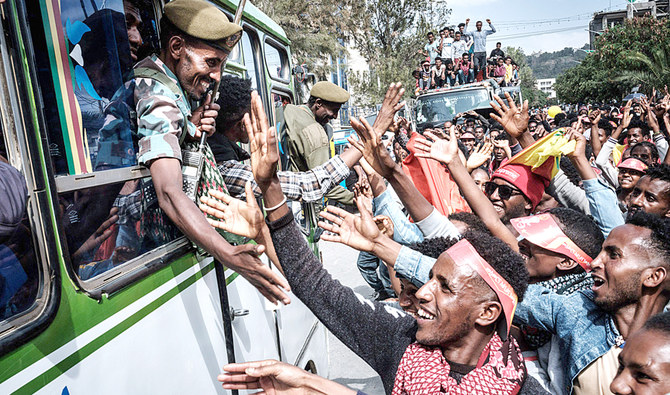
The Tigray People’s Liberation Front, provincial authorities which Ethiopian forces and troops from neighboring Eritrea had driven out last year, returned to regional capital Mekelle this week to cheering crowds, in a dramatic reversal of eight months of war.
The Ethiopian government declared a unilateral cease-fire which the TPLF dismissed as a joke. There are reports of continued clashes in some places as pressure builds internationally for all sides to pull back.
“The allegation that we are trying to suffocate the Tigrayan people by denying humanitarian access and using hunger as weapon of war is beyond the pale,” Deputy Prime Minister Demeke Mekonnen told diplomats in Addis Ababa.
“We have been exerting every possible effort to rebuild damaged infrastructure and restore electricity, telecoms, internet and banking services.”
Just before Mekelle was taken, Reuters saw a convoy of 34 trucks — each laden with 43 tons of food aid — stopped in the Tigray town of Mai Tsebri. Blue flags from the UN’s World Food Programme (WFP) hung from the cabins, sodden with rain.
The trucks had waited four days at a checkpoint controlled by government-allied Amhara regional forces.
Finally, they unloaded the food, without having reached the area where it was needed.
Aid has been completely blocked since the TPLF took the capital, a senior diplomat in Addis Ababa said.`
The allegation that we are trying to suffocate the Tigrayan people by denying humanitarian access and using hunger as weapon of war is beyond the pale
Demeke Mekonnen, Deputy prime minister
In a speech on Tuesday, Prime Minister Abiy Ahmed said Tigrayans needed to reflect on who they chose as leaders.
“If they are cheering after we left — while we were the ones who had been giving them wheat — they need a time of silence,” he said.
The UN said in early June at least 350,000 people in Tigray faced famine. The US Agency for International Development last week estimated the number at 900,000.
The TPLF dominated the central government for decades before Abiy came to power in 2018. His government has been battling the TPLF since late last year, when it accused the TPLF of attacking military bases in Tigray. Thousands have been killed.
TPLF spokesperson Getachew Reda has repeatedly told Reuters this week that the group condemns the government’s shutdown of services as a continued act of war.
He accused the military and Amhara regional forces of destroying one of three bridges across the Tekeze River on Thursday.
He said that the forces also damaged the two other bridges, calling the destruction “a deliberate effort” to ensure that aid doesn’t reach the people of Tigray.
Demeke’s comments denying that the government was blocking aid “fly fully in the face of the reality on the ground,” said Getachew, alleging that the government had systematically destroyed infrastructure, including farming tools needed for the planting season.
The WFP also raised alarm at the destruction on Thursday of a bridge across the Tekeze, saying that even prior to that, the agency had food destined for people in famine conditions that was being held up.
With the bridge out, a WFP official said in Geneva on Friday: “We currently have one possible road into Tigray that is much longer and will take much more time to reach hard hit areas of Tigray.”
The WFP has resumed deliveries in Tigray, but faces continuing access problems and is “way behind” in bringing supplies to people facing starvation, its emergency coordinator, Tommy Thompson, said.
Speaking by satellite phone from Mekelle, he said fighting continued in some “hot zones,” and that its 35 staff had been “trapped” during the hostilities.
“WFP suspended its operations for only about 48 hours and we began operating in the northwest fairly quickly thereafter, managing to reach probably by the end of this weekend probably about 40,000 people,” he told a Geneva briefing.
But Thompson said he was “cautiously optimistic” an air bridge could be set up in coming days to speed aid delivery.
Government official Redwan Hussein told reporters that airspace would be opened “in case UN airplanes need to transport aid.”
But he added that once the planes landed in Tigray: “For anything that happens on the ground, the government will not take responsibility because that chance is now closed.”