

Germany withdraws last troops from Afghanistan

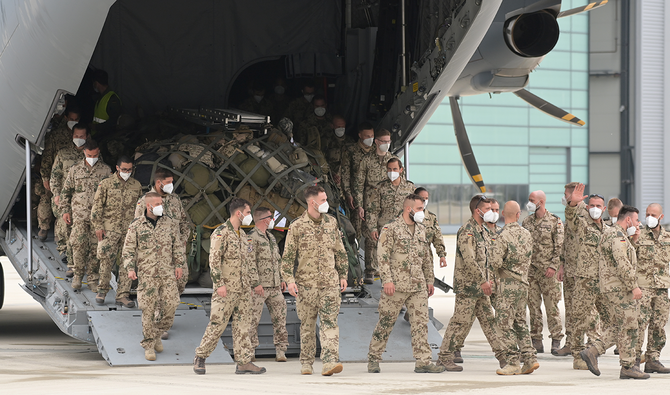
German soldiers leave an Airbus A400M cargo plane of the German armed forces Bundeswehr, after returning from Afghanistan at the airfield in Wunstorf, Germany. (Reuters)
Short Url
Updated 01 July 2021
Follow

Germany withdraws last troops from Afghanistan

  • Ends mission in the country, which its defense minister says soldiers ‘can be proud of’

KABUL: Germany withdrew its last remaining soldiers from Afghanistan on Tuesday, bringing to an end nearly 20 years of its mission in the war-torn country, amid the total withdrawal of US-led foreign troops and fears that the nation might slide back into anarchy.

In a Twitter post last evening, German Defense Minister Annegret Kramp-Karrenbauer said that her last soldier had “left Afghanistan safely.”

Around 750 containers of equipment have been shipped back to Germany by land and air, including 120 vehicles and six helicopters, she said before thanking the over 150,000 troops who had served in Afghanistan since the Taliban’s ousting in a US-led invasion in 2001.

German troops “can be proud of this mission,” Kramp-Karrenbauer said.

Afghan officials said on Wednesday that the presence of German troops had been “highly effective” in Afghanistan, where the Taliban has been gaining ground since the phased drawdown process began on May 1.

It is scheduled to be completed by Sept. 11, the anniversary of the twin tower attacks in the US.

“No doubt their assistance has been highly effective, particularly on raising the potential of our troops’ military capabilities,” Fawad Aman, Defense Ministry spokesman, told Arab News.

He added that German soldiers based in the northern region, particularly in the Balkh province — the key city of the area — had “helped Afghan forces in terms of education, mentoring, the conduct of offensives” and would be involved in future projects too.

“They have committed that the exit of the troops does not mean the end of their assistance , and they will help us in the future too. They were also involved in development projects in the area,” Aman said.

Nearly 60 German soldiers lost their lives during the mission in Afghanistan, where the resurgent Taliban staged deadly strikes on foreign troops and Afghan government forces.

German troops came under fire during a series of air raids in the past two decades, which also killed scores of Afghan civilians, mainly in the northeastern Kunduz province.

In one such incident, over 90 Afghan civilians lost their lives in a September 2009 attack, prompting Germany to offer a $5,000 compensation for each individual, which Afghanistan’s former economy minister said at the time was a “laughable sum.”

In retaliation to another deadly airstrike on Kunduz in 2016, the Taliban launched a suicide attack on the German Consulate in Mazar-i-Sharif, Balkh’s provincial capital, in which a group of Afghan civilians were killed. While no German national was hurt, the building housing the consulate was severely damaged.

In 2017, a powerful truck bomb outside the German Embassy in Kabul killed dozens of Afghans, forcing Berlin to halt its diplomatic mission in Afghanistan.

Commenting on the “lasting legacy” of German troops in the country, Afghan political analyst Zabihullah Pakteen said that the residents of Balkh believed that the city “would not fall to the Taliban in the presence of its troops.”

“Warlords turned contractors have been the main beneficiary of the German presence,” Pakteen told Arab News, highlighting some of the drawbacks.

“The deteriorating security in Afghanistan … Taliban advances and rapid losses of territory by the Afghan government had given Afghans the feeling that the world is abandoning Afghan partners,” he added.

In April, the US-led coalition agreed to withdraw its roughly 7,000 non-American forces from Afghanistan based on a directive by President Joe Biden.

Since May 1, the Taliban have intensified their attacks and overrun dozens of crucial districts, confiscating weapons and armored vehicles from government forces.

As part of an effort to curb Taliban advances amid a reduced number of foreign troops, President Ashraf Ghani’s embattled government has been handing out arms and cash through regional strongmen to locals in certain areas under a controversial scheme in recent weeks.

On Tuesday, the top US commander in Afghanistan, Gen. Scott Miller, highlighted the risk of a civil war as the last American troops prepare to withdraw from the country.

Miller said Afghanistan could face “very hard times” if its leadership cannot unite once international troops leave.

“The security situation is not good right now. Civil war is certainly a path that can be visualised if this continues on the trajectory it’s on right now,” he told reporters, adding: “That should be a concern to the world.”

Afghan officials refused to comment on Miller’s warning when contacted by Arab News on Wednesday.

However, Ghani has, in the past, insisted that the country’s security forces are “fully capable” of keeping insurgents at bay.


Russia-ally Touadera seeks third term in Central African Republic

Updated 1 sec ago
Follow

Russia-ally Touadera seeks third term in Central African Republic

BANGUI: Central African Republic President Faustin-Archange Touadera is seeking a third term in an election on Sunday, campaigning on security gains after signing deals with rebel groups and enlisting support from Russian mercenaries and Rwandan ​forces.
He faces six opposition candidates including Anicet-Georges Dologuele, a former prime minister and runner-up in the 2020 election, but is likely to win in part due to his control over state institutions, analysts say.
Such a result would likely further the interests of Russia, which has traded security assistance for access to resources including gold and diamonds. Touadera is also offering access to the country’s lithium and uranium reserves to anyone interested.
The 68-year-old mathematician took power in 2016 after the worst crisis in the chronically unstable country’s history, when three years of intercommunal strife forced a fifth of the population to flee their homes, either internally or abroad.
Touadera has signed peace deals this year with several rebel groups, while ‌others have been ‌weakened in the face of Russian mercenaries and troops from Rwanda deployed to ‌shore ⁠up Touadera’s ​government as ‌well as UN peacekeepers.
“During the 10 years that we have been working together, you yourselves have seen that peace is beginning to return, starting from all our borders and reaching the capital,” Touadera told a rally at a stadium in the capital Bangui this month.
His opponents, meanwhile, have denounced a constitutional referendum in 2023 that scrapped the presidential term limit, saying it was proof Touadera wants to be president for life.
They have also accused him of failing to make significant progress toward lifting the 5.5 million population out of poverty.
“The administrative infrastructure has been destroyed and, as you know, the roads are in a ⁠very poor state of repair,” Dologuele told a recent press conference.
“In short, the Central African economy is in ruins.”
SECURITY THREATS REMAIN DESPITE PEACE DEALS
The presidential ‌contest is taking place alongside legislative, regional and municipal elections, with provisional results ‍expected to be announced by January 5.
If no ‍candidate gets more than 50 percent of the vote, a presidential runoff will take place on February 15, while legislative ‍runoffs will take place on April 5.
A smooth voting process could reinforce Touadera’s claim that stability is returning, which was buttressed last year with the UN Security Council’s lifting of an arms embargo and the lifting of a separate embargo on diamond exports.
“The fact that these measures were lifted, it shows that we’re gradually getting back to normal. Or at least that’s the narrative,” said Romain ​Esmenjaud, associate researcher at the Institut Francais de Geopolitique.
The peace deals are credited with a decline in violence in some areas and an expected boost in economic growth projections to 3 percent this ⁠year, according to the International Monetary Fund. US President Donald Trump’s administration has said the UN should hand security back to the government soon.
But serious security threats remain. Rebels have not fully disarmed, reintegration is incomplete, and incursions by combatants from neighboring Sudan fuel insecurity in the east.
Pangea-Risk, a consultancy, wrote in a note to clients that the risk of unrest after the election was high as opponents were likely to challenge Touadera’s expected victory.
“The election will take place in an atmosphere marked by heightened grievances over political marginalization, increasing repression, and allegations of electoral fraud,” said chief executive Robert Besseling.
Dologuele alleged fraud after he was recorded as winning 21.6 percent of the vote in 2020, when rebel groups still threatened the capital and prevented voting at 800 polling stations across the country, or 14 percent of the total. A court upheld Touadera’s win.
Paul-Crescent Beninga, a political analyst, said voters will be closely scrutinizing the voting and counting processes.
“If they do not go well, it gives those ‌who promote violence an excuse to mobilize violence and sow panic among the population of the Central African Republic. So that is why we must ensure that the elections take place in relatively acceptable conditions,” he said.