

PM Khan says Pakistan can be US partner in peace, not conflict, in post-withdrawal Afghanistan

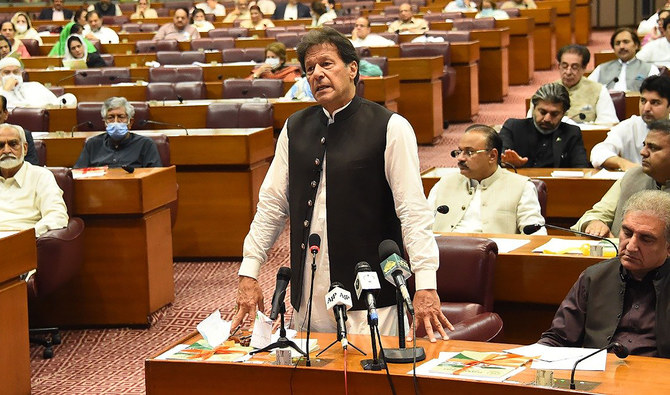
Pakistan's prime minister Imran Khan addressing to the National Assembly in Islamabad on June 30, 2021. (Photo courtesy: @NAofPakistan/Twitter)
Short Url
Updated 01 July 2021
Follow

PM Khan says Pakistan can be US partner in peace, not conflict, in post-withdrawal Afghanistan

  • Urges nation never to compromise on sovereignty out of fear
  • Says Pakistan's decision to join US-led war on terror was "our darkest time"

ISLAMABAD: Pakistan would never compromise its sovereignty or become a "partner in conflict" with the United States, Prime Minister Imran Khan said on Wednesday, amid media reports the US wants to use Pakistani military bases to carry out counter-terror operations in Afghanistan after its troops leave the war-battered country.

US President Joe Biden has set a deadline of September 11 for US troops to fully withdraw from Afghanistan, but recent reports suggest most of the American troops will be out by mid-July.

The quality of counterterrorism and intelligence capabilities in Afghanistan is a critical question facing the Biden administration as the withdrawal nears, with media outlets reporting in recent weeks that the US was seeking military bases in Pakistan.

Khan told "Axios on HBO" in a wide-ranging interview that aired last Sunday that Pakistan would "absolutely not" allow the CIA to use bases on its soil for cross-border counterterrorism missions.

"I urge my nation to never compromise on their sovereignty under any fear," Khan said in an address to the National Assembly on Wednesday evening. "I am asked if Pakistan will give bases to America, and I respond: has the US acknowledged our role in the war on terror as one of their frontline allies?"

"We can be partners in peace with America, but not partners in conflict."

In the past, despite an uneasy relationship with Pakistan, the US has conducted hundreds of drone strikes and cross-border counterterrorism operations from Pakistani soil.

Predicting a "difficult time" for Pakistan after the US withdrawal, Khan said it was in the interest of the US and Pakistani that there was peace in Afghanistan.

"We have told everybody that peace in Afghanistan is in our interest," he said. "We are thinking about regional connectivity for peace and economic growth."

Recalling Pakistan's decision to join the US-led "war on terror" after the September 11, 2001 attacks, Khan said he had never felt more “insulted."

"We decided to become a frontline state for the Americans in war on terror. I questioned repeatedly, what did we have to do with the war?" the PM said.

He added the while the US was still blaming Islamabad for its failure in Afghanistan, it was Pakistan that had lost 70,000 lives and suffered $150 billion in economic losses due to the US-led campaign.

"That was our darkest time ... we had to compromise our self-esteem," Khan said. "The nation that doesn't respect itself, the world doesn't care about it."


Pakistan saw 73% increase in combat-related deaths in 2025— think tank

Updated 8 sec ago
Follow

Pakistan saw 73% increase in combat-related deaths in 2025— think tank

  • Pakistan reported 3,387 deaths thus year, among them 2,115 militants and 664 security forces personnel, says think tank
  • Civilian deaths increased by 24% to 580 in 2025, compared to 468 in 2024, as Pakistan saw 1,063 militant attacks in 2025

ISLAMABAD: Combat-related deaths in Pakistan this year increased by 73%, with both security forces and militants suffering casualties in large numbers, a report published by an Islamabad-based think tank said on Sunday.

As per statistics released by the Pakistan Institute for Conflict and Security Studies (PICSS), combat-related deaths in 2025 rose 73% to 3,387, compared with 1,950 in 2024. These deaths included 2,115 militants, 664 security forces personnel, 580 civilians and 28 members of pro-government peace committees (combatants), the think tank said in a press release. 

“Militants accounted for about 62% of total combat-related deaths, and their 2,115 fatalities represented the highest annual militant death toll since 2015, when 2,322 militants were killed,” PICSS said. 

Compared to last year, militant deaths recorded a steep increase by 122% as the PICSS reported that 951 militants had been killed in 2024.

The think tank, however, said this year was also particularly bloody for Pakistani security forces. PICSS recorded 664 security personnel deaths in 2025, a 26% rise from 528 in 2024, and the highest annual figure since 2011, when 677 security forces personnel lost their lives. 

Civilian deaths also increased by 24% to 580 in 2025, compared with 468 in 2024, marking the highest annual civilian toll since 2015, when 642 civilians were killed. 

As per the PICSS report, at least 1,063 militant attacks took place in 2025, a 17% increase compared with 908 in 2024 and the highest annual total since 2014, when 1,609 militant attacks were recorded. 

The report also noted a 53 percent increase in suicide attacks this year, with 26 such incidents reported in 2025 compared with 17 in 2024. 

“PICSS noted an expanding trend in the use of small drones, including quadcopters, with 33 such incidents recorded during 2025, alongside increased use of unmanned aerial vehicles by security forces,” the report said. 

The report noted an 83% rise in arrests of suspected militants, with 497 arrested in 2025 compared to 272 in 2024. 

This 2025 figure is the highest annual total of suspected militants arrested since 2017, when 1,781 militants were either arrested or laid down their weapons.

“PICSS noted that most violence remained concentrated in Pashtun-majority districts of Khyber Pakhtunkhwa, including the tribal districts (erstwhile FATA), and in Balochistan,” it said. 

Pakistan has been grappling with a surge in militant attacks in its western provinces of Khyber Pakhtunkhwa and Balochistan, both bordering Afghanistan, this year. 

Islamabad blames Afghanistan for providing sanctuaries to militants it alleges use Afghan soil to carry out attacks against Pakistan. Kabul denies the charges.