

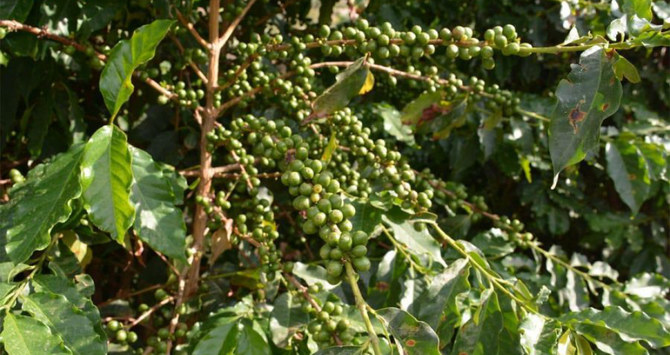
Number of coffee trees in Saudi Arabia more than doubles in three years

The ministry said that authorities in the Kingdom supports coffee projects through a number of programs and initiatives. (SPA)
Short Url
Updated 30 June 2021
Follow

Number of coffee trees in Saudi Arabia more than doubles in three years

  • An agreement has been reached with the International Fund for Agricultural Development to include coffee cultivation within the fund’s work in the Kingdom

RIYADH: An additional 250,000 coffee trees were planted in Saudi Arabia over the past three years, increasing the total number in the Kingdom to 400,000 by the end of 2020, according to the Ministry of Environment, Water and Agriculture.

Official statistics indicate that in 2017 there were fewer than 150,000 coffee trees in the coffee-growing regions of Jazan, Asir and Baha. With the support of the Saudi government that number has more than doubled.

The ministry said that authorities in the Kingdom supports coffee projects through a number of programs and initiatives. These include efforts to rehabilitate agricultural terraces, and the application of rainwater-harvesting techniques.

In addition, an agreement has been reached with the International Fund for Agricultural Development to include coffee cultivation within the fund’s work in the Kingdom. The ministry said a project will be launched in the Coffee Development City in Baha region that includes the planting of more than 300,000 trees, the development of an integrated coffee factory to handle sorting, processing, roasting and packaging, and the creation of the largest coffee exhibition in the Kingdom.

In addition a coffee research unit, the first of its kind, has been established at the Agricultural Research Center in Jazan, the ministry said, in recognition of the region’s successes in the cultivation of coffee.

The ministry stressed its continued support for enhanced production, and said that the development of coffee cultivation, marketing it locally and globally, and attracting further investments are important objectives of the Sustainable Agricultural Rural Development Program.


UNESCO honors Al-Bisht Al-Hasawi as thousands flock to Al-Ahsa festival

Updated 06 February 2026
Follow

UNESCO honors Al-Bisht Al-Hasawi as thousands flock to Al-Ahsa festival

RIYADH: The third edition of Al-Bisht Al-Hasawi Festival is drawing thousands of local and international visitors to Ibrahim Palace in Al-Hofuf.

Running until Feb. 7 at the historic palace, the event features a bisht exhibition, a rare bisht gallery, a handicrafts zone and workshops led by skilled artisans.

The festival showcases a convergence of cultures, with international pavilions highlighting the global appeal of this authentic Saudi heritage. 

The bisht’s allure has drawn international visitors eager to explore Al-Ahsa’s rich history and traditional crafts.

Tourists enthusiastically don the traditional robe, admiring its royal designs. Many participate in workshops with master artisans, learning the intricate art of Zari embroidery.

Organized by the Heritage Commission, this year’s festival celebrates the inscription of the bisht on UNESCO’s Representative List of the Intangible Cultural Heritage of Humanity, the Saudi Press Agency reported.

The event showcases Al-Ahsa’s centuries-old tradition of hand-weaving and gold embroidery, a craft passed down through generations of local families.

Visitors can explore interactive displays, participate in live workshops, and witness the meticulous process of tailoring this iconic symbol of prestige.

With UNESCO’s participation and representatives from six countries, the festival has evolved into a global platform for cultural dialogue, cementing the bisht’s status as a world-class cultural treasure.

At the heart of the festival is the story of the “Golden Threads” (Al-Zari), intricate gold-plated silver threads that define the bisht’s character and prestige.

Visitors can discover them in the Golden Threads VIP Area, where they can watch master artisans demonstrate the full bisht-making process at the Host’s Majlis, offering insight into Al-Ahsa’s centuries-old craftsmanship.